Over the past few years, stablecoins in the crypto market have mainly served as trading mediums and stores of value. As the global interest rate environment has changed and U.S. Treasury yields have remained elevated, market demand for “on-chain dollar assets with real yield generation capability” has grown rapidly. At the same time, real world assets (RWA, Real World Assets) have gradually become an important direction for the blockchain industry, with many traditional financial assets beginning to migrate on-chain.
Against this backdrop, the competitive logic of on-chain dollar assets is changing. Users no longer care only about “stability.” They are paying more attention to whether an asset can generate sustainable yield, whether it is supported by transparent underlying assets, and whether it can circulate and be combined freely in DeFi scenarios.
What Is GUSD?
As an on-chain yield bearing dollar product backed by real world assets such as U.S. Treasuries, the core logic of GUSD is to generate yield from underlying low risk assets and deliver a more efficient dollar asset management experience to users in an on-chain format.
From a product positioning perspective, GUSD is not a traditional payment focused stablecoin. It is an on-chain financial instrument that leans more toward a yield bearing dollar asset. It preserves the stability of dollar assets while introducing a real yield source through an RWA backed structure, allowing users to earn relatively stable yield while holding on-chain dollar assets.
Simply put, GUSD’s core value lies in combining real world dollar yield generation with the blockchain finance ecosystem, helping on-chain dollar assets move beyond “stability” and toward “yield generation.”
How Does GUSD Work?
GUSD’s yield foundation comes from real world assets such as U.S. Treasuries. U.S. Treasuries have long been regarded as among the relatively lower risk and more liquid assets in global financial markets, and they are also an important foundation of the global U.S. dollar interest rate system.
Through the RWA model, U.S. Treasury yields from traditional finance are mapped on-chain, giving on-chain users access to dollar yield products that originally belonged to the traditional financial system. This model not only improves capital efficiency, but also allows blockchain finance to truly capture large scale real world financial yield.
Compared with traditional DeFi yield models that rely on token incentives, GUSD’s yield logic is closer to that of traditional dollar fixed income products. Its core yield mainly comes from interest generated by underlying assets rather than highly volatile market incentives. As a result, GUSD places greater emphasis on sustainability and stability of yield.
How Is GUSD Different from Traditional Stablecoins?
Traditional stablecoins such as USDT and USDC mainly provide on-chain trading, payment, and dollar peg functions, while GUSD is positioned more as a yield bearing dollar asset.
Traditional stablecoins focus on circulation and stability. GUSD places more emphasis on capital efficiency and yield generation. By holding GUSD, users can gain exposure to dollar yield generated by underlying real world assets such as U.S. Treasuries, giving on-chain dollars not only stability, but also asset allocation value.
This means GUSD is more like a dollar yield layer in on-chain finance, rather than just a simple trading medium.
Why Is RWA Becoming an Important Sector in Crypto?
RWA is regarded as an important growth direction for the blockchain industry because it deeply connects real world financial assets with on-chain financial systems. In recent years, traditional assets including U.S. Treasuries, bonds, funds, and real estate have gradually begun moving on-chain.
Behind this trend, traditional finance is looking for more efficient channels for global liquidity, while the crypto industry needs more real and sustainable sources of yield. In the past, many DeFi yields relied on token incentives, which had limited long term sustainability. RWA, by contrast, allows on-chain finance to directly access the real world dollar yield system for the first time.
What Are the Use Cases of GUSD?
GUSD can serve as an on-chain dollar wealth management tool, giving users a more stable yield option. During periods of high market volatility, some users may prefer to hold assets that have dollar characteristics and can continuously generate yield. GUSD provides such an on-chain solution.
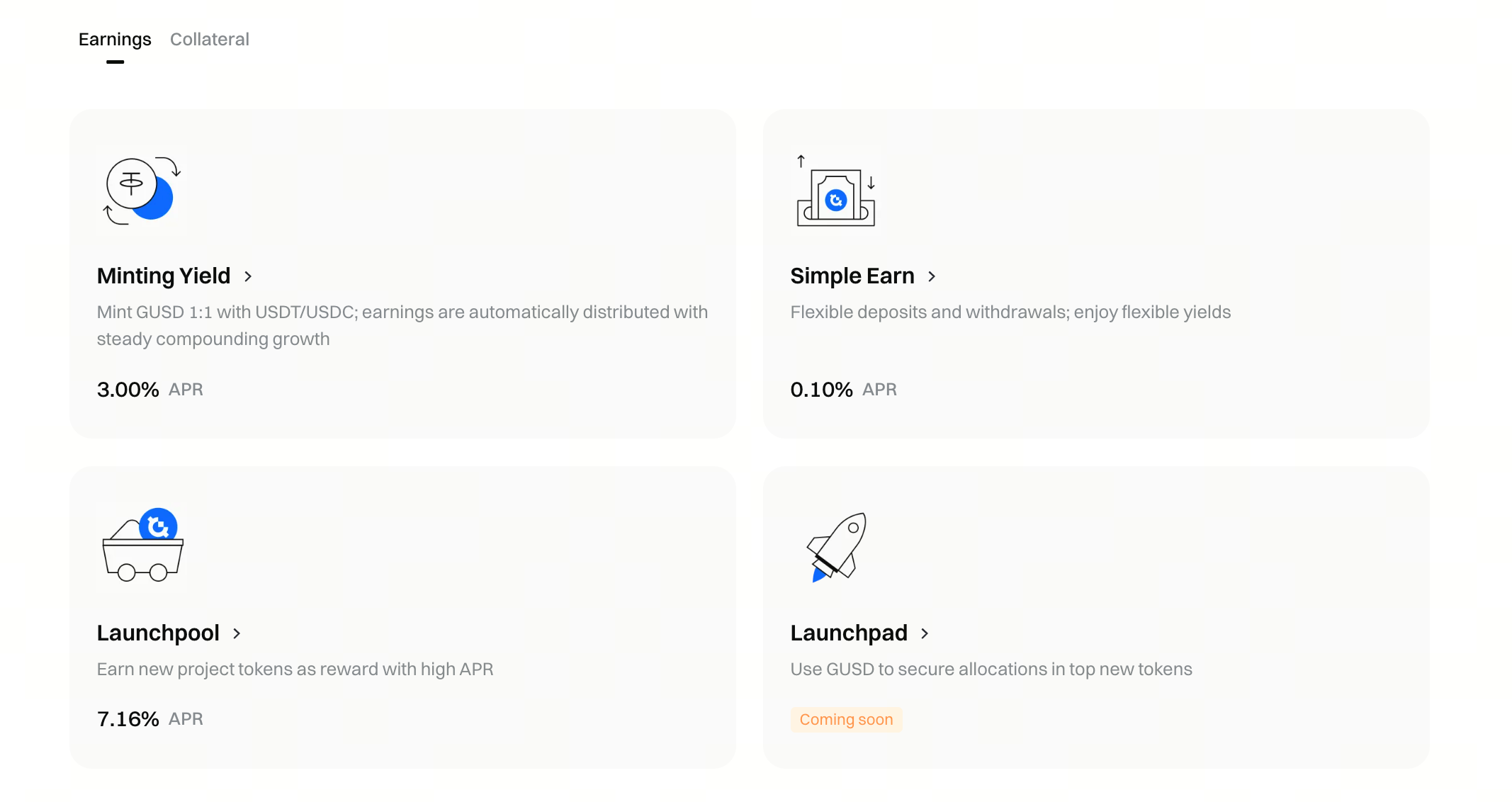
At the same time, GUSD can also improve the efficiency of idle capital. Compared with simply holding stablecoins, yield bearing dollar assets allow users to maintain dollar exposure while earning additional returns.
As RWA and DeFi become more deeply integrated, GUSD may also connect with more on-chain financial scenarios in the future, including lending protocols, liquidity pools, and structured yield products, further expanding its use cases across the on-chain finance ecosystem.
GUSD’s Advantages and Potential Risks
GUSD’s core advantage is that its yield source is more transparent and supported by real world assets as the underlying foundation. Compared with highly volatile crypto yield models, GUSD places greater emphasis on stability and long term sustainability.
In addition, on-chain assets naturally have the characteristics of high liquidity, global accessibility, and composability. This allows GUSD not only to preserve the attributes of a dollar asset, but also to adapt to more DeFi scenarios in the future.
However, as an RWA product, GUSD still faces certain risks. For example, changes in U.S. interest rates may affect yield performance; real world asset custody, regulation, and compliance structures may also introduce uncertainty; and on-chain protocol risks and market liquidity risks remain issues that all crypto financial products need to consider.
Therefore, users participating in related products also need to fully understand how they work and what potential risks they involve.
Summary
GUSD is an on-chain stable yield product launched by Gate and backed by real world assets such as U.S. Treasuries. Its core goal is to bring traditional dollar yield capability into the crypto ecosystem.
Compared with traditional stablecoins, GUSD places greater emphasis on yield. Through the RWA model, it connects real world financial assets with the on-chain financial system, offering users a dollar asset solution that balances stability, yield, and on-chain flexibility.
FAQs
Is GUSD a Stablecoin?
GUSD has dollar attributes and stability, but its positioning goes beyond that of a traditional stablecoin. It is more of an on-chain yield bearing dollar asset backed by RWA such as U.S. Treasuries.
Where Does GUSD’s Yield Come From?
GUSD’s yield mainly comes from interest generated by underlying real world assets such as U.S. Treasuries.
How Is GUSD Different from USDT?
USDT is more of a trading and payment tool, while GUSD places greater emphasis on yield generation and asset allocation value.
Why Are U.S. Treasury RWAs So Popular Recently?
In a high interest rate environment, U.S. Treasuries offer relatively stable yield potential, making them an important underlying asset in the RWA sector.
Who Is GUSD Suitable For?
GUSD is better suited to users who want dollar asset exposure, care about stable yield, and want to participate in the on-chain finance ecosystem.