What Is Gold CFD? Understanding Gold Contract for Difference Trading

Last Updated 2026-05-28 01:57:56
Reading Time: 6m
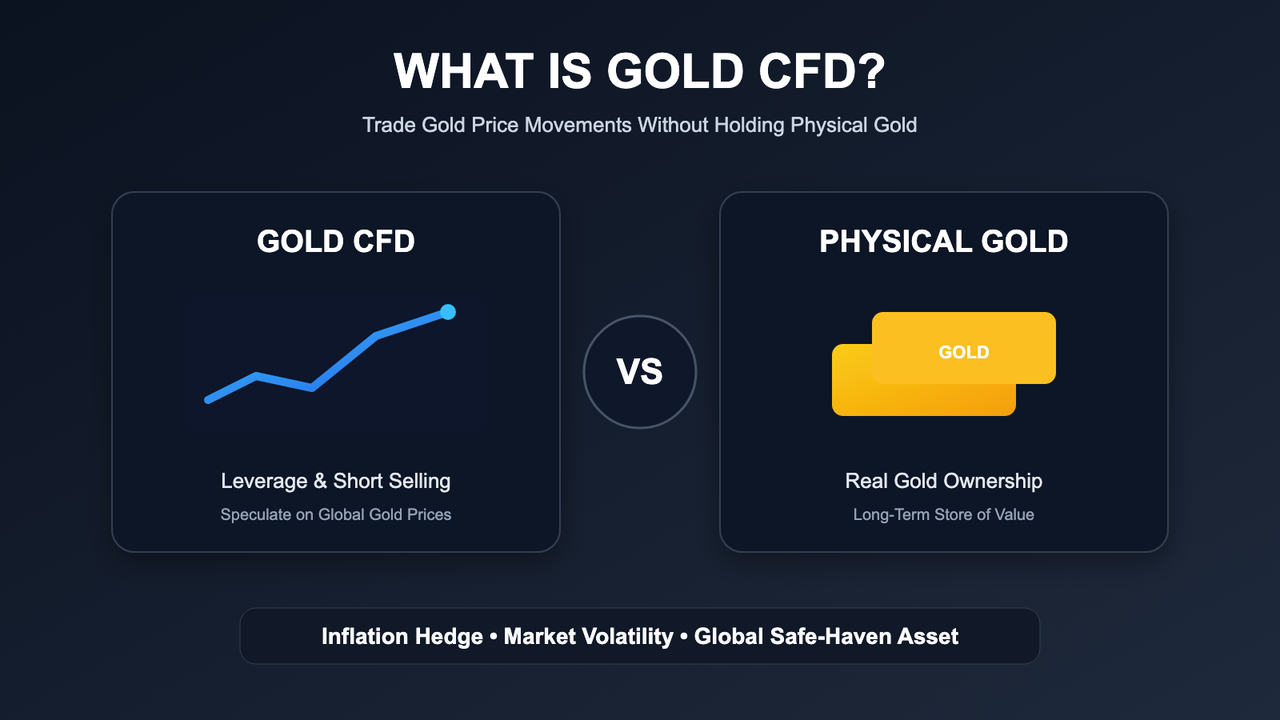
A Gold CFD, or Gold Contract for Difference, is a financial derivative settled based on changes in the price of gold. Traders do not need to actually hold physical gold to seek returns from movements in international gold prices. Gold CFDs usually support leverage and two way trading, so they are widely used in short term trading, macro market trading, and hedging strategies.

As the global online trading market has developed, gold CFDs have become an important part of the precious metals derivatives market. Compared with traditional physical gold investment, gold CFDs focus more on trading market price movements, which is why they are widely used in short term trading, trend trading, and macro risk hedging.

In global financial markets, gold has long been regarded as an important safe haven asset. When markets face rising inflation, U.S. dollar volatility, or geopolitical risk, gold prices often attract close attention.

How Do Gold CFDs Work?

The core logic of gold CFDs is “settlement by price difference”.

For example, if a trader believes the international gold price will rise, they may open a long gold CFD position at USD 2,300 per ounce. If the price rises to USD 2,350 and the position is closed, the profit is calculated based on the price difference.

Throughout this process, the trader does not actually hold gold. They are only participating in gold price movements.

If the trader believes the gold price will fall, they can also open a short position. If the price then declines and the position is closed, the trader may likewise earn from the price difference.

Because gold CFDs support two-way trading, both rising and falling markets may create trading opportunities.

What is gold CFD?

How Are Gold CFDs Different from Physical Gold Investment?

The biggest difference between gold CFDs and traditional physical gold investment is whether the investor actually holds the gold asset.

Traditional gold investment usually involves holding physical assets such as gold bars, gold coins, or gold jewelry. Gold CFDs, by contrast, are financial derivatives, and traders only participate in price changes themselves.

The core differences include:

Comparison Dimension Gold CFD Physical Gold Investment
Holds actual gold No Yes
Supports leverage Usually yes Usually no
Supports short selling Yes Usually no
Involves storage No Yes
Core logic Settlement by price difference Holding gold assets

Compared with long term gold investment for wealth preservation, gold CFDs are more focused on short term market trading.

Why Do Gold CFDs Support Short Selling?

Gold CFDs are essentially based on price movements, so traders can participate in both rising and falling markets.

For example, when a trader believes a stronger U.S. dollar may weigh on gold prices, they can open a short gold CFD position. If the gold price falls and the position is closed, the trader may earn the price difference.

Compared with the traditional physical gold market, the short selling mechanism of gold CFDs is more flexible, so it is relatively common in macro market trading.

This is also one of the important reasons gold CFDs are widely used in interest rate expectation trades and risk sentiment trades.

What Is the Leverage Mechanism in Gold CFDs?

Gold CFDs usually use a margin trading model.

For example, with 20x leverage, traders only need to pay part of the required margin to open a larger gold market position.

The leverage calculation logic can usually be expressed as:

Leverage can improve capital efficiency, but it also amplifies both potential gains and the risk of losses caused by market movements.

Because the gold market itself is affected by the U.S. dollar, interest rates, and global risk sentiment, price volatility may expand significantly within a short period.

What Fees Do Gold CFDs Incur?

The main trading costs of gold CFDs usually include spreads and overnight financing fees.

The spread is the difference between the buying price and the selling price, and it is also one of the platform’s important sources of revenue.

If traders hold gold CFD positions for a long time, they usually also incur overnight financing fees, because leveraged trading essentially involves the cost of using capital.

As a result, gold CFDs are more commonly used for medium and short term trading rather than long term holding.

What Are the Main Risks of Gold CFDs?

Gold CFDs are high risk leveraged derivatives, and their main risks come from:

  • Leverage risk

  • Forced liquidation risk

  • Market volatility risk

  • Liquidity risk

  • Financing fee risk

For example, during Federal Reserve interest rate decisions or U.S. CPI data releases, gold prices may move quickly, affecting profits and losses on CFD positions.

Under high leverage, even a relatively small market movement may cause account equity to decline rapidly.

What Is the Difference Between Gold CFDs and Gold Futures?

Gold CFDs and gold futures both allow participation in international gold price movements, so they are often compared with each other.

However, their underlying structures are clearly different.

Gold CFDs are usually quoted by online trading platforms, and trading is more oriented toward the retail leveraged market. Gold futures, by contrast, are standardized exchange traded contracts with fixed expiration dates.

In addition:

Comparison Dimension Gold CFD Gold Futures
Has an expiration date Usually no Yes
Trading scenario Online retail trading Exchange market
Leverage method Margin mechanism Futures margin
Contract structure Non standardized Standardized contract
User type More retail traders More institutional participation

Gold CFDs place greater emphasis on flexibility, while gold futures are more aligned with the structure of professional commodities markets.

The Role of Gold CFDs in Global Markets

Gold CFDs give users a way to participate in international gold price movements without holding physical gold.

For some traders, gold CFDs can be used for short term trading, macro market trading, inflation hedging, risk hedging, and U.S. dollar volatility trading.

As the global online derivatives market continues to develop, gold CFDs have gradually become an important part of the modern precious metals trading system.

Conclusion

As a financial derivative settled based on changes in gold prices, gold CFDs allow traders to participate in market volatility without holding physical gold.

Compared with traditional gold investment, gold CFDs place greater emphasis on leverage, two-way trading, and participation in market price movements. At the same time, they involve higher risks, including forced liquidation, financing fees, and market volatility risk.

FAQs

Do Gold CFDs Require Traders to Actually Hold Gold?

No. Gold CFDs are derivatives settled by price difference and do not involve the transfer of actual gold ownership.

Why Do Gold CFDs Support Short Selling?

Because CFDs are essentially based on price movements, users can participate in both rising and falling markets.

What Is the Difference Between Gold CFDs and Physical Gold?

Physical gold involves holding a real asset, while gold CFDs are settled only based on price differences.

Why Are Gold CFDs Higher Risk?

Because gold CFDs are usually used with leverage, market movements may amplify changes in account profits and losses.

What Factors Affect Gold CFDs?

They usually include U.S. dollar trends, interest rate policy, inflation levels, and global safe haven sentiment.

Are Gold CFDs Suitable for Long Term Holding?

Because long term positions usually generate overnight financing fees, gold CFDs are more commonly used for medium and short term trading.

Author: Jayne
Translator: Jared
Disclaimer
* The information is not intended to be and does not constitute financial advice or any other recommendation of any sort offered or endorsed by Gate.
* This article may not be reproduced, transmitted or copied without referencing Gate. Contravention is an infringement of Copyright Act and may be subject to legal action.

Related Articles

Exploring 8 Major DEX Aggregators: Engines Driving Efficiency and Liquidity in the Crypto Market
Beginner

Exploring 8 Major DEX Aggregators: Engines Driving Efficiency and Liquidity in the Crypto Market

DEX aggregators integrate order data, price information, and liquidity pools from multiple decentralized exchanges, helping users find the optimal trading path in the shortest time. This article delves into 8 commonly used DEX aggregators, highlighting their unique features and routing algorithms.
2026-04-05 18:15:50
What Is Copy Trading And How To Use It?
Beginner

What Is Copy Trading And How To Use It?

Copy Trading, as the most profitable trading model, not only saves time but also effectively reduces losses and avoids man-made oversights.
2026-04-09 06:04:24
What Is Technical Analysis?
Beginner

What Is Technical Analysis?

Learn from the past - To explore the law of price movements and the wealth code in the ever-changing market.
2026-04-09 10:30:57
How to Do Your Own Research (DYOR)?
Beginner

How to Do Your Own Research (DYOR)?

"Research means that you don’t know, but are willing to find out." - Charles F. Kettering.
2026-04-09 10:20:26
What Is Fundamental Analysis?
Intermediate

What Is Fundamental Analysis?

Suitable indicators and tools combined with crypto news make up the best possible fundamental analysis for decision-making
2026-03-24 11:52:13
What Are Altcoins?
Beginner

What Are Altcoins?

An altcoin is also known as a Bitcoin Alternative or Alternative Cryptocoin, which refers to all cryptocurrencies other than Bitcoin. Most of the cryptocurrencies in the early stage were created through forking (copying Bitcoin codes).
2026-04-09 10:51:50