Unlike traditional event prediction platforms, Gate Prediction Market has begun introducing the ecosystem structure of on-chain prediction markets and is gradually forming connections with on-chain prediction platforms such as Polymarket. This model combines a centralized trading entry point with on-chain market liquidity, allowing ordinary users to participate in global trending event trading without complex on-chain operations.
As trending event aggregation, leaderboards, strategy observation, and real time trend systems continue to improve, competition in prediction markets is also shifting from “simple event trading” toward “information discovery efficiency” and “market behavior analysis capabilities.”

Source: www.gate.com/prediction
What Is Gate Prediction Market?
Gate Prediction Market is, at its core, a market structure for trading future event outcomes. Users can buy or sell positions on a specific event result, while market prices continue to change with trading activity and gradually form a shared market view on the probability of that event occurring.
Unlike stocks or futures in traditional financial markets, prediction markets do not trade the asset itself. Instead, they trade whether a certain event will happen. For example, crypto prices, sports results, policy changes, trending news, and even social events can all become tradable objects in a prediction market.
In Gate Prediction Market, users can usually participate in event trading through a simplified product entry point, without directly managing complex on-chain processes. Compared with native on-chain prediction markets, this structure lowers the barrier for ordinary users while preserving the core experience of quickly trading trending events.
From an industry development perspective, prediction markets are increasingly viewed as a form of information finance, or InfoFi, infrastructure. Their core value lies in using market prices to aggregate dispersed information and market expectations.
The Relationship Between Gate Prediction Market and the Polymarket Ecosystem
Polymarket is one of the most representative on-chain prediction markets today. Its core mechanism is based on blockchain and stablecoin settlement, using the concept of “price as probability” to reflect the market’s judgment about future events.
The connection between Gate Prediction Market and Polymarket is essentially a combined model of “centralized entry point + on-chain market structure.” Users can participate in trending events through a more familiar trading product entry point, while part of the underlying market structure connects with the on-chain prediction ecosystem.
Compared with traditional on-chain interaction processes, this structure significantly reduces participation complexity. Users do not need to manage wallets, gas, cross chain bridges, or on-chain order structures on their own, making it easier to access on-chain prediction markets.
At the same time, Polymarket’s trending markets, event structure, and information flow characteristics further strengthen the trending event aggregation capabilities of Gate Prediction Market. This model means prediction markets are no longer just simple “prediction products,” but are gradually evolving into real time markets for trending information.
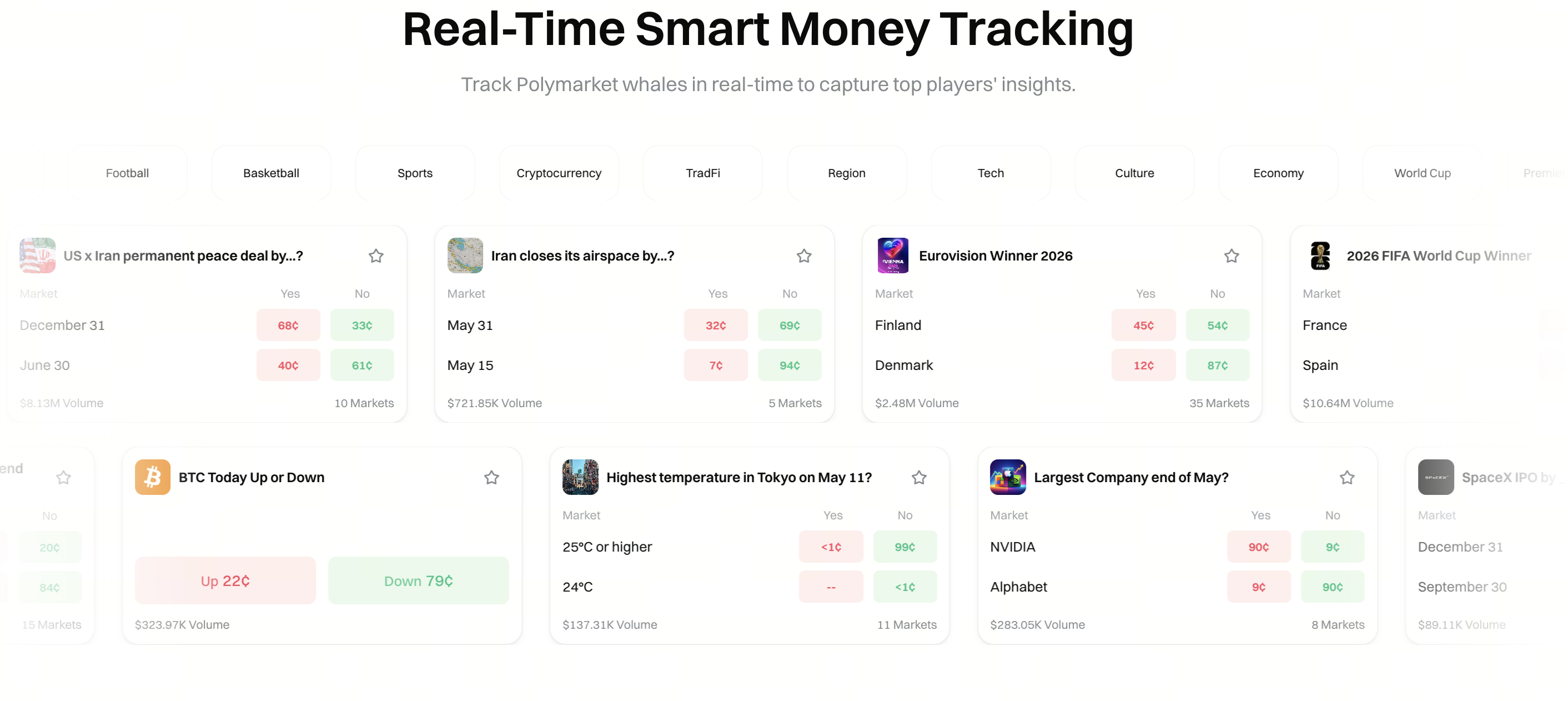
Source: www.gate.com/prediction
How On-Chain Prediction Markets Work
A blockchain based prediction market is an event trading system that operates on-chain. Its core logic is to form “probability prices” through market buying and selling. When the price of an outcome is closer to 1, it usually means the market believes the event is more likely to happen. When the price is closer to 0, it indicates that the market’s overall expectation is lower. For this reason, prediction markets are not merely tools for event prediction. They are market structures that turn information, sentiment, and probability into financial expression.
At the underlying mechanism level, on-chain prediction markets usually rely on smart contracts to handle fund management and clearing logic. Users trade with stablecoins, and the system settles automatically based on the final event outcome. At the same time, oracle mechanisms synchronize the real world result after the event ends, triggering final market settlement. This structure can reduce human intervention while improving the verifiability and transparency of market outcomes.
Compared with traditional centralized prediction platforms, on-chain prediction markets place greater emphasis on public transparency and non custodial structures. Market trading records, asset flows, and some order states can be verified on-chain, so users do not need to rely entirely on a platform’s internal database. Because they are globally open, on-chain prediction markets have also gradually become an important part of information finance, or InfoFi, within the crypto industry.
However, native on-chain prediction markets also have certain usability barriers. Users usually need to manage wallets, pay gas fees, complete cross chain operations, and understand on-chain confirmation processes. For ordinary users, these steps may increase participation complexity. As a result, more platforms are trying to lower the barrier to prediction market participation through centralized product entry points and simplified interaction structures.
Trending Event Discovery and Trend Aggregation Mechanisms in Gate Prediction Market
Traditional prediction platforms usually use static category structures, requiring users to actively search or browse event lists to find market opportunities. By contrast, the new generation of prediction market products has begun to strengthen “trending event discovery,” allowing the platform itself to serve as both an information aggregator and a trend tracking tool. One of the key directions of Gate Prediction Market’s upgrade is optimization around search, trending event aggregation, and real time trend systems.
The new search system supports fuzzy keyword matching, result highlighting, and category based recommendations, helping users locate global trending events more quickly. At the same time, the platform has added secondary category systems such as Recommended, Sports, and Crypto, making event browsing more refined. Compared with traditional prediction platforms that rely on fixed navigation sections, this structure improves market discovery efficiency and helps users enter trading scenarios they care about more quickly.
In terms of trending event aggregation, the “Live & Trending” system continuously brings together popular trading events, highly watched markets, and real time trend changes. As a result, the prediction market is no longer just a simple trading page. It is gradually taking on the characteristics of an information flow platform. In addition to trading, users can observe changes in market sentiment and event attention through shifts in trending topics.
The platform has also added features such as recent browsing, search history, and a breaking events section, further strengthening users’ ability to continuously track trending events. From a product logic perspective, prediction markets are evolving from traditional “event trading tools” into new market entry points that combine trending event discovery, trend aggregation, and real time information flows.
Leaderboards and Strategy Observation Features in Gate Prediction Market
Beyond event trading itself, prediction markets have increasingly begun to emphasize “user behavior data” and “strategy observation capabilities” in recent years. Gate Prediction Market’s new leaderboard system is an important upgrade in this direction. The platform supports multidimensional rankings such as profit and loss rankings, trading volume rankings, and highest profit rankings, allowing users to observe active traders and high return accounts in the market more intuitively.
The new leaderboard does not only display return results. It also shows key data such as position value, trading size, and total profit and loss. This means the observation dimension of prediction markets has expanded from “the event itself” to “the structure of user behavior.” In addition to judging event probabilities, users are also beginning to pay attention to capital flows and changes in trading strategies within the market.
This structure effectively strengthens the “strategy layer” in prediction markets. By observing the behavior of high return accounts, users can better understand shifts in market sentiment, trending directions, and capital preferences. Compared with traditional prediction platforms, which focus mainly on event outcomes, the new generation of prediction market products places greater emphasis on market behavior analysis and strategy tracking.
In the future, prediction markets may further add features such as smart money labels, whale labels, profit and loss curves, and historical position trends. This means prediction markets are gradually evolving into hybrid platforms that combine information trading with behavior analysis, rather than remaining traditional event prediction systems.
How Gate Prediction Market Lowers the Barrier to On-Chain Participation
Although on-chain prediction markets offer advantages in transparency, native on-chain interaction is usually complex. A traditional on-chain participation process often requires users to:
For ordinary users, these steps can significantly raise the barrier to entry.
Gate Prediction Market simplifies the process through a centralized account system. Users can participate in trending events directly through the Gate App or platform entry point and complete trades using account assets, without relying entirely on native on-chain interaction.
At the same time, the platform has also added product interaction features such as:
-
Category browsing
-
Quick filtering
-
One click order placement
-
Historical record filtering
-
Hiding small value records
In sports prediction markets, it has also added features such as spread markets, total score markets, and sliding score selection to improve interaction efficiency for more complex formats.
This model is essentially about finding a balance between an “on-chain market structure” and a “centralized product experience.”
Traditional prediction platforms usually use a centralized structure, where the platform is responsible for creating events, managing odds, custodying funds, and completing final settlement. Users mainly participate in outcome prediction and have limited ability to observe market structure or fund flows.
The new generation of prediction markets places greater emphasis on transparency and information value, focusing on market transparency, trending information aggregation, probability pricing mechanisms, and user behavior analysis. By integrating with the on-chain ecosystem and strengthening search, leaderboards, and trend aggregation features, Gate Prediction Market upgrades prediction markets from simple prediction tools into comprehensive information and trading platforms, with multiple attributes such as a trending information platform, probability trading market, behavior analysis system, and real time trend entry point.
| Comparison Dimension |
Traditional Prediction Platforms |
New Generation Prediction Markets, Gate as an Example |
Core Upgrade |
| Market structure |
Centralized operation, fully managed by the platform |
Hybrid on-chain + centralized model, with smart contract execution |
Significantly improves transparency and trust |
| User role |
Passive predictor |
Active trader and information participant |
From bettor to information trader |
| Core functions |
Event prediction and settlement |
Trending event aggregation + probability pricing + behavior analysis |
Combines information platform and trading market attributes |
| Key competition factor |
Number of events and prize pools |
Speed of trending event discovery, information aggregation efficiency, participation barrier |
Shifts toward competition in information efficiency and user experience |
From an industry trend perspective, the future of prediction market competition is no longer about “who has more events.” It is about who can discover trending topics faster, aggregate information more efficiently, let users participate with lower barriers, and present market behavior more clearly.
Advantages, Limitations, and Potential Risks of Gate Prediction Market
One of Gate Prediction Market’s biggest advantages is that it combines the open structure of on-chain prediction markets with the interaction convenience of a centralized platform. Users can access global trending events while avoiding the usability barriers created by complex on-chain operations.
At the same time, trending event aggregation, leaderboards, and strategy observation systems further improve the information discovery efficiency of prediction markets. This is helping prediction markets evolve from “event trading products” into “trending probability information markets.”
However, prediction markets also carry certain risks. Because event prices can be affected by liquidity, market sentiment, and information asymmetry, prices are not necessarily the same as true probabilities.
In addition, on-chain prediction markets still face issues such as:
For ordinary users, understanding probability markets, controlling position size, and avoiding emotional trading remain key considerations when participating in prediction markets.
Summary
Gate Prediction Market represents a new type of information trading structure that combines the on-chain prediction market ecosystem with a centralized product experience. By integrating with the Polymarket ecosystem and strengthening search, trending event aggregation, leaderboards, and strategy observation systems, prediction markets are gradually evolving from traditional prediction platforms into real time trending information infrastructure.
As InfoFi, on-chain probability markets, and trending event trading structures continue to develop, prediction markets may become more than event trading tools in the future. They may also become important data entry points connecting market sentiment, trending information, and trading behavior.
FAQs
What Is Gate Prediction Market?
Gate Prediction Market is a prediction market product built around trading future event outcomes. Users can express their views on future trends by trading event results.
What Is the Relationship Between Gate Prediction Market and Polymarket?
Gate Prediction Market has partially integrated with the Polymarket on-chain prediction market ecosystem, using a centralized entry point to reduce the complexity of participating in on-chain prediction markets.
Why Do Prices in on-chain Prediction Markets Represent Probabilities?
In prediction markets, outcome prices are usually viewed as market implied probabilities. For example, a price of 0.7 usually means the market believes the probability of that outcome occurring is about 70%.
What Are the Core Features of Gate Prediction Market?
Its main features include trending search, trend aggregation, leaderboards, strategy observation, sports derivatives, and real time trending event trading.
What Risks Do Prediction Markets Have?
Prediction markets may face risks such as liquidity volatility, market manipulation, regulatory uncertainty, and prices deviating from true probabilities.