With the rapid advancement of generative AI, intelligent agents (AI Agent), and large-scale models, high-quality data has emerged as a vital resource for enhancing AI capabilities. However, the current AI data industry faces persistent challenges, including opaque data sources, unclear copyright ownership, and limited opportunities for individuals to realize value from their contributions. Data Network seeks to redefine data production, authorization, and value distribution by establishing a verifiable data network.
From the perspective of Web3 and AI convergence, Data Network signals a new direction in data infrastructure. Leveraging technical modules such as Trace, Poseidon, and Confidential Data Rails, the DATA network explores how to protect user privacy while enabling data to become a composable, verifiable, and economically incentivized digital asset.
What Is Data Network (DATA)? Project Background and Development
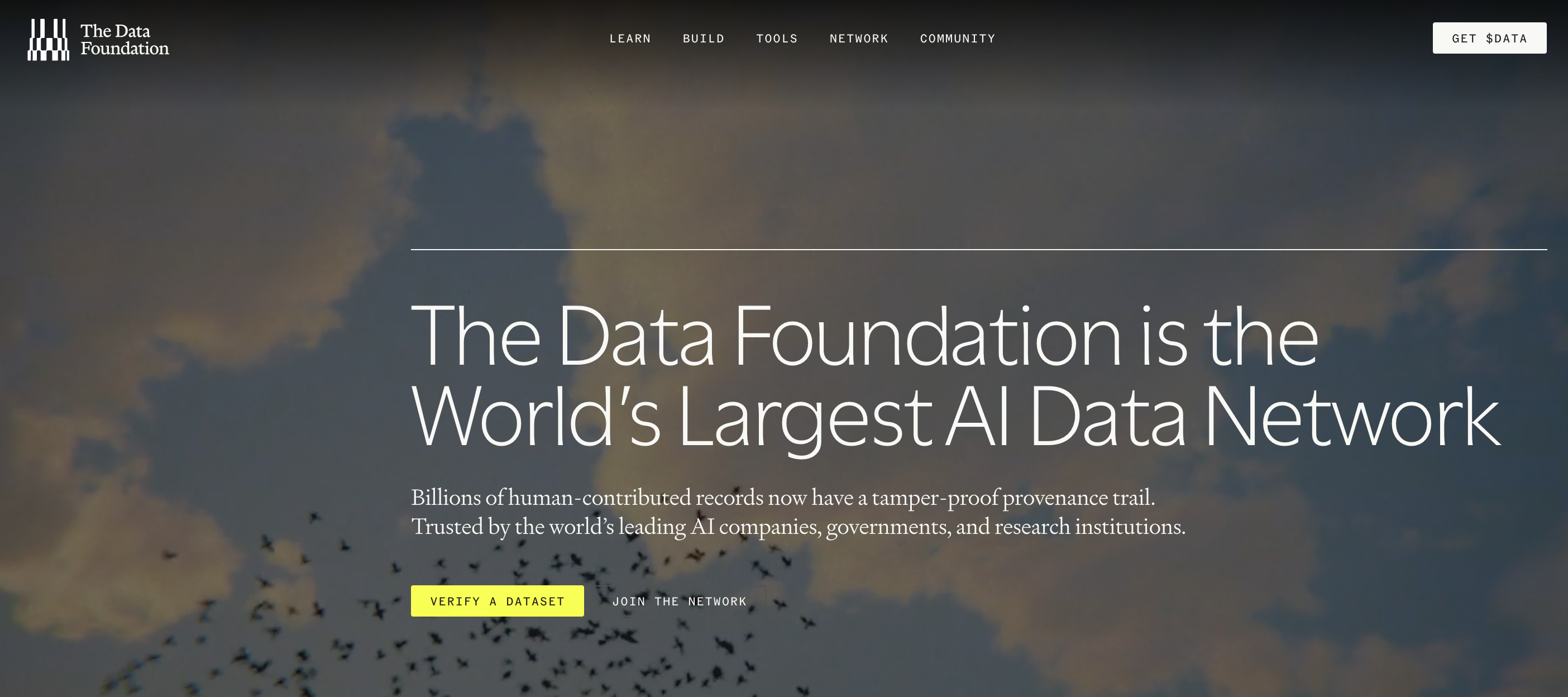
Data Network (DATA) is an infrastructure project designed for the AI era, connecting human-generated data resources, AI models, and data consumers. Through decentralized technology, it creates a transparent, secure, and verifiable data ecosystem.
Traditional internet data systems are dominated by centralized platforms. Users generate data across social media, search engines, e-commerce sites, and digital services, but platforms collect, analyze, and commercialize this data, making it difficult for contributors to share in the value. As AI models evolve rapidly, training high-quality models requires vast, authentic, diverse, and context-rich data, further intensifying concerns around data ownership, privacy, and source verification.
Data Network’s core vision is to build a “Human Data Network,” enabling individuals, developers, enterprises, and AI systems to connect and exchange value on a unified infrastructure. By leveraging blockchain for transparent record-keeping and cryptographic technologies for data protection, DATA aims to transform data from a passive resource into a managed and authorized digital asset.
In terms of development, Data Network aligns with the integration trend of AI and Web3. Recent industry focus has centered on decentralized storage, computing resources, and model infrastructure, with projects like Filecoin and Arweave addressing data preservation. Data Network, however, emphasizes verification, authorization, usage, and value flow after data generation.
As AI enters large-scale application, computing power alone is no longer sufficient for competitive advantage. High-quality data is now a key driver of model performance. Building new infrastructure for data production, management, and trading is a major focus for the Web3 AI sector.
DATA Token Economic Model and Ecosystem Incentives
The DATA token is the core value medium of the Data Network ecosystem, connecting network participants, incentivizing data contributions, and coordinating ecosystem rewards. In traditional data industries, value is concentrated in large technology companies. Users provide behavioral, content, or professional knowledge data, but without transparent authorization mechanisms, it is difficult to earn direct rewards. Data Network aims to connect data contributors, consumers, and network maintainers through its token economic model.
Key ecosystem roles include:
- Data Providers: Individuals or organizations contribute authorized data resources and receive incentives based on data quality, scarcity, and usage.
- Data Validators: Responsible for verifying data authenticity, completeness, and validity, maintaining network data quality standards.
- AI Developers and Enterprise Users: Those requiring high-quality training or application data can access authorized resources via the network.
- Network Participants: Earn rewards by participating in protocol operations, ecosystem growth, or data service provision.
Unlike traditional data markets, the DATA token is more than a payment tool—it is an economic model coordinating data production relationships. Contributors gain rewards, users access transparent sources, and the network expands through incentives.
However, the long-term value of the DATA token depends on actual ecosystem growth, including data supply scale, enterprise adoption, developer participation, and AI market demand.
Why Does the AI Era Require New Data Infrastructure?
AI is reshaping the value of data. In the internet era, data was primarily used for recommendation systems, advertising, and business analytics. In the generative AI era, data becomes the foundation for training large models, optimizing algorithms, and enhancing AI Agent intelligence. For example, large language models require massive amounts of text, code, images, audio, and domain-specific data for training. The current AI data system faces several clear challenges:
- Lack of transparency in data sources. Many AI models rely on public internet data, but authorization, copyright compliance, and contributor compensation remain contentious.
- Increasing scarcity of high-quality data. As public data is consumed by extensive model training, AI competition may shift from “who owns more data” to “who owns higher-quality, more specialized, and more trustworthy data.”
- Underutilized personal data value. Users generate significant behavioral data daily—language, knowledge sharing, content creation, and professional expertise—but centralized platforms manage this data, limiting user control.
Data Network aims to address these issues through decentralized infrastructure, enabling data to be:
- Verifiable: Confirming source and authenticity;
- Authorizable: Clarifying usage rights;
- Traceable: Recording how data is used;
- Incentivized: Rewarding contributors economically.
For the future AI industry, data infrastructure may become as essential as cloud computing, chips, and networking.
How Does Data Network Build a Verifiable Data Ecosystem?
Data Network centers its design on “Verifiable Data.” Traditional data trading gives buyers files but little assurance of origin, generation process, or modification status—critical for AI training, where poor or unverified data can degrade model outputs.
Data Network uses blockchain records and cryptographic mechanisms to establish a trusted proof system for data.
Key approaches include:
- Recording data sources: Each network entry is linked to source details—generation time, contributor authorization, and processing flow—making the data lifecycle transparent.
- Tracking data usage: On-chain mechanisms record how data is called and used for model training or AI applications, enhancing transparency.
- Incentivizing data quality: Rather than simply collecting volume, Data Network rewards authentic, valuable contributions, fostering a high-quality data pool.
Unlike traditional platforms, data becomes a resource circulating in an open network—not just an internal asset.
How Do Trace, Poseidon, and Confidential Data Rails Operate?
Data Network’s technical architecture focuses on data tracking, privacy protection, and trusted circulation. Trace, Poseidon, and Confidential Data Rails are key components underpinning network operations.
Trace: Building a Data Source and Usage Recording System
Trace is Data Network’s mechanism for provenance and verification. In the AI era, data must not only exist but also have clear origin, generation, authorization, and usage. In AI training, uncertain sources expose developers to copyright, contamination, and compliance risks.
Trace functions as a lifecycle management system, recording generation, submission, verification, and usage to create a traceable data path.
For example, a user contributes professional domain data, which, after network validation, enters the AI data market. When an AI team uses this data for training, Trace records the relationship, allowing contributors to track value flow and receive incentives.
This mechanism replaces the traditional “data becomes untraceable after platform entry” with a transparent lifecycle.
Poseidon: Privacy-Preserving Data Verification
A core dilemma in the data economy: valuable data contains rich information, but richer information heightens privacy risks. Poseidon addresses the balance between verification and privacy.
Traditional transactions require full data disclosure, risking sensitive leaks. Medical, financial, and behavioral data are highly valuable but sharing exposes privacy. Poseidon uses cryptography to validate data effectiveness without revealing content—akin to “proof of possession without full disclosure.”
Examples:
- Medical institutions prove research compliance without exposing patient identities.
- Users prove behavioral data ownership without disclosing histories.
- AI companies validate training data quality without accessing originals.
Privacy protection is a competitive factor for AI data infrastructure, as enterprises and individuals must balance value realization and security.
Confidential Data Rails: Secure Private Data Transmission
Confidential Data Rails is Data Network’s infrastructure for private data transmission.
As AI penetrates enterprise scenarios, more data involves business secrets, personal privacy, and industry-sensitive information:
- Internal knowledge bases;
- Financial transaction data;
- Medical research materials;
- Domain-specific databases.
If these data cannot circulate securely, they cannot fully participate in the AI ecosystem. Confidential Data Rails aims to enable authorized use while ensuring security.
Three key principles:
- Data control remains with owners. Providers decide access, scope, and usage.
- Risk reduction: Encryption and permission management minimize exposure.
- Enhancing enterprise adoption: High-value data with strict compliance needs privacy infrastructure for safe market participation.
Together, Trace addresses “origin and destination,” Poseidon “verification with privacy,” and Confidential Data Rails “secure circulation,” forming Data Network’s technical foundation.
DATA Use Cases in AI Training Data, Authorization, and Data Markets
Data Network’s primary applications are in the AI data industry. As competition shifts from parameter scale to data quality, networks providing high-quality, verifiable data may become core AI infrastructure.
AI Model Training Data
Training requires massive data, but quantity alone doesn’t determine capability.
High-quality data features:
- Clear origin;
- Accurate content;
- Domain expertise;
- Authorization;
- Continuous updates.
Data Network offers structured resources for transparent model training. For example, a medical AI company training diagnostic models may need more than public internet data. Through Data Network, it can access authorized, validated medical data, improving training quality and reducing compliance risk.
Data Authorization and Personal Value Realization
The future data economy may shift from “platform-owned” to “user-managed” data. Data Network aims to establish a new authorization model.
Users can select:
- Which data to share;
- Which organizations access it;
- Usage purposes;
- Economic returns.
This is akin to copyright management, enabling active control. For creators, professionals, and unique knowledge holders, data authorization may become a new income stream.
AI Data Market
Data Network also serves as a marketplace connecting suppliers and consumers. Providers contribute resources; AI enterprises find data for training or application development.
Segmented markets may emerge:
- Text data;
- Image and video data;
- Professional knowledge;
- Enterprise private data;
- AI Agent data services.
As AI Agents proliferate, they require not only model capabilities but also continuous access to reliable information, increasing the importance of data networks.
While Data Network, traditional platforms, and decentralized storage all address data, their focus diverges. Traditional platforms (e.g., large internet companies) solve collection, analysis, and commercialization.
Features:
- Centralized management;
- Strong platform control;
- Limited user value participation.
Data Network emphasizes ownership, authorization, and value sharing. Decentralized storage projects (Filecoin, Arweave) focus on “where to store data.”
They address:
- Long-term storage;
- Distributed nodes;
- Storage markets.
Data Network, by contrast, focuses on “verification, authorization, and usage.”
Simply:
- Storage networks answer “where data is stored.”
- Data Network answers “whose data, is it trustworthy, and how does it circulate?”
AI data infrastructure requires storage, computation, verification, and trading—Data Network operates at the value circulation layer.
Future AI ecosystems may have multiple foundational layers:
- Decentralized compute networks provide hashrate;
- Decentralized storage networks store data;
- Data networks enable trusted circulation;
- AI model platforms deliver intelligence.
Data Network targets the data connection layer.
Investment Risks for DATA Token
Despite opportunities from AI and Web3 integration, investing in DATA tokens entails several risks.
Ecosystem Adoption Risk
Network value depends on real-world usage.
If lacking:
- Data providers;
- AI enterprise users;
- Developer ecosystem;
- Business partners;
Token demand may not be sustainable.
AI Data Market Competition Risk
The AI data sector is evolving rapidly, with both centralized and decentralized competitors. Large tech companies may build their own data ecosystems.
Data Network must establish competitive barriers through technology, incentives, and scale.
Data Quality Risk
A major challenge is data quality. Low-quality, duplicate, or unverified data undermines AI applications and user engagement.
Effective screening and verification mechanisms are critical for long-term growth.
Regulatory Risk
Data involves privacy, copyright, and cross-border issues. As regulations mature, data assetization faces increasing legal requirements—especially in personal protection, training authorization, and commercial usage.
Continuous adaptation to regulatory changes is essential.
Token Market Risk
As a crypto asset, DATA’s price is influenced by liquidity, sentiment, and broader market cycles.
Even with technical promise, prices may fluctuate in the short term.
Future Direction and Market Potential
The AI industry is entering a phase of data competition. Recent focus has been on GPUs, architecture, and compute power. As foundational models proliferate, high-quality data becomes the key constraint. Data Network may develop along several lines:
- Expanding the AI data ecosystem: More developers and enterprises sourcing training data through the network could make it core infrastructure.
- Promoting personal data assetization: Users may become both consumers and value contributors.
- Strengthening enterprise applications: Enterprises hold high-value data, but privacy, security, and compliance limit utilization. Privacy infrastructure can unlock these resources.
- Integrating with AI Agent ecosystems: AI Agents will require ongoing access to trusted external information.
Long-term, Data Network represents a new data economy—transforming data from centrally controlled resources into verifiable, authorized, and tradable digital assets.
Summary
Data Network (DATA) is an AI-era infrastructure project exploring the creation of a human data network via blockchain, cryptography, and decentralized incentives.
Its core value is addressing critical AI data issues—source verification, privacy protection, authorization management, and value distribution.
Through modules like Trace, Poseidon, and Confidential Data Rails, Data Network aims to build a transparent ecosystem for efficient data connection among individuals, enterprises, and AI developers.
However, DATA’s long-term success depends on ecosystem scale, business adoption, technical competition, and regulatory environment. Investors should monitor both AI data infrastructure trends and the project’s real-world progress.
FAQs
What Is Data Network (DATA)?
Data Network (DATA) is a Web3 project focused on AI data infrastructure, connecting human data resources and AI application needs through decentralized networks, data verification, and privacy protection technologies.
What Is the Purpose of the DATA Token?
The DATA token is used for ecosystem incentives, data contribution rewards, and value exchange among network participants, driving economic cycles among producers, validators, and users.
How Does Data Network Support AI Development?
Data Network provides verifiable, authorized data infrastructure, enabling AI developers to access higher-quality data and reducing risks of unclear sources and copyright.
How Is Data Network Different from Filecoin?
Filecoin addresses decentralized storage, while Data Network focuses on data verification, authorization, and value circulation for AI.
Does DATA Token Have Investment Value?
DATA’s value depends on AI data market growth, ecosystem adoption, and technical execution. Investors should monitor project development, competition, regulatory changes, and crypto market risks.
Why Does the AI Era Need a Data Network?
As AI models advance, high-quality data becomes vital for performance. Data networks solve issues of source, privacy, and value distribution, providing new infrastructure for the AI industry.







