For investors, CAT stock combines the traits of both cyclical and dividend-paying equities. The company is influenced by factors such as construction equipment orders, dealer inventory levels, and raw material costs, while also boosting long-term shareholder returns through parts sales, after-sales services, cash dividends, and share repurchases. As a result, analyzing CAT requires a broader perspective than simply tracking equipment sales.
In the first quarter of 2026, Caterpillar reported $17.4 billion in sales and revenue, a 22% increase year-over-year, though its operating margin dipped slightly from 18.1% to 17.7%. These figures highlight that demand growth, price realization, and profitability may not always align, making them an essential starting point for understanding CAT’s valuation.
What Is CAT Stock?
CAT stock represents ownership in Caterpillar Inc. through its common shares. Listed on the New York Stock Exchange, shareholders of Caterpillar’s common stock participate in share price movements and, if eligible, receive cash dividends and voting rights.
CAT is generally classified as an industrial, cyclical stock, since Caterpillar’s customers typically purchase large equipment as part of their capital expenditures. When builders, mining companies, or energy firms ramp up investment, demand for equipment and services rises; when economic activity slows or financing costs increase, procurement plans may be deferred.
| Item |
Basic Information |
| Company Name |
Caterpillar Inc. |
| Stock Symbol |
CAT |
| Listing Exchange |
New York Stock Exchange |
| Main Industries |
Construction Machinery, Mining Equipment, Power & Energy Systems |
| Core Drivers |
Orders, Capital Expenditure, Industrial & Commodity Cycles |
| Shareholder Returns |
Dividends, Share Buybacks, Share Price Appreciation |
Caterpillar’s Core Business Structure
Caterpillar’s core manufacturing operations are divided into three main segments: Construction Industries, Resource Industries, and Energy & Transportation, with Financial Products offering equipment financing, leasing, and related financial services. Each segment serves distinct markets, including infrastructure construction, mining, oil & gas, power generation, industrial power, and transportation.
Construction Industries covers excavators, bulldozers, loaders, and road construction equipment. Resource Industries focuses on large mining trucks, extraction equipment, and related services. Energy & Transportation encompasses generator sets, engines, gas turbines, and applications in oil & gas and data centers. The financial arm supports equipment purchases through financing and leasing, influenced by interest rates and credit conditions.
Caterpillar’s diversified business model ensures it is not reliant on a single end market. When construction demand weakens, mining, oil & gas, or power generation can offset the impact. However, simultaneous downturns across multiple industrial sectors still present challenges for orders and margins.
Revenue Streams and Profit Model
Caterpillar’s revenue is generated from equipment sales, power systems, parts, after-sales services, and financial products. New equipment sales provide significant revenue flexibility, while parts and maintenance services support recurring income throughout the equipment lifecycle, helping mitigate volatility from one-time purchases.
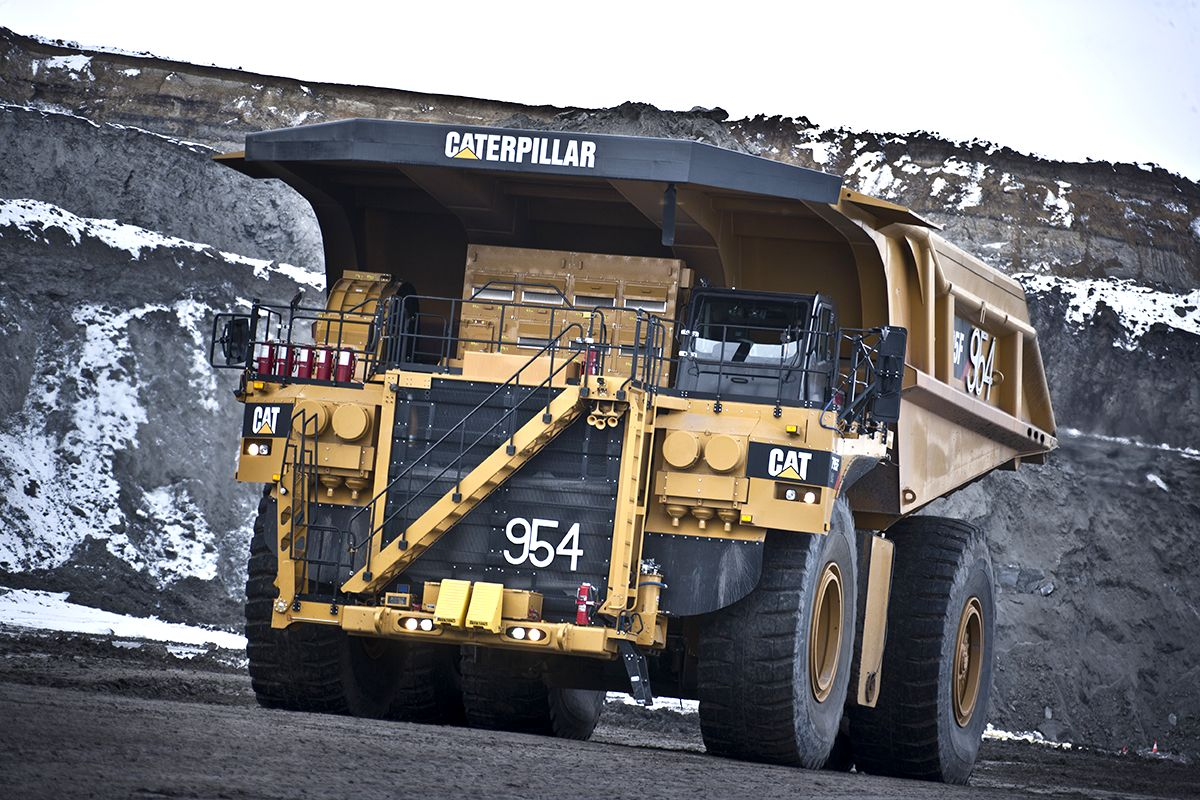
In 2025, Caterpillar reported $67.6 billion in sales and revenue, along with $11.7 billion in operating cash flow. That same year, the company returned $7.9 billion to shareholders via share repurchases and cash dividends. Service revenue reached $24 billion, underscoring the importance of after-sales and lifecycle services to the overall business model.
Profitability is further influenced by selling prices, manufacturing costs, product mix, and channel inventory. In 2025, revenue grew 4% year-over-year, but operating margin fell from 20.2% to 16.5%, showing that higher sales volumes can be partially offset by unfavorable pricing, tariffs, and increased manufacturing costs.
The construction equipment industry cycle directly impacts Caterpillar’s sales through shifts in customer capital expenditure. During economic expansion, infrastructure growth, or higher commodity prices, customers are more likely to upgrade fleets; in downturns, they may extend equipment lifespans or reduce new purchases.
Most Caterpillar machinery and power systems are sold through independent dealers and OEMs, creating a potential time lag between company shipments and end-user demand. Dealer restocking can temporarily boost Caterpillar’s sales, while destocking may cause reported sales to lag behind actual usage.
When evaluating CAT, investors typically monitor end-user retail sales, dealer inventory, order backlogs, and equipment utilization rates. These indicators help clarify whether revenue changes are driven by real demand or by adjustments in channel inventory.
Infrastructure, Mining, and Energy Demand Impact on CAT Stock
Infrastructure investment primarily drives demand in Caterpillar’s Construction Industries segment. Growth in road, bridge, residential, industrial, and public works projects increases demand for earthmoving, loading, and road equipment, also boosting parts and maintenance services.
Mining and energy investments impact Resource Industries and Energy & Transportation. Rising metal prices can prompt mining companies to expand, while power, oil & gas, and data center projects drive demand for engines, gas turbines, and power systems. In Q1 2026, Caterpillar reported growth in Energy & Transportation, fueled by sales of large engines, gas turbines, and data center applications.
These demand shifts affect CAT stock through changes in orders, revenue forecasts, and valuation. The market often anticipates infrastructure budgets, mining capex, and power construction trends before actual equipment revenue is fully recognized.
Caterpillar’s Competitive Advantages
Caterpillar’s strengths include a globally recognized brand, a broad product portfolio, an extensive independent dealer network, and a robust after-sales service system. Large equipment customers value reliability, rapid repairs, and parts availability, making Caterpillar’s service network a significant barrier to switching.
The company also diversifies revenue across construction, mining, oil & gas, and power generation. Cat Financial offers financing that allows Caterpillar to participate throughout the customer lifecycle—from purchase to operation and maintenance.
However, scale does not guarantee stable margins in all cycles. Competitors’ pricing, product innovation, regional demand shifts, and manufacturing cost changes can all impact Caterpillar’s market share and profitability.
Key Factors Influencing CAT Stock Price
CAT’s stock price is primarily affected by company earnings, equipment orders, profit margins, cash flow, dividend policy, and broader industrial cycles. The market closely watches whether sales growth leads to profit growth and whether high orders and dealer restocking are sustainable.
| Factor |
Potential Market Impact |
| Construction & Mining Orders |
Drives expectations for equipment revenue growth |
| Energy & Transportation Demand |
Influences power, oil & gas, and data center business |
| Dealer Inventory |
Creates timing differences between shipments and end-user demand |
| Selling Price & Manufacturing Costs |
Affect operating margins |
| Interest Rates & Financing Conditions |
Impact customer purchases and financial services |
| Dividends & Buybacks |
Shape shareholder return expectations |
In Q1 2026, Caterpillar’s revenue rose 22% and EPS reached $5.47, though its operating margin slipped compared to the prior year. This pattern—strong revenue growth with margin pressure—often prompts a market reassessment of growth quality, not just revenue pace.
Caterpillar Stock Dividends and Shareholder Returns
Caterpillar pays quarterly cash dividends. In June 2026, the board increased the quarterly dividend by 8% to $1.63 per share, with payment scheduled for August 2026 to eligible shareholders.
Returns for CAT shareholders include cash dividends, per-share equity gains from buybacks, and potential capital appreciation. In 2025, Caterpillar returned $5.2 billion via buybacks and paid $2.7 billion in dividends, demonstrating a commitment to rewarding shareholders through multiple channels.
It’s important to distinguish between owning actual shares and derivatives. Holders of CAT common stock typically receive dividends and voting rights if eligible, while CAT CFDs or perpetual futures mainly track price changes and do not confer the same rights. Cash adjustments and benefits are subject to specific product terms.
Operational Challenges and Industry Risks
Caterpillar’s main risk is exposure to economic cycles. Delayed infrastructure projects, lower mining capex, weaker energy investment, or persistently high interest rates can all dampen equipment and financing demand.
Profitability is also challenged by rising tariffs, raw material, labor, and logistics costs, which can erode gains from price increases. Caterpillar reported that Q4 2025 profits in Construction and Resource Industries declined due to manufacturing costs and tariffs.
Other risks include dealer inventory levels, customer credit, exchange rates, and regional market changes. Investors should evaluate sales growth alongside end-user demand, cash flow, and margins, rather than relying solely on individual orders or quarterly results.
Trading CAT Stock with USDT on Gate
Gate offers a dedicated CAT stock market page and supports Caterpillar price exposure through various products. For crypto users, USDT serves as both funding and settlement currency, streamlining transfers between digital asset and traditional securities accounts.
CAT-related trading products on Gate may include stocks and USDT-margined perpetual futures, each with distinct asset characteristics. In July 2026, Gate launched CAT USDT-margined perpetual futures, enabling both long and short trades with leverage. Perpetual futures are not equivalent to owning Caterpillar common stock.
| Comparison |
Gate USDT-Based Trading |
Traditional Brokerage Stock Trading |
| Funding |
USDT or platform-supported balances |
Usually fiat currency |
| Product Types |
Stocks, futures, etc. as listed |
Primarily common shares and securities |
| Shareholder Rights |
Varies by product |
Actual ownership usually confers shareholder rights |
| Trading Hours |
Product-specific rules |
Depends on stock market hours |
| Risk Mechanism |
Futures may involve margin and leverage |
Typically tied to stock price fluctuations |
Regardless of the channel, CAT’s price is affected by U.S. stock market conditions, liquidity, trading hours, and order execution. Users should confirm whether they are trading actual shares or derivatives and review each product’s fees, settlement, and rights details.
Summary
CAT stock represents Caterpillar’s common shares, with value rooted in construction equipment, mining machinery, power and energy systems, services, and financial products. Industry cycles, infrastructure investment, mining capex, and power demand collectively determine the company’s order flow and growth potential.
Caterpillar builds resilience through its global dealer network, after-sales service, cash dividends, and share buybacks, but still faces headwinds from economic cycles, rising costs, channel inventory, and margin volatility. Gate provides access to CAT-linked trading with USDT, though rights and risks differ across stocks, CFDs, and futures.
FAQ
Is CAT Stock Cyclical or Defensive?
CAT is best characterized as a cyclical industrial stock, as demand for Caterpillar’s equipment is closely linked to infrastructure, mining capex, energy investment, and global economic activity.
How Long Must You Hold CAT Stock to Get Dividends?
Eligibility for CAT dividends depends on holding qualified common shares before the ex-dividend date, not simply on the duration of ownership.
Why Does CAT’s Dividend Yield Change?
CAT’s dividend yield fluctuates with quarterly payouts and market price. If the dividend per share stays constant, a rising stock price lowers the yield, while a falling price increases it.
Which Caterpillar Financial Metrics Matter Most?
Key metrics include end-user retail sales, dealer inventory, operating margin, service revenue, operating cash flow, and order trends across business segments.
Does Rising Commodity Pricing Always Benefit CAT Stock?
Higher commodity prices don’t automatically boost CAT stock, but strong metal and energy prices may encourage mining and energy clients to expand capital expenditures.
Do All CAT Products on Gate Pay Dividends?
Not all CAT products on Gate have the same entitlements. Only actual shareholdings that meet product rules may qualify for shareholder rights; CFDs and perpetual futures generally do not confer the same benefits as owning common stock.