Robinhood Chain brings tokenized stocks, ETFs, and crypto assets onto a single unified blockchain platform, eliminating the need to sell positions for liquidity—a process that often triggers tax events and forfeits future upside. Overcollateralized CDPs streamline the process of locking collateral, minting debt, and repaying to release funds into a composable workflow, allowing assets to simultaneously back stable debt and retain growth potential.
From a DeFi perspective, Arrow Finance’s Redemption Router channels redemption pressure to higher-risk Vaults, the Stability Pool centralizes liquidation, and ARROW governance dynamically manages LTV ratios and fees—together creating a robust, closed-loop system for anchoring and repayment.
What Is Arrow Finance? What Problem Does It Solve on Robinhood Chain?
Arrow Finance is the native CDP protocol on Robinhood Chain, empowering users to mint aUSD by collateralizing assets they already hold, instead of liquidating their positions for cash. The protocol is non-custodial and overcollateralized: each Vault is tied to a single user, a single collateral type, and a single debt position, with all debt tracked as ERC-20 tokens.
On-chain challenges include: selling tokenized stocks or crypto assets can trigger taxable events and eliminate upside; idle assets can’t support circulating debt; and fragmented liquidity across chains makes unified deployment difficult. Arrow Finance aggregates holdings into a single overcollateralized position, enabling collateralization, debt minting, and repayment all on one chain.
Unlike Ethereum-based CDPs such as MakerDAO, Arrow Finance natively supports Robinhood Chain’s tokenized stocks, ETFs, and RWAs, with oracle buffers designed for stock market trading hours. Key differences with MakerDAO include collateral scope, chain environment, and oracle architecture.
| Core Component |
Role |
Main Function |
| Vault |
Single-user debt position |
Holds one collateral type, tracks aUSD debt and LTV |
| aUSD |
USD-denominated debt token |
Redeemable at par, fully overcollateralized |
| Redemption Router |
Redemption routing |
Directs redemptions to Vaults with the lowest health factor |
| Stability Pool |
Liquidation buffer pool |
Burns debt, acquires collateral at a discount |
| Surplus Buffer |
Governance reserve |
Receives fees, backstops bad debt |
| ARROW |
Governance token |
Fixed supply, one vote per token for parameter changes |
How Do Vaults and aUSD Work? What’s the Core Overcollateralized Borrowing Process?
A Vault is the fundamental debt unit: deposit a specific collateral, mint aUSD up to the LTV cap, accrue interest via the stability fee, and reclaim collateral by repaying principal and fees. The Health Factor gauges the safety margin of collateral versus debt; values above 1 indicate a safe zone.
The process: select collateral and target LTV → deposit collateral → mint aUSD → monitor health factor and fees → repay to release collateral. Debt is issued as ERC-20 tokens and can circulate on-chain until repaid.
How to Open a Vault and Mint aUSD details the steps from collateral selection and LTV setup to health factor confirmation. Mintable amounts are governed by LTV; price swings and fee accrual can impact the health factor.
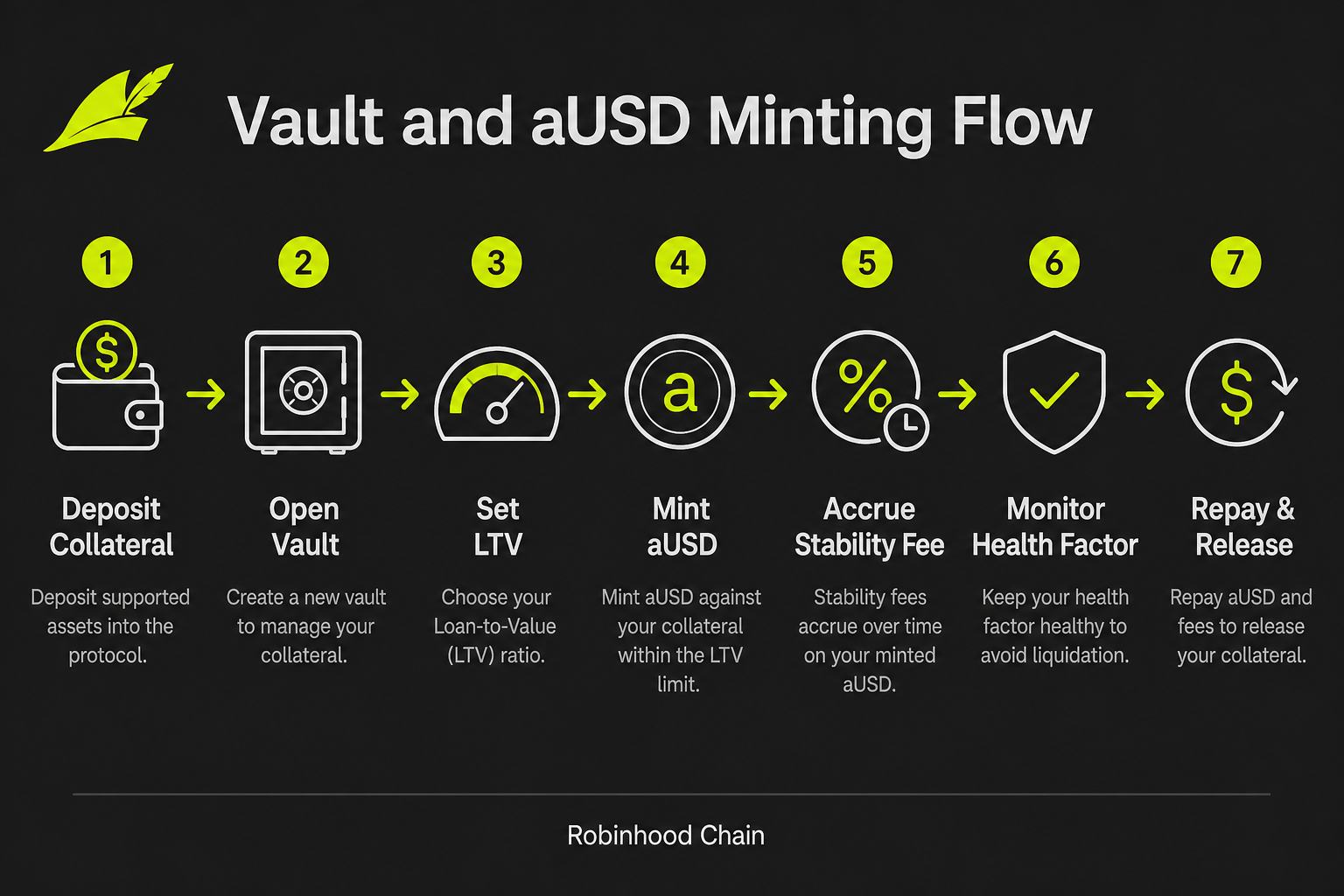
Figure 1. Arrow Finance Vault and aUSD minting flow: deposit collateral, open a position, mint debt, monitor health factor, and repay to release collateral.
What Collateral Does Arrow Finance Support? How Do LTVs Differ by Asset Class?
Collateral types include stablecoins, liquid staking tokens, major crypto assets, primary and secondary tokenized stocks, and on-chain ETFs and RWAs. LTV ratios reflect asset liquidity, volatility, and oracle reliability.
Collateral LTV Parameters summarize each asset’s max LTV, liquidation threshold, and debt cap. ARROW governance can adjust listings and parameters through voting.
| Collateral Type |
Example Asset |
Max LTV |
Risk Profile |
| Stablecoin |
USDC |
90% |
High liquidity, low volatility |
| Yield-Bearing Stablecoin |
sUSDe |
85% |
Earns yield, slightly more conservative |
| Liquid Staking |
wstETH, weETH |
72% |
Staking yield and depeg risk |
| Major Crypto |
WETH / WBTC |
75%/70% |
Deep liquidity, moderate volatility |
| Primary Tokenized Stock |
Major index component |
55% |
Bound by trading hours and NAV oracle |
| Secondary Tokenized Stock |
Small-cap equity |
40% |
Higher volatility and liquidity risk |
| ETF & RWA |
On-chain tokenized ETF |
Governance-set |
Dependent on native issuance and settlement |
Stablecoin Vaults offer the highest capital efficiency. Tokenized stocks use lower LTVs and wider liquidation buffers to mitigate price gaps during market closures.
How Does aUSD Maintain Its $1 Peg? What Are the Roles of the Redemption Router and Oracles?
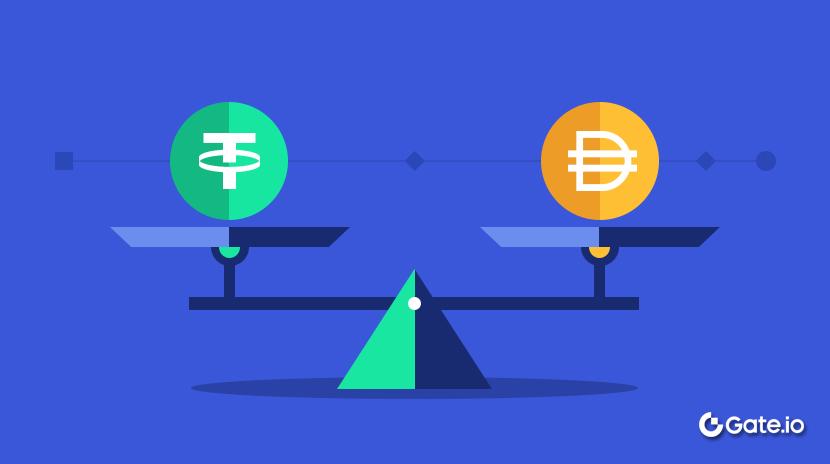
aUSD’s peg is maintained through on-chain redemption arbitrage and robust overcollateralization. Holders can redeem collateral at par via the Redemption Router, which prioritizes Vaults with the lowest health factor, focusing redemption pressure on the riskiest debt.
Oracles: Chainlink covers crypto assets and stablecoins; tokenized stocks use dedicated NAV oracles synchronized with on-chain stock venues. Price feeds are frozen or buffers widened during market closures to prevent stale price minting or liquidation.
aUSD Peg and Redemption Router explains the routing algorithm, redemption fee (0.25%–2%), and arbitrage dynamics. The Redemption Router manages downstream pressure, while oracles provide upstream pricing, jointly supporting the peg.
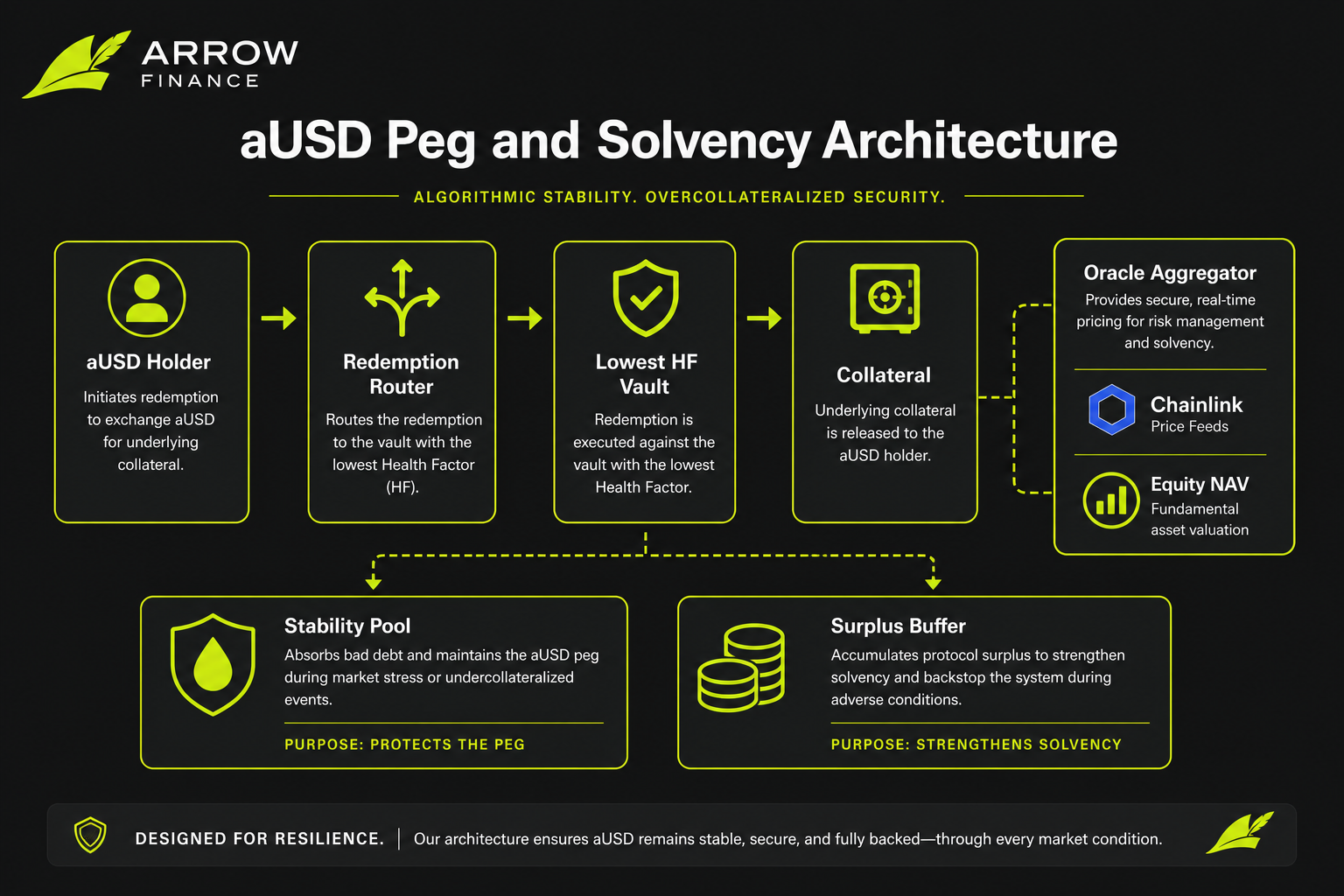
Figure 2. aUSD peg and repayment architecture: the Redemption Router and oracles maintain the peg, while the Stability Pool and Surplus Buffer ensure solvency.
How Do Liquidation, the Stability Pool, and Surplus Buffer Safeguard System Solvency?
A health factor below 1 triggers liquidation. The Stability Pool burns aUSD to offset debt, letting depositors acquire collateral at a discount (liquidation penalty: approximately 10%–13%). If pool capacity is insufficient, debt and collateral are redistributed across other Vaults.
The Surplus Buffer, governed by protocol, accumulates stability fees, liquidation penalties, and redemption fees, absorbing losses in case of bad debt. Fee structure:
| Fee Type |
Rate Range |
Destination |
| Stability fee |
0.5%–4% APR |
Surplus Buffer |
| Liquidation penalty |
10%–13% |
Liquidators & reserve |
| Redemption fee |
0.25%–2% |
Redemption pressure control |
The Stability Pool handles standard liquidations, redistribution provides a systemic backstop, and the Surplus Buffer absorbs protocol-level losses. Each collateral type has a debt cap to limit single-asset risk.
What Is the Role of the ARROW Token? What Parameters Can Governance Change?
ARROW is a fixed-supply governance token—one vote per token, no dividends, no inflation. Governance can adjust: collateral listings and removals; LTVs, liquidation thresholds, and debt caps; stability fees, liquidation penalties, and redemption fees; Surplus Buffer allocation; oracle sources; and both global and per-asset debt caps. All votes are executed on-chain, directly impacting system risk and fee structure.
What Are the Advantages and Risks of Using Arrow Finance?
Advantages: non-custodial ownership of collateral; aUSD is fully backed by real assets; native support for tokenized stocks as collateral without selling positions; Redemption Router and Stability Pool offer transparent peg and liquidation paths; and the protocol claims to have undergone a security audit.
Risks: price drops or fee accumulation may push the health factor below 1, triggering liquidation; oracle delays or NAV lags during market closures can cause valuation errors; smart contract vulnerabilities are inherent risks; tokenized stocks are subject to trading hours and liquidity constraints; users must verify contracts and official sites to avoid phishing. These features are not financial advice—users must assess their own risk tolerance.
Summary
Arrow Finance delivers a native overcollateralized CDP on Robinhood Chain: Vaults manage single-asset debt, aUSD is redeemable at par, the Redemption Router and dual-layer oracles maintain the peg, the Stability Pool and Surplus Buffer support solvency, and ARROW governance enables parameter changes. Arrow Finance is not affiliated with Arrow Markets on Avalanche—verify protocol identity before participating.
FAQ
What Is Arrow Finance?
Arrow Finance is the first native overcollateralized CDP protocol on Robinhood Chain for tokenized assets. Users deposit approved collateral to mint aUSD at par in Vaults, retaining upside exposure to underlying assets. Not to be confused with Arrow Markets on Avalanche.
What’s the Use of the ARROW Token?
ARROW is a fixed-supply governance token, one vote per token, used to vote on collateral listings, LTV and liquidation parameters, fee curves, Surplus Buffer allocation, oracle sources, and debt caps. ARROW offers no revenue dividends or inflationary issuance.
What Is aUSD? How Is It Minted?
aUSD is a USD-denominated debt token, overcollateralized in Vaults and redeemable for collateral at par via the Redemption Router. Minting process: deposit collateral, open a Vault, mint aUSD up to the LTV cap, and repay debt plus stability fee to release collateral.
What Collateral Does Arrow Finance Support?
Supported assets include USDC, sUSDe, wstETH, weETH, WETH, WBTC, primary and secondary tokenized stocks, and on-chain ETFs and RWAs. Max LTV for USDC is about 90%, primary tokenized stocks about 55%, secondary about 40%—all subject to governance.
What Happens if a Vault’s Health Factor Falls Below 1?
If the health factor falls below 1, the Vault is subject to liquidation. The Stability Pool burns the corresponding aUSD debt and acquires collateral at a discount (liquidation penalty: 10%–13%). If the pool is insufficient, debt and collateral are redistributed to other Vaults.
How Does aUSD Maintain Its $1 Peg?
The peg is maintained through the Redemption Router’s par-value arbitrage, along with accurate pricing from Chainlink and NAV oracles. The redemption fee and governance parameters manage redemption pressure, while oracles pause or widen buffers during market closures to prevent stale price minting.