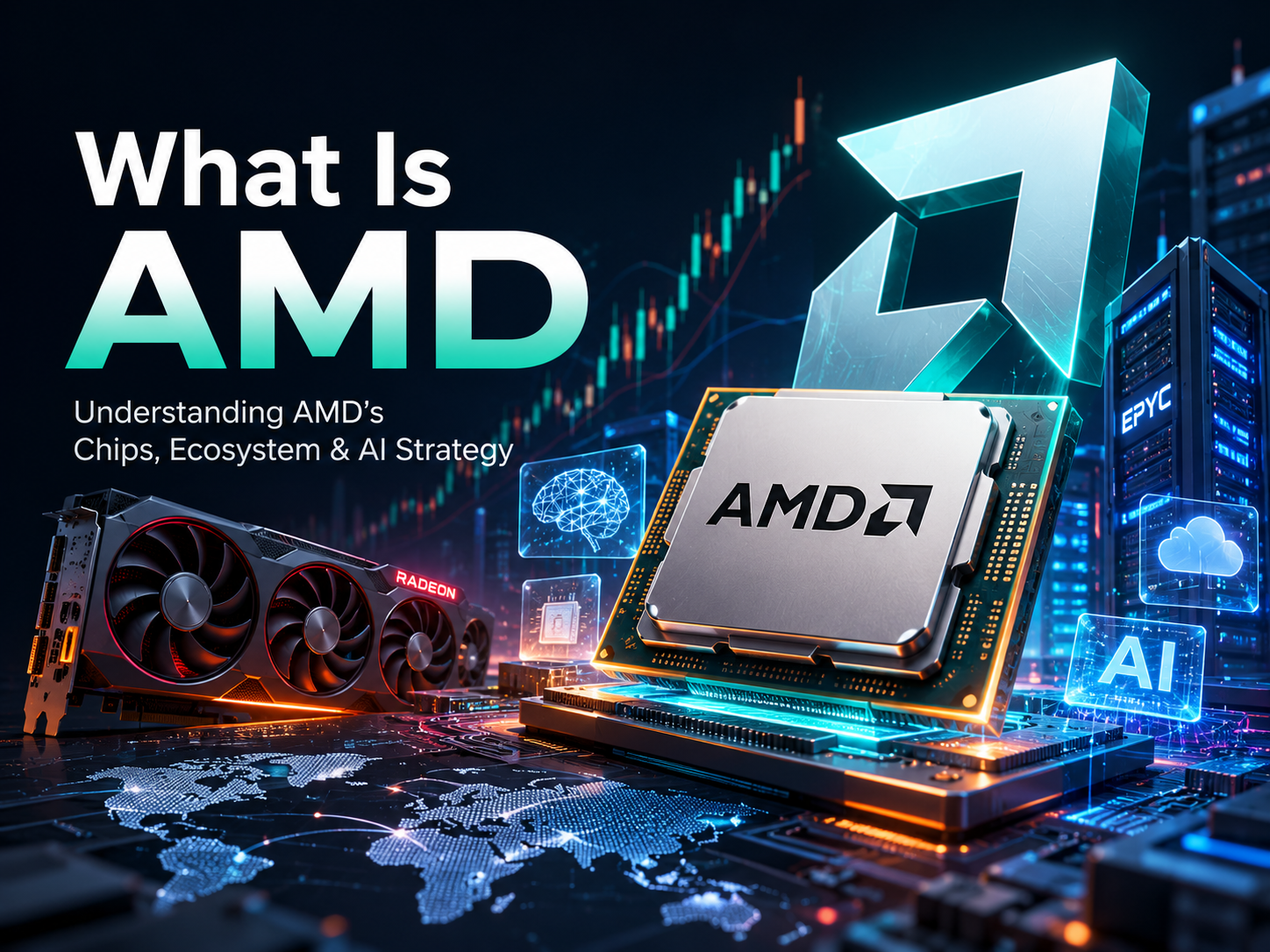
AMD has long competed with companies such as Intel and NVIDIA in the global semiconductor industry. Its Ryzen processors, Radeon graphics cards, and EPYC data center chips have become important product lines in both consumer and enterprise markets.
The rising demand for AI computing is reshaping the global chip market. AMD is also putting more resources into AI GPUs, data center accelerators, and high performance computing platforms, while gradually expanding its influence in cloud computing and enterprise markets.
What Is AMD
From a business perspective, AMD is closer to a diversified semiconductor platform covering CPUs, GPUs, and AI chips than a traditional PC chipmaker. Its products are now used in personal computers, game consoles, servers, cloud computing, and AI training.
AMD’s core revenue sources mainly come from four areas:
AMD’s product system is built on x86 CPU architecture and parallel GPU computing capabilities. The Ryzen series mainly serves the consumer market, while the EPYC series is primarily designed for enterprise servers and cloud computing.
AMD’s position in the AI market is also expanding. Its MI series AI accelerators have entered large scale data centers and artificial intelligence training scenarios, where they compete with NVIDIA.
AMD’s History and Market Positioning
AMD was founded in 1969 and was one of the earlier American companies to enter the semiconductor industry. In its early years, AMD mainly produced logic chips and processor products, before gradually moving into the CPU and GPU markets.
AMD has competed with Intel in the PC market for decades. In the early days, AMD mainly attracted consumers through value for money. After the launch of the Zen architecture, however, AMD began to reenter the high performance processor market.
After acquiring ATI Technologies in 2006, AMD officially entered the GPU market. ATI’s original graphics technology later became an important foundation for Radeon graphics cards.
AMD’s current market positioning is no longer limited to consumer PCs. AMD is expanding across:
| Business Area |
Main Products |
| Consumer CPUs |
Ryzen |
| Data Center CPUs |
EPYC |
| GPUs |
Radeon |
| AI Accelerators |
Instinct MI Series |
| Embedded Business |
Xilinx FPGA |
AMD’s competitive focus has gradually shifted toward the AI and data center markets. High performance computing and AI infrastructure have also become key growth areas for AMD today.
How AMD’s CPU Architecture Works
AMD’s CPU architecture is mainly based on the Zen microarchitecture family. Zen focuses on improving multi core performance, energy efficiency, and parallel processing capability.
AMD Ryzen processors usually use a Chiplet design. The Chiplet architecture separates multiple computing modules and then combines them, which helps improve chip yield and scalability.
The main components of an AMD CPU include:
-
CPU cores
-
Cache system
-
I/O module
-
Memory controller
AMD has strong advantages in multithreaded processing. Ryzen and EPYC processors usually provide higher core counts, making them highly competitive in content creation, rendering, and server workloads.
AMD’s CPU performance gains are also tied to advances in manufacturing processes. After partnering with TSMC, AMD gradually moved into advanced process nodes such as 7nm and 5nm, improving overall energy efficiency.
AMD’s GPU and AI Chip Ecosystem
AMD’s GPU products mainly belong to the Radeon series, while the company also has the Instinct AI accelerator lineup for the AI market. The defining feature of GPU chips is their ability to handle large scale parallel computing.
AMD GPUs mainly cover three areas:
| GPU Area |
Main Applications |
| Gaming GPUs |
PC gaming and graphics rendering |
| Professional GPUs |
Workstations and creative work |
| AI GPUs |
AI training and inference |
Radeon graphics cards have long served the consumer market and compete with NVIDIA’s GeForce series. AMD GPUs have certain advantages in gaming performance and value for money.
The AMD Instinct MI series is mainly designed for AI data centers. AI accelerators are commonly used for large language model training, machine learning, and high performance computing tasks.
AMD is also continuing to develop the ROCm software ecosystem. ROCm is AMD’s open source computing platform, mainly used to support AI and GPU parallel computing environments.
AMD’s Role in the Data Center Market
The data center business has become one of AMD’s most important growth drivers. AMD EPYC server chips are entering cloud computing, high performance computing, and AI infrastructure markets.
AMD EPYC server processors emphasize:
AMD’s data center customers include major cloud service providers and AI infrastructure platforms. AMD chips have already been adopted in some supercomputing systems and enterprise server markets.
Growing demand for AI training is also pushing AMD to expand its data center GPU business. AMD Instinct AI accelerators are beginning to enter large scale AI clusters and model training scenarios.
AMD’s competition in the data center market has expanded from traditional servers to AI infrastructure and high performance computing platforms.
Differences Between AMD and Intel Chip Architectures
AMD and Intel are both x86 processor manufacturers, but they differ noticeably in chip design and market strategy.
AMD places more emphasis on Chiplet architecture and multi core scalability. Intel relied on monolithic chip integration for many years, although it has also begun adjusting its design direction in recent years.
The main differences between AMD and Intel include:
| Comparison Area |
AMD |
Intel |
| Core Strategy |
Multi core |
Single core performance |
| Architecture Direction |
Chiplet |
Monolithic integration |
| Manufacturing Strategy |
TSMC foundry |
Own fabs |
| Market Focus |
Value for money and parallel computing |
Enterprise ecosystem and stability |
AMD has competitive advantages in high core counts and energy efficiency. Intel, meanwhile, has long standing strengths in enterprise ecosystems, OEM partnerships, and certain areas of software compatibility.
Competition between AMD and Intel has also pushed the global CPU market toward faster technological upgrades and pricing adjustments.
Differences Between AMD and NVIDIA’s AI Ecosystems
The competition between AMD and NVIDIA mainly centers on AI GPUs and the high performance computing market. Both companies are building AI data center products and large model training capabilities.
The core differences between AMD and NVIDIA come not only from hardware performance, but also from software ecosystems.
One of NVIDIA’s biggest advantages today is its CUDA software ecosystem. CUDA has become an important computing platform in AI development and has built a strong developer ecosystem.
AMD, by contrast, mainly promotes the open source ROCm ecosystem. ROCm places greater emphasis on openness and cross platform compatibility, but its developer base and maturity still trail NVIDIA.
The main differences between AMD and NVIDIA’s AI ecosystems include:
| Comparison Area |
AMD |
NVIDIA |
| AI Platform |
ROCm |
CUDA |
| GPU Ecosystem |
Open source oriented |
Closed ecosystem |
| Market Advantage |
Cost and openness |
Developer ecosystem |
| AI Market Position |
Continuously expanding |
Industry leader |
Competition in the AI chip market is no longer just about hardware. It also involves software platforms, developer tools, and data center ecosystems.
What Are AMD’s Main Use Cases
AMD chips now cover multiple consumer and enterprise fields. Different product lines serve different market needs.
AMD Ryzen is mainly used in:
-
Gaming PCs
-
Laptops
-
Creator workstations
AMD Radeon GPUs are mainly used for graphics rendering, gaming, and visual computing. Some professional GPUs are also used in video production and industrial design.
AMD EPYC and Instinct chips are mainly used for:
-
Cloud computing
-
AI training
-
Data centers
-
Supercomputers
AMD has also entered the automotive, industrial, and communications sectors through FPGA and embedded chips. The addition of Xilinx has further expanded AMD’s enterprise product structure.
AMD’s Strengths and Limitations
One of AMD’s core strengths is its strong value for money and multi core performance. AMD has remained highly competitive in both the CPU and GPU markets.
AMD’s main strengths include:
-
Strong multi core performance
-
Highly scalable Chiplet architecture
-
Clear growth in data center business
-
Continued expansion of AI market share
AMD also faces several challenges. In the AI software ecosystem, AMD still has a clear gap with NVIDIA.
Some of AMD’s limitations include:
-
AI software ecosystem is not yet mature enough
-
Shorter track record in the enterprise market
-
Lower GPU market share than NVIDIA
-
Intense competition in the high end AI market
The semiconductor industry itself is also highly cyclical. Changes in global demand, process technology competition, and shifts in the AI market can all affect AMD’s business growth and market performance.
Conclusion
AMD has gradually expanded from a traditional PC chipmaker into a comprehensive semiconductor platform covering CPUs, GPUs, AI chips, and data center businesses. The Ryzen, Radeon, EPYC, and Instinct series form AMD’s current core product ecosystem.
AMD’s influence in AI and high performance computing is growing. Data centers, AI GPUs, and enterprise computing are also becoming important directions for AMD’s future business.
AMD’s competition with Intel and NVIDIA is pushing the global semiconductor industry into a new stage of technological competition.
FAQs
What Kind of Company Is AMD?
AMD is an American semiconductor company whose main businesses include CPUs, GPUs, AI accelerators, data center chips, and high performance computing products.
What Is the Difference Between AMD and Intel?
AMD and Intel are both x86 chipmakers, but AMD places more emphasis on multi core performance and Chiplet architecture, while Intel has long focused on single core performance and enterprise ecosystems.
How Are AMD GPUs Different from NVIDIA GPUs?
AMD GPUs are mainly based on the open source ROCm ecosystem, while NVIDIA GPUs rely primarily on the CUDA software platform. The two companies differ in AI software ecosystems and developer scale.
Why Is AMD Entering the AI Market?
AI model training requires large amounts of GPU and high performance computing resources, so AMD is entering the AI data center market through its Instinct AI accelerators.
What Are AMD’s Main Products?
AMD’s main products include Ryzen processors, Radeon graphics cards, EPYC server chips, and Instinct AI accelerators.
What Are AMD Chips Mainly Used For?
AMD chips are mainly used in gaming PCs, cloud computing, AI training, data centers, creator workstations, and high performance computing.