In GameFi and AI creation crossover scenarios, content production, distribution, and incentives are often fragmented across various tools, making it difficult to close the loop on costs and liquidity using a single accounting unit. $AKE consolidates “creation consumption—protocol fee return—new token LP” onto one token, enabling creators, nodes, players, and issuers to collaborate under a unified settlement framework.
From an on-chain asset perspective, $AKE’s mainnet is deployed on BNB Smart Chain (BSC), with a distinct division of labor compared to the social access points on Telegram / TON. The social side focuses on user acquisition and lightweight gameplay, while the BSC side emphasizes token settlement and contract verification. Each layer—definition, allocation, utility, ecosystem linkage, verification, and risk—should be understood independently, without reference to price or yield.
What Is $AKE?
AKE is the native functional token of AKEDO. It does not replace the Creation Engine or the multi-agent framework itself, but serves as the medium for fee payments, incentive returns, and liquidity. Creators pay AKE for prompts and publishing; stakers share the protocol fee according to rules; new game tokens are paired with $AKE for liquidity.
Distinguish between platform names and game products: AKEDO refers to the multi-agent AI framework and creation/distribution infrastructure; AKEDO Games hosts playable content; $AKE connects fees, incentives, and LP. Confusing the three may lead to misjudging the token’s purpose or mixing up the social access chain and settlement mainnet.
How Is the $AKE Token Allocated? What Is the Supply Structure?
According to the whitepaper Tokenomics, $AKE has a total supply of 100 billion tokens, released over approximately four years in different allocation buckets. Each bucket has its own proportion and unlocking schedule, which should be verified against the official whitepaper table.
| Allocation Bucket |
Percentage |
Unlock Highlights (Whitepaper) |
| Community |
31.5% |
Node 16% / Creator 8% / Player 7.5%; TGE releases about 2.08%, remainder linear over 48 months |
| Investors |
25% |
3-month cliff + 24-month linear |
| Ecosystem & Growth |
17.5% |
15.8% ecosystem marketing TGE fully unlocked; 1.7% KOL etc. 20% TGE + 6-month unlock |
| Early Contributors |
15% |
6-month cliff + 42-month linear |
| Advisors |
5% |
Same as Early Contributors: 6-month cliff + 42-month linear |
| LP |
5% |
TGE release |
| Community Airdrop |
1% |
Community airdrop during TGE |
This table separates “fixed total supply” from “circulating supply released via unlocking”: the total supply is capped at 100 billion tokens, while circulating supply depends on each bucket’s cliff and linear release schedule. The Community bucket is further divided into node, creator, and player rewards, reflecting a long-term incentive design for content supply and node contributions.
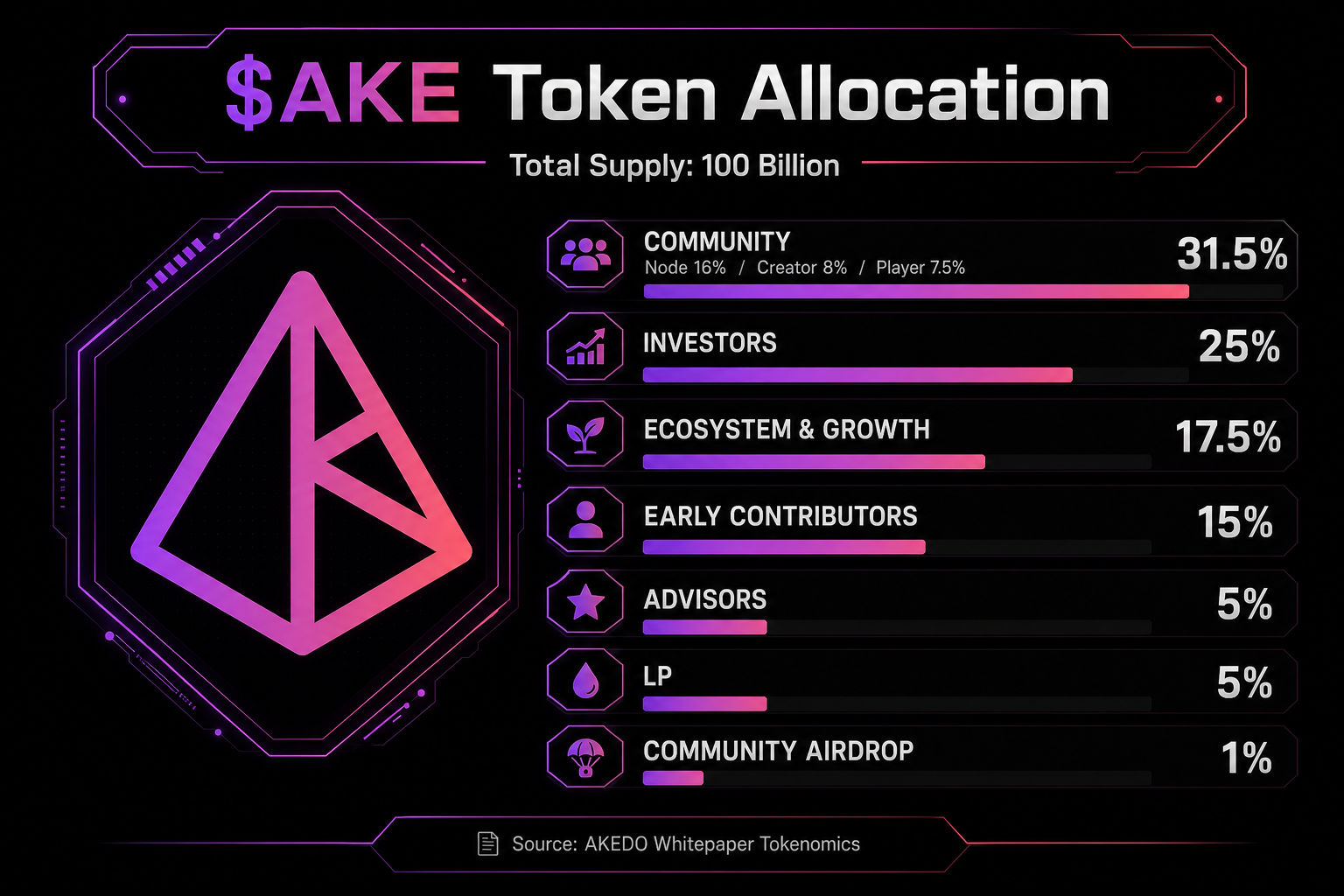 Figure 1. $AKE token allocation structure: total supply of 100 billion tokens, divided into seven buckets including community, investors, ecosystem growth, etc.
What Are $AKE’s Uses in Creation, Staking, and Liquidity?
$AKE’s public utilities fall into three connected categories:
| Utility |
Mechanism Highlights |
Participant Side |
| AI Creation |
About $0.1/prompt, $10/publish, paid in $AKE |
Creators / Content Production |
| Staking |
Protocol fee: about 33% platform / 33% stakers / 33% burn |
Stakers / Protocol Layer |
| LP Provision |
New game tokens paired with $AKE in LP pool |
Issuance and liquidity |
AI Creation makes natural language creation costs explicit as token consumption: every prompt and formal publish requires payment in $AKE, linking content generation and settlement. For Staking, protocol fees are split: one-third to platform revenue, one-third to AKE stakers, and one-third burned, balancing operational retention, staking incentives, and deflationary paths. LP Provision requires new Launchpad tokens to be paired with AKE, making the native token a liquidity anchor for new assets.
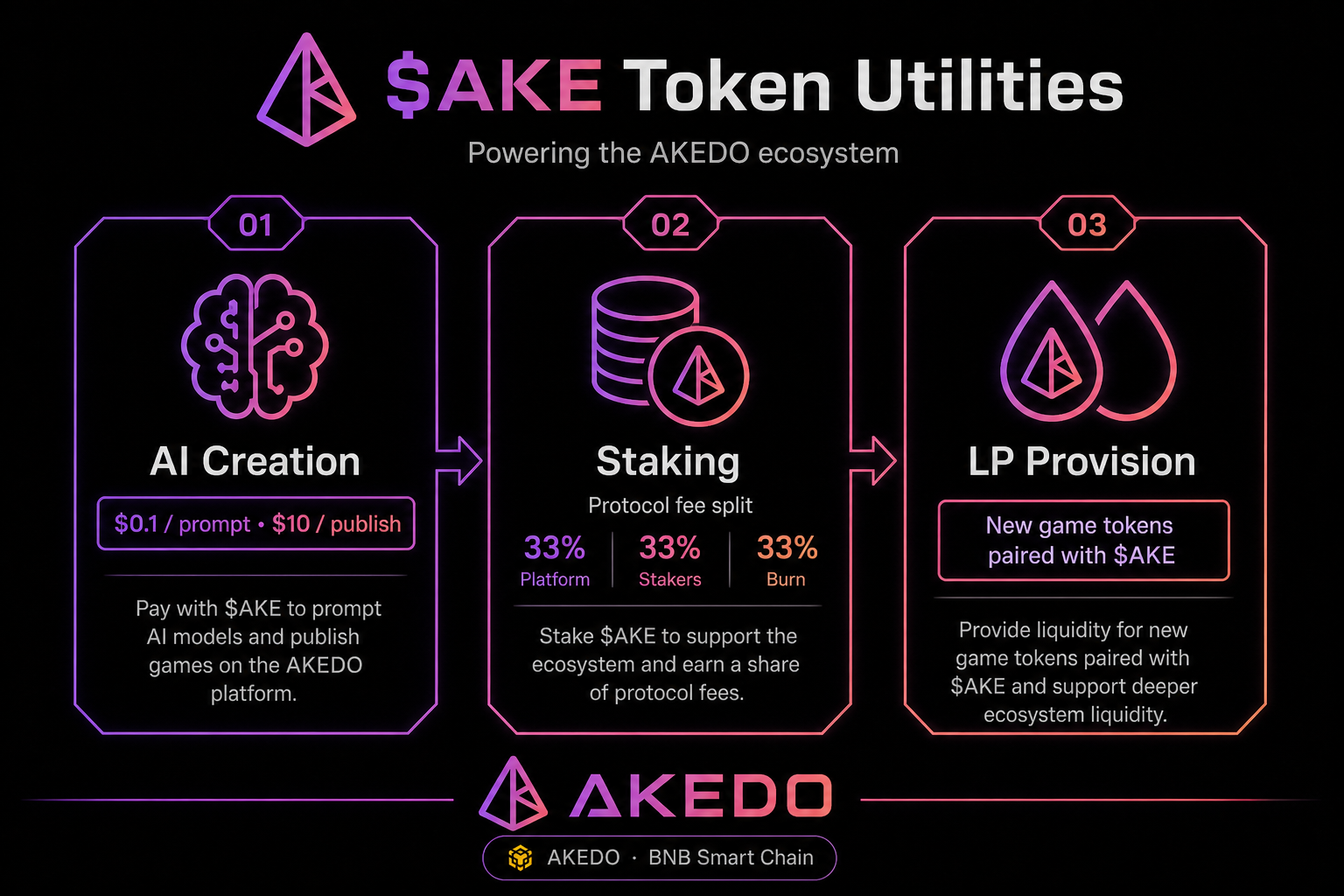 Figure 2. Three utilities of $AKE: AI creation payment, protocol fee staking share and burn, new game token LP pairing.
The above fees and proportions are based on whitepaper Tokenomics. Actual settlement standards, fee updates, and on-chain implementation should rely on the official website, whitepaper, and contract disclosures; no yield commitment is made.
How Does $AKE Integrate with Adodo and Launchpad?
AKE’s utility extends beyond payments and staking, forming links with ecosystem products. Adodo and the AKEDOG NFT ecosystem strengthen community identity and assetization of gameplay through pet imagery, cards, and NFTs. Related interactions and node mechanics connect with node/player incentives in the Community bucket, but Adodo is not a substitute for AKE.
Creator Launchpad handles game-related tokenization and early discovery tools. After new game tokens are paired with AKE in the LP pool, issuer-side liquidity is deeply tied to the native token. For creators, AKEDO creator monetization mechanism includes ad revenue sharing, protocol sharing, and AKE incentives, which can be understood alongside prompt/publish consumption: creators spend $AKE to produce content and earn incentives or shares through interaction and protocol rules.
Compared to AKEDO vs traditional GameFi structures—typically “long-cycle development + single gold farming”—$AKE emphasizes creation payments, tripartite protocol fee distribution, and Launchpad LP anchoring, with revenue sources not reliant on a single gameplay loop.
How Do You Verify the $AKE Contract? BSC or TON?
The commonly referenced $AKE contract address is 0x2c3a8ee94ddd97244a93bc48298f97d2c412f7db, deployed on BNB Smart Chain. For verification, compare the contract code and holder distribution on the official website, whitepaper, and block explorer, confirming name, symbol, and chain consistency. Do not rely solely on token icons or community-forwarded addresses.
| Verification Item |
Recommended Approach |
| Contract Address |
Character-by-character comparison with website/whitepaper disclosures |
| Deployment Network |
Confirm BNB Smart Chain, not any arbitrary sidechain |
| Name & Symbol |
Check if Token Name/Symbol is $AKE |
| Social Access vs Settlement Layer |
Telegram/TON for access; BSC for asset settlement |
AKEDO’s early stage may reach social users via Telegram/TON, but $AKE’s functional token mainnet is on BSC. Equating “having played TON-side lightweight gameplay” with “holding official $AKE” is a common misconception. Verification should focus on address and chain, not transaction guidance.
What Risks and Common Misunderstandings Are Associated with Holding or Using $AKE?
Platform mechanisms may change: creation fees and protocol fee rules can be adjusted; Launchpad new token LP is subject to liquidity depth and volatility; multi-agent output quality depends on models and human iteration, and token consumption does not guarantee content success.
Risks include smart contract and key security, counterfeit contracts and sites, changes in circulating supply due to unlocking progress, and misunderstanding airdrops/incentives as fixed returns. Common misunderstandings include treating AKEDO, AKEDO Games, and $AKE as the same entity; assuming 100 billion total supply means immediate full circulation; or thinking TON access equals the chain where BSC contracts reside. Advantages (unified settlement, tripartite protocol fee, LP anchor) and risks should be stated separately, without judgment on “worthwhileness.”
Summary
$AKE is capped at 100 billion tokens, allocated across seven buckets including community, investors, ecosystem growth, etc., with cliff and linear unlocking. Its three utilities cover AI creation payments, protocol fee staking share and burn, and new game token LP pairing, and it connects to Adodo/NFT, Launchpad, and creator monetization paths. Participants should verify the contract address on BSC, distinguish between social access chains and settlement mainnets, and separate token utility from price expectations.
FAQ
What Is the Use of the $AKE Token?
AKE is mainly used for three purposes: paying AI creation prompt and publish fees (whitepaper: about $0.1/prompt, $10/publish); staking to share about one-third of protocol fees (another third goes to the platform, one-third is burned); and as LP pairing asset for Launchpad new game tokens. These utilities serve creation settlement, protocol return, and liquidity anchoring.
What Is AKEDO? How Is It Related to $AKE?
AKEDO is a multi-agent AI framework for autonomous content creation, providing a creation engine and launchpad. $AKE is the ecosystem’s native functional token, responsible for fee payments, staking share, and new token liquidity pairing, and does not replace the framework or multi-agent collaboration.
What Is the Total Supply of $AKE? How Is It Allocated?
$AKE has a total supply of 100 billion tokens. Main allocations: Community 31.5%, Investors 25%, Ecosystem & Growth 17.5%, Early Contributors 15%, Advisors 5%, LP 5%, Community Airdrop 1%.
Is $AKE Deployed on BSC or TON?
$AKE’s functional token mainnet is deployed on BNB Smart Chain; the commonly referenced contract address is 0x2c3a8ee94ddd97244a93bc48298f97d2c412f7db. Telegram/TON mainly serve as social access and lightweight gameplay entry points, distinct from the BSC settlement layer.
How Do You Verify If the $AKE Contract Is Official?
Compare the contract address in the block explorer character by character with the website and whitepaper, confirm deployment on BNB Smart Chain, and check Token Name/Symbol. Do not rely solely on community-forwarded icons or similar addresses; no transaction guidance is provided.
How Do AKEDO Creators Monetize? Is It Related to $AKE?
Monetization paths include brand-related ad game sharing, protocol revenue sharing, platform ad revenue sharing, and AKE incentives; Launchpad can also support game or collection token issuance. Creators may consume $AKE for prompt/publish, with monetization and consumption occurring simultaneously. Proportions are subject to platform disclosures, with no yield commitment.