As AI applications and AI Agents evolve rapidly, more systems are embracing multi-model AI architectures. Different AI models vary significantly in reasoning capability, response speed, and cost structure. Relying on a single model for all tasks often leads to excessive costs or inefficiency. That's why AI model routing has become a critical component of modern AI infrastructure.
An AI Router intelligently allocates tasks across multiple models, giving AI systems greater flexibility, scalability, and stability. This multi-model approach is emerging as a key technical foundation for AI SaaS platforms, AI Agents, and automated AI applications.
What Is AI Model Routing?
AI model routing is a technical mechanism that selects the most appropriate model for each request based on task requirements.
In traditional AI setups, a system usually connects to just one model. For instance, a chatbot might call a certain large language model API. But different tasks demand different capabilities:
- Text summarization or simple Q&A typically requires minimal reasoning
- Complex logic analysis or code generation demands more powerful models
- Multilingual translation may need a specially optimized model
Using a high-performance model for every task drives up costs, while a simpler model handling complex tasks may compromise quality. AI model routing analyzes request content and dynamically assigns tasks to the best-fitting model, striking a balance between performance and cost.
Why Do AI Applications Need Multiple Models?
As AI technology advances, models are becoming increasingly specialized in their capabilities and use cases. This drives the adoption of multi-model AI architectures.
First, different models excel in different areas. Some are stronger at complex reasoning, while others shine in speed or cost efficiency. By combining models, the system can pick the best tool for each job.
Second, a multi-model architecture lowers operating costs. Simple tasks use cheaper models, while complex ones call on premium models—significantly reducing total expenses.
Third, this architecture improves reliability. If one model fails or goes offline, the system can route requests to another, ensuring uninterrupted service.
How Does AI Model Routing Work?
AI model routing systems typically rely on a Routing Engine to decide which model processes a request. The engine considers several factors:
Task complexity: The system analyzes the prompt length and task type to gauge the required model power.
Model capability: Different AI models perform differently on specific tasks, such as code generation or multimodal processing.
Response speed: For real-time apps like chatbots and AI Agents, low latency is crucial.
Call cost: AI model API prices vary widely, so cost influences routing decisions.
When a user or AI Agent sends a request, the AI Router first analyzes the task, selects the optimal model, processes the request, and returns the result to the application.
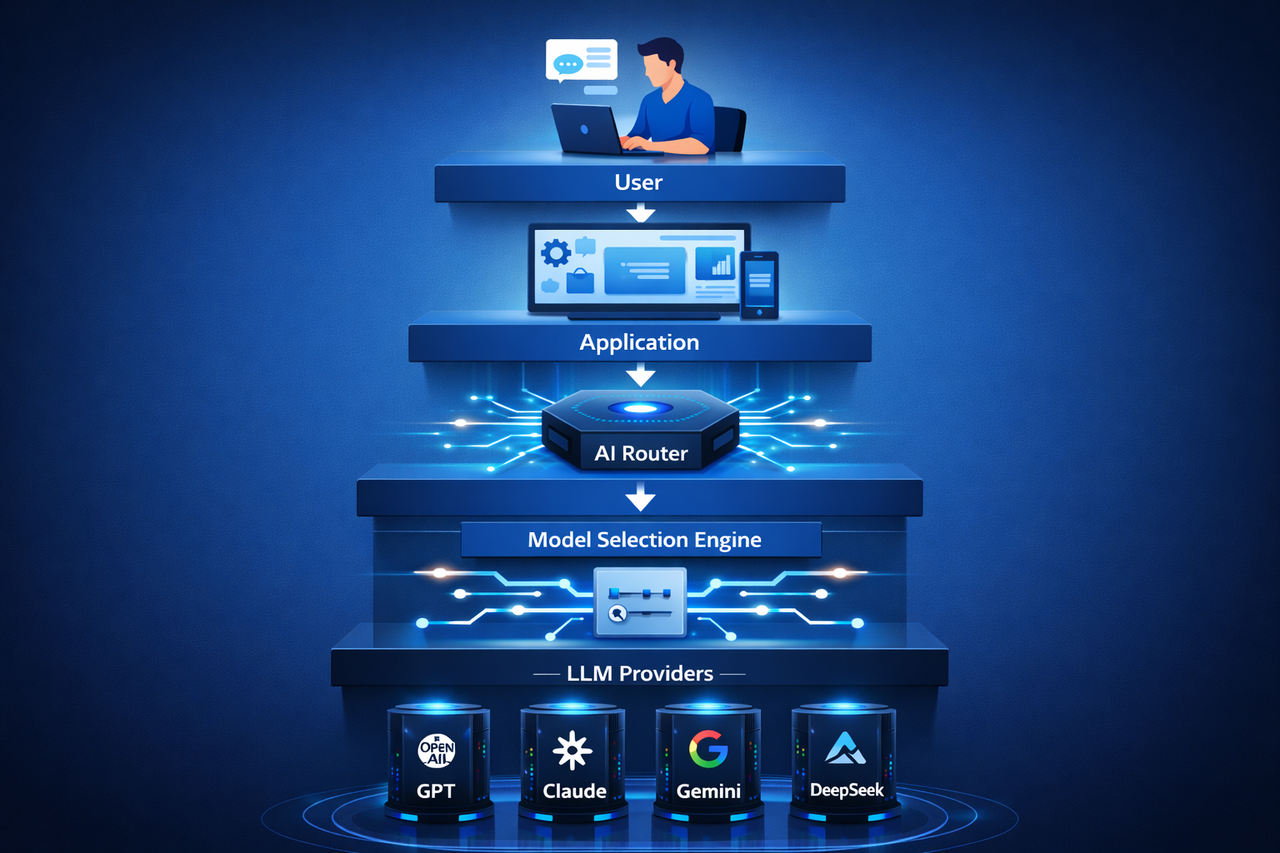
Comparison of Mainstream AI Routing Strategies
In real-world AI infrastructure, model routing employs several strategies to optimize performance.
Cost-first strategy: Prioritizes cheaper models, only switching to high-performance models for complex tasks.
Performance-first strategy: Focuses on output quality, typically using the most capable model even at higher cost.
Hybrid strategy: Many modern AI Routers use a hybrid approach, balancing cost, performance, and response speed.
Task-specific strategy: Selects specially optimized models for certain tasks, like code generation or multimodal processing.
Different strategies suit different applications, so routing systems are usually tuned to specific needs.
AI Model Routing vs AI API Gateway
AI model routing and traditional API Gateway serve distinct purposes.
AI API Gateway: Manages API requests—handling authentication, traffic control, and security—but does not decide which AI model to use.
AI Model Router: Selects the best AI model based on request content and routes accordingly.
In practice, developers often combine both: the API Gateway manages requests, while the AI Router handles model selection.
Typical Use Cases for AI Model Routing
As the AI ecosystem grows, model routing is widely applied across scenarios where multiple models collaborate for efficiency.
AI Agents: They often call different models for tasks like search, analysis, and content generation. Model routing helps them automatically pick the best model.
AI SaaS Platforms: Many offer multiple LLMs to users. An AI Router centrally manages these model APIs.
AI Data Analysis: Different models handle data parsing, logic reasoning, and result generation respectively.
Typical Architecture of an AI Router Infrastructure
A complete AI Router system includes several layers:
API access layer: Receives requests from applications or AI Agents.
Routing decision layer: Analyzes request content to decide which AI model to use.
Model execution layer: Connects to multiple model providers, e.g., various LLM services.
Monitoring and optimization system: Tracks model performance, response times, and costs, continuously improving routing strategies.
This architecture allows the AI Router to efficiently distribute tasks across models, building more flexible AI infrastructure.
Gate.AI's Role in the AI Router Space
As multi-model AI applications grow, specialized AI Router platforms have emerged to help developers manage multiple models.
Some AI infrastructures now offer unified model access interfaces, like the AI model routing platform Gate.AI, designed for managing multiple LLM services.
Unlike traditional AI API gateways, Gate.AI focuses on automated AI use cases. It provides model access for AI Agents, supporting automated calls and task execution. It also integrates the x402 protocol for automatic payment of AI Agent APIs, enabling machines to pay for services seamlessly.
Summary
AI model routing is a key technology in multi-model AI architecture. By dynamically distributing tasks across models, the AI Router helps applications balance performance, cost, and speed.
With the rise of AI Agents and automated applications, multi-model architecture is becoming a major trend. AI model routing not only boosts efficiency but also enhances stability and flexibility.
In this landscape, AI Router platforms are becoming vital infrastructure connecting AI models, developers, and automated applications.
FAQs
What Is AI Model Routing?
AI model routing is a technical mechanism that dynamically selects the best model from multiple AI models to handle a given request.
What's the Difference Between AI Router and LLM Router?
An LLM Router is specifically designed for large language models, while an AI Router covers a broader range of AI model types.
Why Do AI Applications Need a Multi-Model Architecture?
Different models differ in ability, cost, and speed. A multi-model architecture lets the system choose the best model for each task.
How Does AI Model Routing Reduce Costs?
By routing simple tasks to low-cost models and complex tasks to high-performance ones, the system lowers overall operating expenses.