What Is AFX?
 (Source: AFX_XYZ)
As demand for perpetual futures and on-chain derivatives grows across the crypto market, many decentralized trading platforms are hitting performance bottlenecks — high slippage, trade execution delays, and network congestion. AFX is a Layer 1 blockchain purpose-built for decentralized derivatives trading. Its goal: combine the speed of centralized exchanges with blockchain transparency to deliver an on-chain trading environment that rivals professional financial markets.
Unlike general-purpose blockchains, AFX focuses its entire network architecture on high-frequency trading and perpetual futures, aiming to overcome the performance limits that plague traditional DeFi derivatives platforms.
What Problems Does AFX Solve?
Most DeFi trading platforms still run on shared blockchains, making them vulnerable to interference from other applications.
Issues include:
- On-chain congestion causing trade delays
- Gas fee spikes during high volatility
- Large orders prone to slippage
- MEV problems compromising trade fairness
- High-frequency strategies that are nearly impossible to execute
For professional traders, any of these can directly impact results.
That's why AFX chose to build a dedicated Layer 1 network — one that serves derivatives trading exclusively, without competing for resources with other applications.
What Are AFX's Core Features?
 (Source: AFX_XYZ)
-
High-Speed Trading & Low Latency
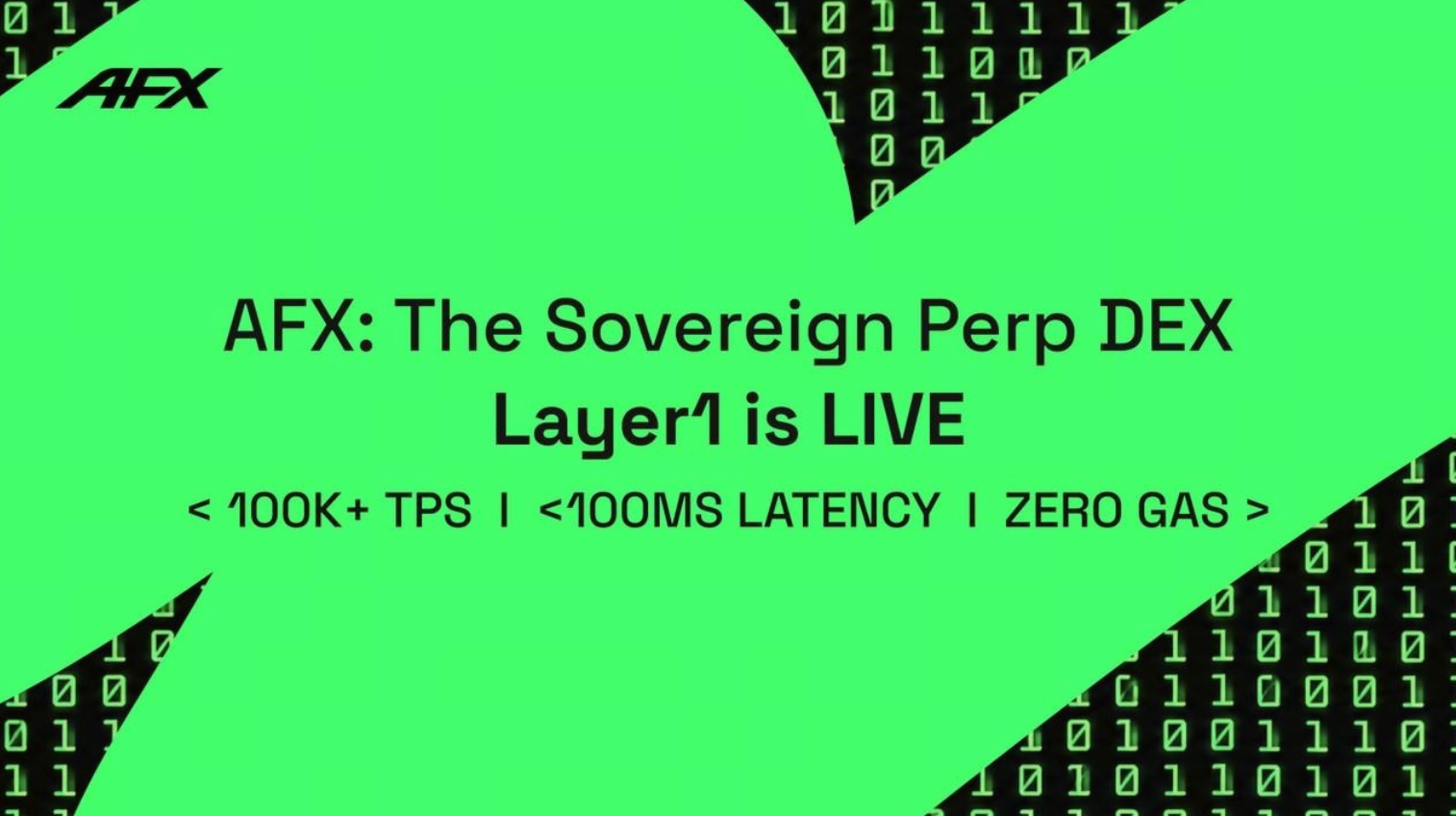
AFX uses a DAG consensus architecture with a modular execution layer. The team reports median transaction latency under 100 milliseconds, meaning orders get matched faster — critical for high-frequency traders, quantitative strategies, and short-term scalpers.
The network's theoretical throughput exceeds 100,000 transactions per second (TPS), aiming for a trading experience as smooth as a centralized exchange.
-
Zero-Gas Transaction Model
Another standout: Zero Gas mode. On most blockchains, users pay gas for every operation. AFX removes that friction, cutting costs for frequent traders.
This design is ideal for:
- Perpetual futures trading
- High-frequency quant strategies
- Arbitrage trading
- Heavy order placement and cancellation activity
For professional traders, it means better capital efficiency.
- Multiple Perpetual Futures Markets
AFX launched with several markets right out of the gate: BTC Perpetual, ETH Perpetual, Gold (XAU), and Crude Oil (CL).
Beyond crypto, it's already integrating traditional financial assets, pushing on-chain derivatives toward greater diversity. The platform also supports up to 40x leverage for more flexible capital use.
How Is AFX's Trading Architecture Different?
- Dedicated Trading Execution Environment
AFX isn't built on top of an existing blockchain — it has its own independent execution layer.
Key design elements include:
- A dedicated mempool
- High-frequency order optimization
- Protocol-level MEV protection
- Separation of execution and consensus
That means trade execution stays isolated from other applications, boosting matching efficiency and stability.
- Native FIX Protocol Support
AFX also integrates the FIX Protocol (Financial Information eXchange), standard in traditional finance. Many institutions and quant firms use FIX for standardized trade communication, making it easier for algorithmic trading systems to plug in.
This enables:
- Institutional-grade quantitative trading
- Automated strategy deployment
- High-frequency trading connections
- Lower technical integration costs
It also shows AFX wants to draw more professional financial players into on-chain derivatives.
What Does the AFX Mainnet Launch Mean?
AFX recently launched its Mainnet, signaling that the Layer 1 network is now live and operational.
The launch also includes:
- Pro-Trader Suite — professional trading tools
- A high-efficiency margin engine
- Real-time re-use of unrealized profits
- Multi-market perpetual trading
AFX says its margin system requires a minimum maintenance margin of about 1.25%, aiming to improve overall capital efficiency.
Why Does AFX Emphasize the Sovereign Trading Layer?
AFX positions itself as a Sovereign Trading Layer — a self-contained financial environment built exclusively for on-chain derivatives.
Its core philosophy:
- Users control their own assets
- No reliance on centralized custody
- On-chain transparency maintained
- A trading experience close to centralized exchanges
AFX aims to balance speed with decentralization.
AFX says it skipped traditional VC private sales and large unlock schedules, opting for a community-driven approach instead. It also introduces a 100% Revenue Pass-through model, where network-generated income flows back to ecosystem participants and traders. In DeFi, this kind of design is often seen as a way to boost community engagement and support long-term ecosystem growth.
Summary
AFX is a Layer 1 blockchain optimized for decentralized derivatives trading. It aims to improve on-chain perpetual futures market efficiency through high-speed execution, zero gas costs, and institutional-grade architecture. As the DeFi derivatives market expands, demand for low-latency, high-liquidity, and professional trading environments continues to rise. AFX reflects a broader shift — blockchain infrastructure moving from general-purpose chains toward specialized financial use cases.
FAQ
-
What is AFX?
AFX is a Layer 1 blockchain built specifically for decentralized derivatives trading, focused primarily on the perpetual futures market. It combines the speed of centralized exchanges with blockchain transparency to create a more efficient on-chain trading environment.
-
What are AFX's core features?
AFX's main features include high-speed, low-latency trading, a zero-gas fee model, and support for multiple perpetual futures markets including BTC, ETH, gold, and crude oil. The platform also offers up to 40x leverage to accommodate various trading strategies.
-
How is AFX different from typical DeFi trading platforms?
AFX uses a dedicated Layer 1 architecture with its own trading execution environment, MEV protection, and native FIX protocol support. This reduces network congestion and slippage, making it far better suited for high-frequency trading, quantitative strategies, and institutional-grade users.







