As a decentralized AI Oracle network, APRO needs to continuously coordinate off chain data, validator nodes, and cross chain information transmission. For that reason, APRO must establish an economic incentive mechanism that can sustain node collaboration over the long term. Traditional centralized data services are usually maintained by a single organization, while decentralized oracle networks rely more heavily on token models to keep operating.
The AT token is built around node staking, network governance, data verification, and ecosystem incentives. Several core modules within the APRO network are directly connected to AT, so AT is not just a medium of exchange. It also supports network security and governance functions.
The AT token plays a value coordination role within the APRO network. Through AT, APRO connects nodes, data services, and governance mechanisms, helping keep the entire oracle network running.
Structurally, AT is closer to a utility token for network operations than a simple payment tool. Validator nodes need to hold and stake AT before they can participate in the data verification process, so AT directly affects APRO’s security model.
Data requests in the APRO network usually require multiple nodes to work together. First, a smart contract initiates an off chain data request. Then nodes retrieve content from different external data sources. Next, the APRO network aggregates and verifies the results from multiple nodes. Finally, the verified data is submitted to on-chain applications.
This mechanism means the AT token is directly tied to data reliability. If a node submits incorrect data, its staked AT assets may be penalized, so nodes need to maintain stable data service quality.
According to official materials, the AT token is also used for governance voting and ecosystem incentives. AT holders can participate in governance over protocol parameter adjustments, node rule changes, and network upgrades.
Core Functions of AT in the APRO Network
The core functions of the AT token are mainly concentrated in node staking, data services, network governance, and incentive distribution. These different modules work together to affect the long term stability of the APRO network.
Nodes in the APRO network need to stake AT to qualify for validation. First, a node submits a staking application to the network. Then the APRO system verifies the node’s status and staking amount. Next, the node can participate in data validation tasks. Finally, the node receives rewards based on its service results.
The table below shows the main functions of the AT token in the APRO network:
| Function Module |
Main Role |
| Node staking |
Maintains network security |
| Data rewards |
Incentivizes node operation |
| Governance voting |
Adjusts protocol parameters |
| Service payment |
Pays data request fees |
| Ecosystem incentives |
Supports network expansion |
The AT token is designed to coordinate node behavior through economic incentives. A decentralized oracle network cannot rely on a single administrator, so APRO must use a token mechanism to maintain node participation.
Unlike traditional centralized data services, validation results in the APRO network are produced collectively by multiple nodes. The AT token affects node earnings, so nodes are more likely to provide stable and accurate data results.
Why Nodes Need to Stake AT
The AT staking mechanism is an important part of APRO’s network security model. The core purpose of node staking is to reduce the risk of malicious data submission and network attacks.
Nodes in the APRO network need to continuously provide off chain data services, so the network must establish an economic constraint mechanism. First, a node locks a certain amount of AT tokens. Then the node can participate in data request processing. Next, the node must submit verification results and undergo network review. Finally, the network determines rewards or penalties based on data quality.
This mechanism means incorrect data directly affects node earnings. If a node submits abnormal data, its staked AT may be deducted, so nodes are more likely to prioritize data accuracy and service stability.
Structurally, the AT staking mechanism serves both access control and security verification functions. APRO can use the staking model to filter out low quality nodes and improve overall data reliability.
APRO’s node model can also reduce single point failure risk. When multiple nodes jointly participate in data verification, an attack on a single node will not directly affect the final on-chain result.
How AT Participates in Network Governance
The AT token affects governance voting and protocol upgrades within the APRO network. A decentralized oracle network needs to adjust parameters over the long term, making governance a key component of APRO.
AT holders can participate in the network governance process. First, the community submits a protocol change proposal. Then AT holders vote on the proposal. Next, the system confirms the proposal’s status based on the voting result. Finally, an approved governance proposal enters the protocol execution stage.
APRO’s governance scope usually includes node rules, reward ratios, and protocol parameters. Different governance outcomes may affect network security, node earnings, and the direction of ecosystem expansion.
This mechanism means the AT token has not only economic value, but also governance rights. The more AT a holder owns, the more influence they typically have in network decision making.
Unlike traditional internet platforms, APRO’s governance model places more emphasis on community participation. Oracle networks need to remain decentralized, so governance power does not depend entirely on a single organization.
APRO’s Reward and Penalty Mechanism
APRO’s reward and penalty mechanism is mainly used to keep the node network running steadily. Oracle systems need to maintain data reliability over the long term, so APRO must establish a continuous incentive model.
The reward process in the APRO network usually revolves around data services. First, an on-chain application initiates a data request. Then nodes complete data retrieval and verification. Next, the APRO network aggregates the node results. Finally, the network distributes AT rewards based on each node’s contribution.
APRO’s penalty mechanism mainly targets malicious nodes and incorrect data. If a node submits abnormal results, the system may reduce its earnings or even deduct part of its staked assets.
The table below shows the core logic of APRO’s reward and penalty mechanism:
| Mechanism |
Main Impact |
| Data rewards |
Increases node participation |
| Staking constraints |
Reduces malicious behavior |
| Abnormality penalties |
Improves data reliability |
| Node review |
Maintains network stability |
This mechanism means APRO relies more on its economic model to protect network security. Node earnings are directly linked to data accuracy, which helps APRO reduce the possibility that incorrect data persists over time.
How AT’s Token Economic Model Is Designed
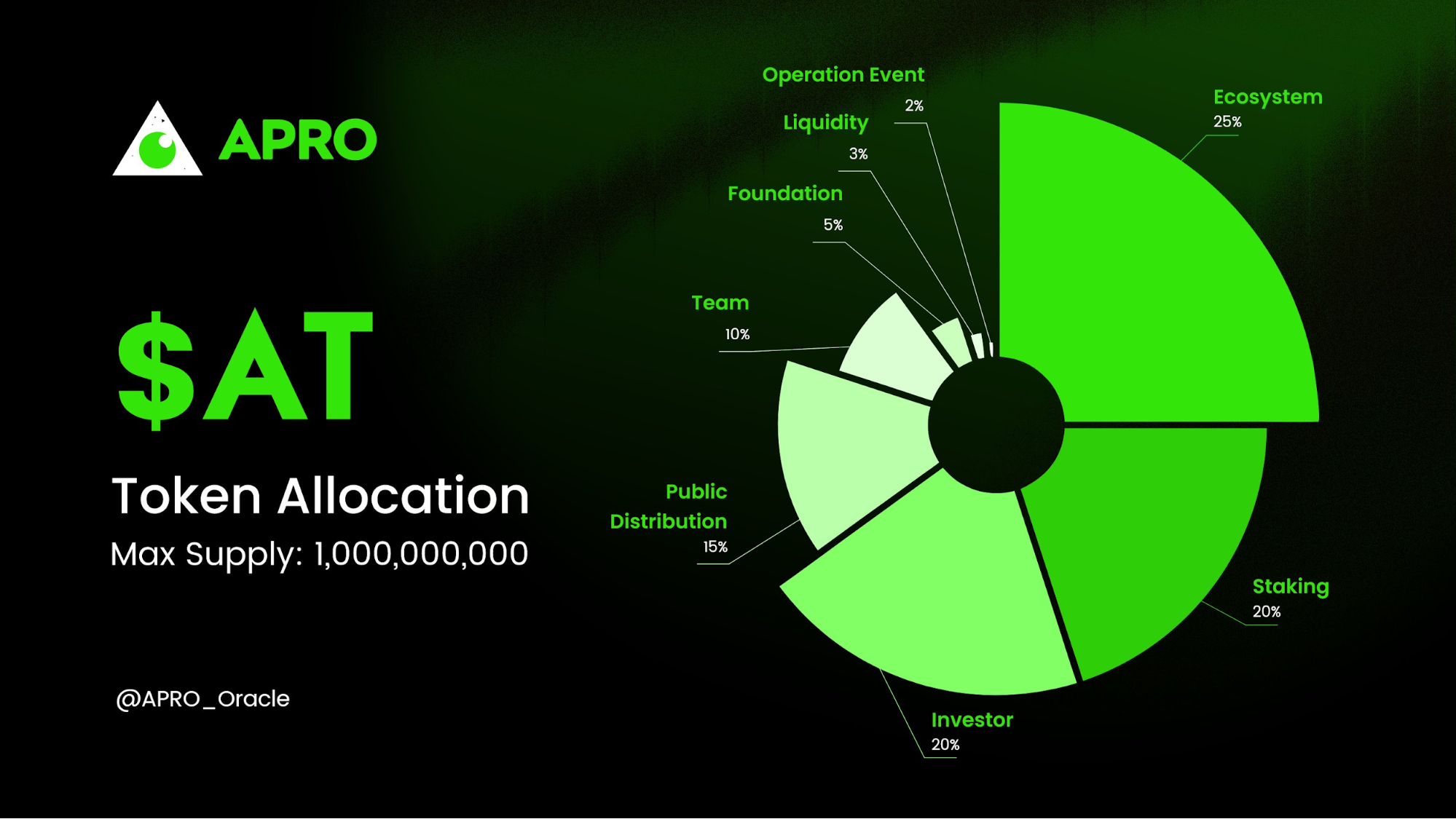
Official token economic data shows that AT has a maximum supply of 1 billion tokens. AT’s allocation structure is mainly built around ecosystem expansion, node incentives, and long term protocol development.
APRO’s token allocation focuses on maintaining network operations and ecosystem growth. Oracle networks need to attract nodes, developers, and partner protocols over the long term, so ecosystem development takes a relatively large share.
The table below shows the officially disclosed AT token allocation structure:
| Allocation Category |
Share |
| Ecosystem development |
25% |
| Staking incentives |
20% |
| Investors |
20% |
| Public distribution |
15% |
| Team |
10% |
| Foundation |
5% |
| Liquidity |
3% |
| Operations and campaigns |
2% |
Ecosystem development has the largest allocation, which shows that APRO places greater emphasis on long term network expansion. The staking incentives portion is mainly used for node rewards and network security maintenance.
The investor and team portions affect the protocol’s early development resources, while the foundation and liquidity modules are more focused on long term operations and market stability support.
Official materials have not yet fully disclosed all unlocking schedules, real time circulating supply, or detailed release timelines, so the future circulating structure should be based on official updates.
What Are AT’s Use Cases?
AT’s main use cases are concentrated in node services, data requests, governance voting, and ecosystem collaboration. Different on-chain applications interact with APRO’s data network.
DeFi protocols are one of AT’s main use cases. Lending protocols, stablecoin systems, and on-chain derivatives usually require real time price data, so the APRO network continuously processes external data requests.
APRO’s cross chain verification system also needs to use AT. First, a cross chain protocol submits a verification request. Then nodes read the source chain state. Next, the APRO network completes data aggregation and verification. Finally, the verification result is submitted to the target chain.
The AT token can also be used for network governance and ecosystem incentives. Some ecosystem partnerships may need AT to coordinate node services and data request costs, making AT an important part of APRO’s business model.
Unlike traditional API services, APRO places greater emphasis on on-chain data reliability. The AT token runs through data verification, node operations, and governance processes, so APRO’s operating efficiency is directly connected to its token model.
Conclusion
The AT token is the core utility asset of the APRO oracle network. It mainly supports node staking, data verification, governance voting, and reward distribution. Through the AT token, APRO coordinates node behavior and builds a decentralized data verification system.
APRO’s operating logic is built around node collaboration and economic incentives. Nodes must stake AT to participate in validation tasks, while the reward and penalty mechanism affects data reliability and network security.
Overall, AT is not just a payment medium. It also provides security constraints, governance coordination, and ecosystem expansion functions within the APRO network.
FAQs
What Does the AT Token Do?
The AT token is mainly used for node staking, data verification, governance voting, and reward distribution in the APRO network. AT directly affects the security mechanism and node incentive system of the APRO oracle network.
Why Do Nodes Need to Stake AT?
Nodes in the APRO network need to stake AT before participating in the data verification process. The staking mechanism can restrict malicious node behavior and improve the reliability of off chain data verification.
How Does AT Participate in APRO Governance?
AT holders can participate in APRO network governance voting, including governance matters such as protocol parameter adjustments, node rule changes, and protocol upgrades. AT holdings usually affect governance weight.
How Does APRO’s Reward Mechanism Work?
The APRO network distributes AT rewards based on the quality of a node’s data service. After nodes complete data retrieval, verification, and aggregation, the system issues rewards based on contribution.
What Is AT’s Maximum Supply?
Official token economic data shows that AT has a maximum supply of 1,000,000,000 tokens.
How Is the AT Token Allocated?
The officially disclosed allocation structure includes ecosystem development, staking incentives, investors, public distribution, team, foundation, liquidity, and operations and campaigns. Ecosystem development has the largest share at 25%.







