Why Understanding Derivatives Trading Risk Matters
 (Source: AFX_XYZ)
The on-chain derivatives market has experienced explosive growth in recent years. A growing number of traders are migrating from spot markets to perpetual contracts, seeking to maximize capital efficiency through leverage or capitalize on two-way trading strategies across different market conditions. However, derivatives trading differs fundamentally from spot trading. In spot markets, price fluctuations don't result in realized losses unless you sell. In perpetual contracts, price movements directly impact margin levels and can trigger forced liquidations.
AFX is designed to create a more efficient trading environment. But as infrastructure tailored for the derivatives market, its users must contend with the inherent risks of derivatives themselves. Before diving into AFX's technical advantages, it's essential to understand the challenges and limitations it may face.
The Risks of High-Leverage Trading
 (Source: AFX_XYZ)
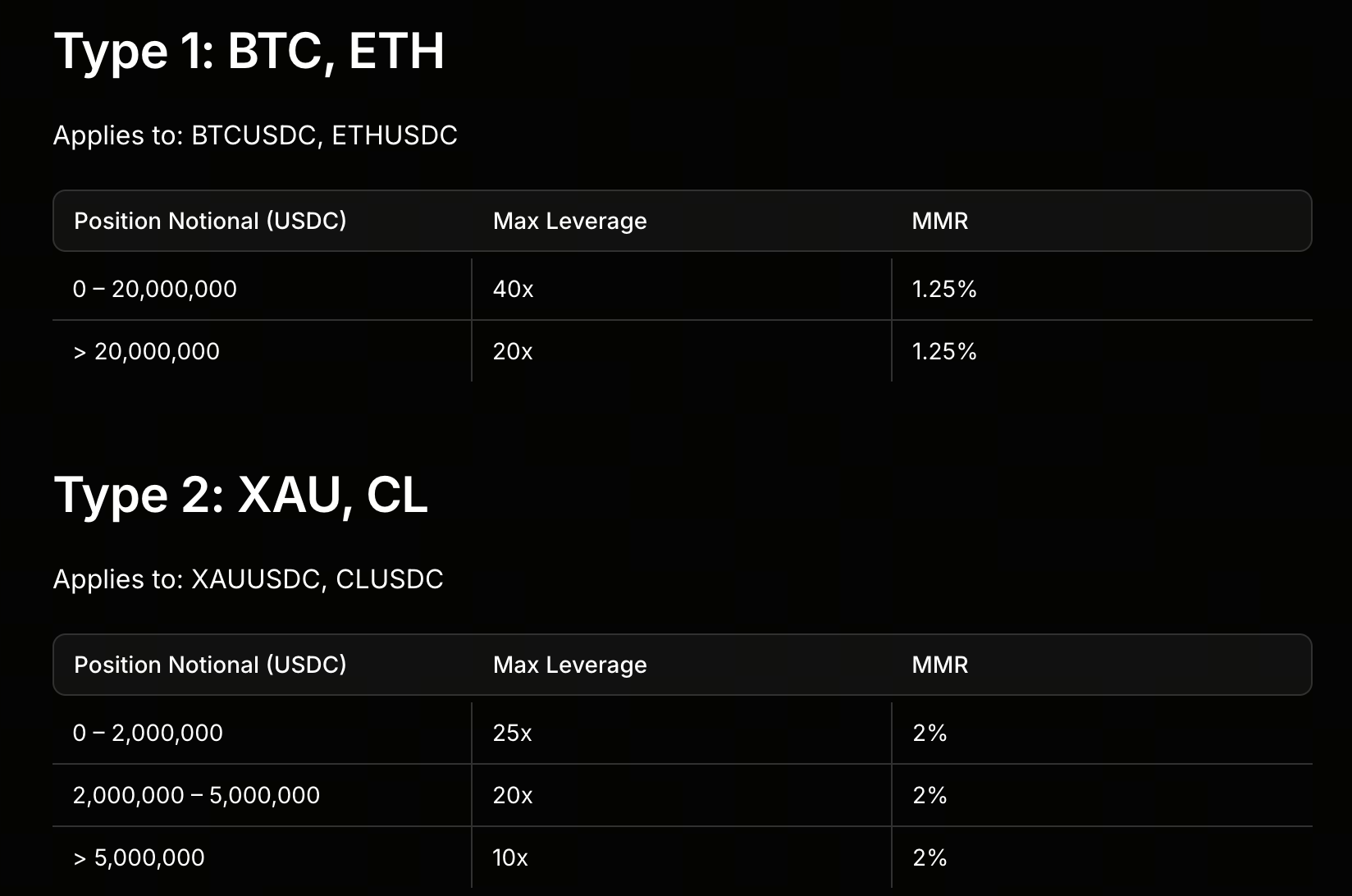
AFX supports leverage up to 40x. For seasoned traders, leverage boosts capital efficiency, allowing smaller principal to control larger positions. Yet leverage is a double-edged sword: while it amplifies potential gains, it equally magnifies losses. In volatile markets, even a slight adverse price movement can rapidly erode margin.
If account maintenance margin falls below the threshold, the system may trigger forced liquidation. This risk is especially acute in cryptocurrency markets, where price swings far exceed those of traditional finance. Risk management is paramount in high-leverage environments. Even the fastest execution can't eliminate the risk of market price movements.
Liquidity Shortages Can Hurt the Trading Experience
Every trading market depends on liquidity. Higher liquidity means traders can execute orders close to market prices; lower liquidity leads to wider slippage and slower fills. AFX aspires to build a professional derivatives venue, but as a relatively new Layer 1 network, its liquidity pool will take time to develop.
Compared to large centralized exchanges, emerging markets often suffer from fewer participants, shallower order books, and thinner order density. During extreme volatility, if buy-side and sell-side liquidity are insufficient, prices can swing dramatically. The scale of market participation is thus a critical factor for AFX's long-term success.
Technical Risks of an Emerging Layer 1 Network
AFX uses an independent Layer 1 architecture, offering higher performance and lower latency. However, it also requires its own security mechanisms, validator network, and ecosystem. Unlike established blockchains with years of proven operation, new chains must undergo extensive market validation.
Every blockchain system faces potential challenges:
- Software vulnerabilities
- Smart contract risks
- Network stability issues
- Validator mechanism flaws
Even rigorous testing cannot guarantee flawless operation under all extreme conditions.
Technical maturity, therefore, remains a key metric when evaluating emerging blockchain projects.
Potential Challenges with the Zero Gas Model
Zero Gas is a standout feature of AFX. For users, eliminating gas fees reduces transaction costs and boosts the viability of high-frequency trading strategies. But from an economic perspective, a critical question arises: If users don't pay fees, who covers the network's operating costs?
Blockchain networks require resources for validation, data storage, and infrastructure maintenance. The Zero Gas model must rely on alternative revenue streams or incentive mechanisms to sustain the ecosystem. The long-term sustainability of such an economic model can only be verified through real market operations.
Systemic Risks Inherent in Perpetual Contracts
AFX's primary use case is perpetual contract trading, which carries inherently higher systemic risk than spot markets.
During extreme market events, the market may experience:
- Large-scale liquidations
- Rapid liquidity drain
- Insufficient margins
- Abnormal funding rate fluctuations
When many traders are liquidated simultaneously, price moves can cascade and amplify.
This has occurred on both centralized and decentralized platforms in the past. Even with a more advanced trading architecture, AFX cannot completely avoid the cyclical risks endemic to derivatives markets.
Can MEV Protection Fully Solve the Problem?
AFX emphasizes its protocol-level MEV protection. MEV (Maximal Extractable Value) has long been a major concern in DeFi, where participants can extract value through front-running and sandwich attacks.
AFX aims to mitigate these issues via a dedicated execution environment. However, MEV is not merely a technical bug; it's a phenomenon deeply tied to market structure. New architectures may reduce some problems, but the market must continuously evaluate real-world effectiveness. For traders, MEV risk can be lowered but may never be fully eliminated.
AFX adopts a community-driven strategy, emphasizing concepts like Revenue Pass-through and profit-sharing. This model can boost engagement and give users a direct stake in ecosystem growth. But it also introduces long-term governance challenges.
As markets cycle through different phases, community activity, governance efficiency, and incentive structures must remain robust to ensure ecosystem stability. Beyond technology, community governance is a key factor in assessing a project's long-term competitiveness.
Market Competition Pressure on AFX
The on-chain derivatives market is growing fast, but so is competition. Many mature platforms already exist, including protocols focused on perpetual contracts, on-chain order books, and derivatives trading. AFX must translate technical advantages into real users and trading volume.
For any trading platform, true competitiveness hinges on liquidity, market depth, user experience, and ecosystem scale—not just technical specs. Whether AFX can attract sufficient traders and institutional participation is a critical metric for the market to watch.
How to Assess AFX's Risks and Opportunities
From an industry perspective, AFX targets a rapidly expanding market. As on-chain derivatives scale up, the demand for low-latency, high-throughput, and professional trading infrastructure continues to grow—exactly the problem AFX aims to solve.
Any new financial infrastructure requires time to prove itself. Beyond technological innovation, liquidity building, ecosystem development, user growth, and market cycles will shape AFX's trajectory. Its risks are not limited to technology but also include market competition and industry uncertainties.
Summary
AFX aims to deliver a centralized-exchange-like experience for on-chain derivatives, improving on traditional DeFi through high-speed execution, a Zero Gas model, and a professional trading architecture. However, as an emerging Layer 1 network focused on perpetual contracts, it must navigate leverage risk, liquidity challenges, technical maturity, and market competition. As the on-chain derivatives market continues to evolve, whether AFX can establish a stable, scalable trading ecosystem will be the key to unlocking its long-term potential.







