As AI Agents become an important direction for the blockchain industry, more projects are exploring how artificial intelligence can be combined with crypto networks. However, different projects do not define AI Agents in exactly the same way. Some focus on how Agents participate in financial activities, while others focus on how Agents can become independent digital entities.
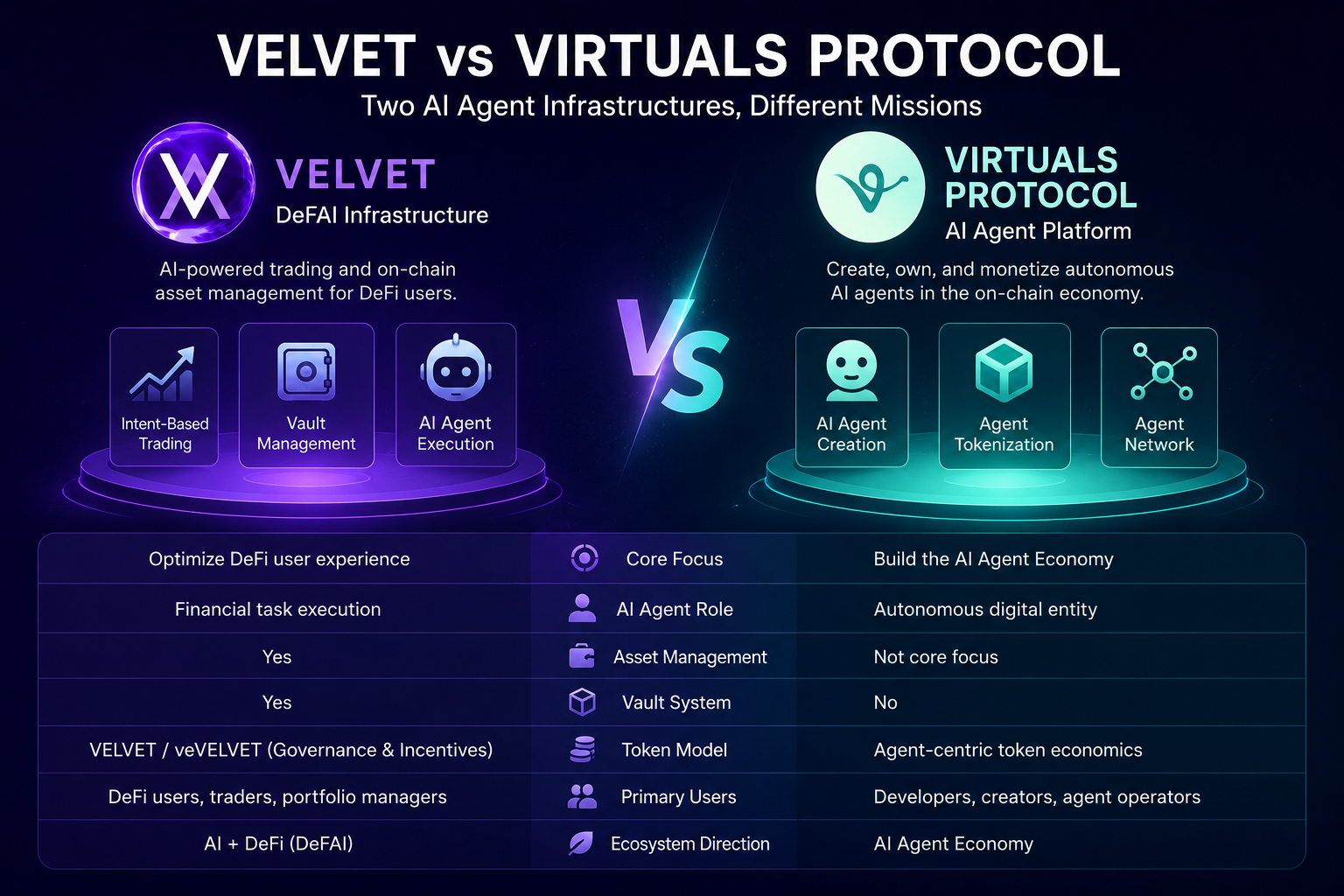
In today’s AI Agent sector, Velvet and Virtuals Protocol are both representative infrastructure projects. Both use AI technology to enhance on-chain applications, but their target markets, product design, and ecosystem structures are clearly different.
What Is Velvet?
Velvet is an infrastructure platform for the DeFAI sector. It simplifies the process of participating in DeFi through AI Agents, Intent-Based Trading, and on-chain asset management tools.
Velvet’s core idea is to let users complete on-chain activities by expressing goals rather than manually executing operations. For example, a user can directly state that they want a certain asset allocation or wish to execute a specific investment strategy, while the system is responsible for finding the best execution path and completing the related operations.
In addition to trade execution capabilities, Velvet also provides a Vault asset management system, allowing users to create and manage on-chain portfolios. As a result, Velvet is closer to a financial operating system that combines AI with asset management capabilities.
What Is Virtuals Protocol?
Virtuals Protocol is an open platform built around AI Agents, designed to help developers create, deploy, manage, and commercialize autonomous AI Agents.
Virtuals’ core goal is to make AI Agents independent participants in on-chain economic activity. Developers can not only create Agents, but also give them economic properties through tokenization mechanisms, enabling them to operate continuously and capture value.
Unlike traditional chatbots, Virtuals Protocol aims to build digital entities with identity, memory, behavioral logic, and economic incentives. This makes it closer to AI Agent ecosystem infrastructure than a simple AI application platform.
How Do Their Product Positions Differ?
The most fundamental difference between Velvet and Virtuals lies in product positioning.
Velvet mainly serves DeFi users. Its core task is to help users complete trades, allocate assets, and manage portfolios. In Velvet, AI Agents act as execution tools and intelligent assistants, with the goal of improving the efficiency of financial operations.
Virtuals Protocol treats AI Agents themselves as the core product. The platform focuses on how to create and operate Agents, rather than helping users complete a specific financial task. For Virtuals, Agents are the main participants in the ecosystem, not supporting tools.
Therefore, Velvet’s core question is “How can users use DeFi more easily?” while Virtuals’ core question is “How can AI Agents become independent economic entities?”
How Do Their AI Agent Architectures Differ?
Velvet’s AI architecture is built around task execution logic.
After a user expresses a goal, the AI Agent interprets the request, analyzes market conditions, and coordinates the subsequent execution process. The Agent’s responsibilities mainly revolve around trade optimization, asset management, and strategy execution.
Virtuals Protocol’s Agent architecture places greater emphasis on autonomy and persistence. A Virtual Agent can have an independent identity, long-term memory, and the ability to interact with the external environment.
This difference means Velvet’s Agents are more like financial assistants, while Virtuals’ Agents are more like digital characters that can exist over the long term and participate in economic activity.
How Do They Handle On-Chain Asset Management?
Asset management is one of the areas where the difference between the two is most obvious.
Velvet has built a complete Vault system that allows users to create portfolios, manage asset allocation, and participate in shared investment strategies. Asset management capability itself is an important part of the platform.
In the Velvet ecosystem, Intent-Based Trading and the Vault system together form the asset management framework. Users can not only complete trades, but also manage portfolios over the long term.
Virtuals Protocol does not take asset management as its core objective. Although Agents can participate in on-chain activities, the platform’s focus remains on creating and operating Agents, not managing investment portfolios. As a result, Virtuals has not developed an asset management system similar to Velvet Vault.
How Do Their Token Models Differ?
Velvet’s token economy mainly revolves around protocol governance and ecosystem incentives.
The VELVET token is used for governance participation, incentive distribution, and access to veVELVET rights. Its design logic is similar to many DeFi protocols, with an emphasis on supporting long-term ecosystem development and community governance.
Virtuals Protocol’s token system places more emphasis on the Agent economy model. The platform allows AI Agents to be tied to tokens, giving Agents the ability to conduct independent economic activity.
This model means Virtuals focuses more on value creation and value capture by AI Agents, while Velvet focuses more on the governance and operation of the protocol itself.
Which User Groups Are They Best Suited For?
Velvet is better suited for users interested in DeFi and asset management.
For users who want to simplify trading processes, optimize asset allocation, or use AI to improve portfolio management efficiency, Velvet provides a more direct solution.
Virtuals Protocol is better suited for AI Agent developers, Agent operators, and teams exploring Agent economic models.
For developers who want to build autonomous digital characters, design Agent business models, or study AI Agent network effects, Virtuals provides more complete infrastructure.
How Do the Ecosystem Development Directions of Velvet and Virtuals Protocol Differ?
Velvet’s ecosystem development direction is centered on DeFAI.
The platform continues to expand the capabilities of AI Agents in trade execution, portfolio management, and on-chain financial automation, with the goal of lowering the barrier to DeFi usage and improving asset management efficiency.
Virtuals Protocol focuses on the Agent Economy. The platform aims to build an ecosystem made up of large numbers of autonomous Agents, enabling Agents to have identities, income sources, and independent operating capabilities.
Therefore, although both belong to the AI Agent sector, they actually serve different markets.
Velvet vs Virtuals Protocol Comparison
| Comparison Dimension |
Velvet |
Virtuals Protocol |
| Core positioning |
DeFAI infrastructure |
AI Agent infrastructure |
| Main goal |
Improve the DeFi user experience |
Create and operate AI Agents |
| AI Agent role |
Financial execution tool |
Independent digital entity |
| Intent-Based Trading |
Supported |
Not a core feature |
| Asset management capability |
Strong |
Relatively weak |
| Vault system |
Supported |
Not provided |
| Agent tokenization |
Not a core direction |
One of the core features |
| Main users |
DeFi users and asset managers |
Agent developers and operators |
| Ecosystem focus |
AI-driven financial services |
Agent Economy |
Conclusion
Although Velvet and Virtuals Protocol both belong to the AI Agent sector, they solve completely different problems. Velvet focuses on DeFAI, using Intent-Based Trading, AI Agents, and the Vault system to help users manage assets and execute on-chain financial activities. Virtuals Protocol focuses on the Agent Economy, building an ecosystem of autonomous digital entities through the creation, deployment, and tokenization of AI Agents. At its core, Velvet is closer to AI-driven financial infrastructure, while Virtuals Protocol is closer to an operating system and economic network for AI Agents.
FAQs
What Are Velvet’s Core Features?
Velvet’s core features include Intent-Based Trading, AI Agent-assisted execution, and the Vault portfolio management system, all aimed at improving the DeFi user experience.
What Are Virtuals Protocol’s Core Features?
Virtuals Protocol mainly provides infrastructure for creating, deploying, tokenizing, and operating AI Agents, allowing Agents to participate in on-chain activity as independent digital entities.
Does Velvet Support AI Agents?
Velvet uses AI Agents as financial task execution tools, helping interpret user intent, optimize trading paths, and support asset management.
Does Virtuals Protocol Provide Asset Management Features?
Virtuals Protocol does not focus on asset management. Its emphasis is on building the AI Agent ecosystem, so it does not offer a complete portfolio management system similar to Velvet Vault.
For users who want to participate in on-chain trading, asset allocation, and portfolio management, Velvet’s features are a stronger fit. Virtuals Protocol is better suited for users focused on AI Agent development and operation.







