With the development of stablecoins and digital asset trading infrastructure, some platforms now connect crypto balances with traditional financial market products. Gate stock trading service allows eligible users to trade stocks and ETFs using USDT within the platform.
What does it mean to buy US stocks with USDT?
Buying US stocks with USDT means using Tether, a US dollar-pegged stablecoin, as the asset used to fund stock or ETF purchases instead of depositing fiat currency directly through a bank.
On Gate, users can learn the basic process through the official guide, How to Buy U.S. Stocks with USDT. Gate also describes its stock trading service as a way for users to trade stocks and ETFs using USDT inside the platform, subject to eligibility and account rules.
This does not mean every “US stock” product on a crypto platform has the same structure. Some products may be real stock trading services, while others may be CFDs, stock tokens, or other synthetic exposure products.
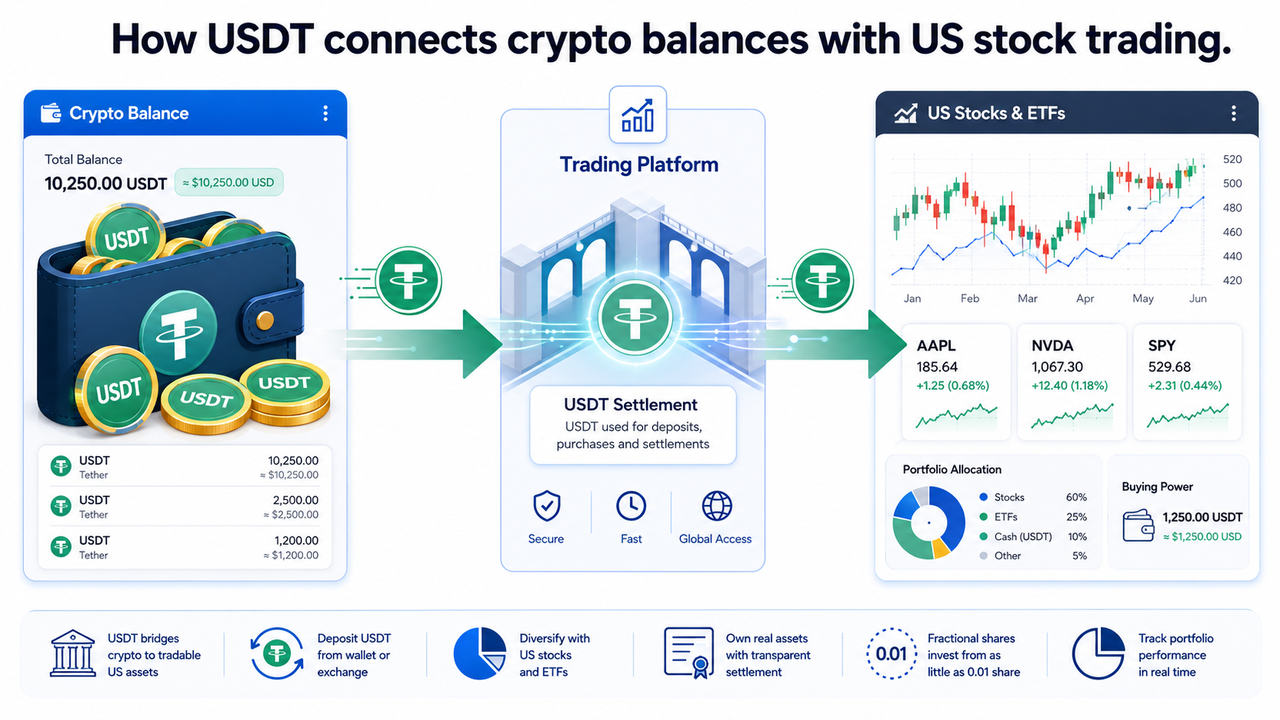
Why use cryptocurrency to buy US stocks?
Cryptocurrency is used to buy US stocks mainly because stablecoins can act as a bridge between digital asset accounts and traditional financial assets.
For users who already hold crypto assets, USDT-based stock trading may reduce the number of operational steps. Instead of converting crypto into fiat, withdrawing to a bank, and funding a separate brokerage account, users may be able to move USDT into a supported stock trading account.
Common reasons users consider this model include:
Stablecoin settlement USDT is commonly used as a dollar-denominated settlement asset in crypto markets. This makes it a practical funding asset for services linked to US dollar markets.
Cross-market access A single platform interface may allow users to view crypto assets, US stocks, ETFs, and related market products in one environment.
Reduced fiat conversion steps Users who already hold USDT may not need to complete a separate fiat deposit flow before accessing supported US stock products.
Portfolio diversification US stocks and ETFs belong to a different asset category from cryptocurrencies. However, diversification does not remove market risk.
What should users prepare before buying US stocks with USDT on Gate?
Before buying US stocks with USDT on Gate, users should prepare an eligible account, complete identity verification, understand the stock trading interface, and hold sufficient USDT.
Gate’s KYC identity verification FAQ states that identity verification is required for core platform functions such as deposits, withdrawals, fiat trading, and other services.
A practical preparation list includes:
Gate account access Users need a registered Gate account and access to a Gate interface where the stock trading function is available.
Identity verification KYC should be completed before attempting to use trading, deposit, withdrawal, or account services that require verification.
USDT balance Users need USDT in a supported account before transferring funds into the stock trading account.
Dedicated stock account USDT may need to be transferred from a spot or unified account into the stock account before stock orders can be placed.
Basic market knowledge Users should understand stock tickers, ETFs, trading hours, order execution, bid-ask spreads, and market volatility.
How to buy US stocks with USDT on Gate: step-by-step tutorial
Buying US stocks with USDT on Gate generally follows four steps: prepare USDT, enter the stock trading page, transfer funds to the stock account, and place a buy order during supported trading hours.
A typical workflow is:
-
Hold or acquire USDT in a Gate account.
-
Enter the stock trading area through the Gate interface.
-
Transfer USDT into the stock account.
-
Search for a US stock or ETF.
-
Place a buy order during supported market hours.
-
Review the filled order and updated position.
Gate’s official USDT stock buying guide provides the platform-specific educational explanation for this process.
How to deposit or convert cryptocurrency into USDT on Gate
To buy US stocks with USDT, users first need a USDT balance. This can be obtained by depositing USDT directly or converting another supported cryptocurrency into USDT.
A typical preparation path includes:
Deposit USDT directly Users who already hold USDT in another wallet or exchange account can deposit it to Gate through a supported network. The selected deposit network must match the withdrawal network used by the sending platform.
Convert crypto into USDT Users who hold assets such as BTC, ETH, or other supported cryptocurrencies may trade or convert them into USDT before using the stock trading function.
Check the account location After USDT arrives or is converted, users should confirm whether the balance is in the correct account category. Stock trading may require an internal transfer before orders can be submitted.
Review costs and network rules Crypto deposits, withdrawals, conversions, and trades may involve network fees, spreads, or trading fees. Gate’s fee page provides current platform fee information, while the order confirmation screen should be checked before each transaction.
How to search for US stocks or ETFs on Gate
Users can search for US stocks or ETFs on Gate by entering the stock name, ticker symbol, or asset category in the stock trading interface.
A user may search by:
Before placing an order, users should verify the ticker carefully. Many companies have similar names, and ETFs may track similar markets while using different strategies, holdings, and expense structures.
Gate’s stock trading service announcement describes the platform’s stock trading service as supporting stock and ETF trading with USDT.
How to place a buy order with USDT
To place a buy order with USDT, users select the stock or ETF, choose Buy, enter the order details, review the estimated cost, and submit the order during supported trading hours.
A careful order process includes:
Select the asset Confirm the ticker, asset name, and product type before entering an order.
Choose Buy Use the buy function in the stock trading interface.
Enter the order amount Input the supported quantity or USDT-denominated purchase amount shown by the interface.
Review estimated execution Check the displayed price, estimated order value, available USDT, and visible cost information.
Submit during supported hours US stock trading is usually tied to US market sessions. Nasdaq states that its regular trading hours are 9:30 a.m. to 4:00 p.m. Eastern Time, and NYSE lists its core trading session as 9:30 a.m. to 4:00 p.m. Eastern Time.
Confirm the filled position After execution, review the position quantity, average cost, market value, and unrealized profit or loss.
How to view, manage, or sell US stock positions
Users can view, manage, or sell US stock positions through the stock account or holdings page in the Gate interface.
After a buy order is filled, the position should appear in the user’s stock account. A position view generally shows the asset name, ticker, quantity, market value, cost reference, and unrealized profit or loss.
To manage a position, users should review:
Position size This shows how much of a stock or ETF the account holds.
Market value This reflects the estimated current value based on available market data.
Average cost This helps users understand the reference cost of the position.
Unrealized profit or loss This changes as the market price moves.
Sell function To exit a position, users select the asset, choose Sell, enter the amount, review the order, and submit it during supported trading hours.
Selling a stock position converts the position value back into the supported settlement balance in the stock account, subject to execution, fees, spread, and product rules.
What fees, trading hours, and order rules should users know?
Users should understand that fees, trading hours, and order rules can change, so the live Gate interface and official fee information should be treated as the operational reference.
Gate’s fee schedule provides platform fee information and may show account-specific rates after login.
Important rule categories include:
Trading hours US stock trading generally follows US market sessions. Regular Nasdaq and NYSE core trading hours are 9:30 a.m. to 4:00 p.m. Eastern Time on trading days, though holidays and early closes may affect availability. (Nasdaq)
Order type Users should check whether the interface supports market orders, limit orders, or other order types for the selected product and region.
Execution price A market order may execute at a price different from the last displayed price, especially during volatile periods or in less liquid securities.
Fees and spreads Users should review displayed fees, settlement costs, conversion costs, and possible spread before confirming an order.
Account transfer rules USDT may need to be transferred into a stock trading account before stock or ETF orders can be submitted.
What are the risks of using USDT to buy US stocks?
Using USDT to buy US stocks involves market risk, stablecoin risk, platform risk, execution risk, and regulatory risk.
Market risk US stocks and ETFs can rise or fall due to earnings, interest rates, economic data, sector changes, liquidity conditions, or company-specific events.
Stablecoin risk USDT is designed to track the US dollar, but stablecoins can face liquidity, reserve, redemption, counterparty, and regulatory risks.
Execution risk Market orders can execute at a worse price than expected. This risk can increase near market open or close, during high volatility, or in less liquid securities.
Product-structure risk Users should distinguish stock trading from CFDs, stock tokens, and other synthetic products. Gate also has separate information on stock tokens and tokenized stocks, which are not automatically the same as traditional stock brokerage products.
Regulatory and eligibility risk Availability may depend on user location, identity verification, and local rules. A feature available in one region may not be available in another.
Operational risk Wrong deposit networks, account transfer mistakes, weak password security, or loss of two-factor authentication access can create avoidable losses.
USDT stock trading vs traditional stock brokerage: what is different?
USDT stock trading and traditional stock brokerage differ mainly in funding method, account structure, settlement process, access route, and platform environment.
In a traditional brokerage account, users usually deposit fiat currency through a bank, complete securities account onboarding, and trade under the brokerage’s market access framework.
In USDT-based stock trading, users fund the stock trading account with a stablecoin balance. Gate’s official materials describe stock and ETF trading with USDT as part of its platform-based stock trading service.
Key differences include:
| Comparison Dimension |
Traditional Stock Brokerage |
USDT Stock Trading on Gate |
| Funding asset |
Usually uses fiat currency as the funding asset. |
Uses a stablecoin balance, such as USDT, as the funding asset. |
| Account environment |
Focuses mainly on securities trading and brokerage services. |
Combines crypto account infrastructure with access to stock market products. |
| Asset movement |
May require bank transfers or fiat deposit channels. |
May involve crypto deposits, crypto-to-USDT conversion, and internal account transfers. |
| Product structure |
Usually involves securities held through brokerage custody arrangements. |
May involve different product structures, including stock trading, CFDs, stock tokens, or tokenized stock products. Users should verify the product type before trading. |
| Risk profile |
Mainly involves stock market risk, brokerage risk, and custody-related considerations. |
Adds stablecoin, crypto-account, and platform-specific operational risks to ordinary stock market risks. |
Beginner checklist before buying US stocks with cryptocurrency
Before buying US stocks with cryptocurrency, beginners should review account readiness, product structure, costs, and risk controls.
Use the following checklist:
-
Complete identity verification through Gate’s KYC process.
-
Confirm regional eligibility.
-
Secure the account with two-factor authentication.
-
Hold or convert sufficient USDT.
-
Transfer USDT into the relevant stock trading account.
-
Search for the correct stock or ETF ticker.
-
Confirm whether the product is a stock, ETF, CFD, stock token, or tokenized asset.
-
Check live trading hours.
-
Review order type, estimated price, fees, and spread.
-
Avoid placing orders based only on short-term price movement.
-
Understand that USDT and stocks both carry risks.
-
Keep records for tax and reporting purposes where applicable.
A beginner should understand the trading mechanism before focusing on individual stock selection. Operational clarity is part of basic risk management.
Summary
Buying US stocks with USDT on Gate is a cross-market trading process that uses a stablecoin balance to access supported US stock and ETF products.
The core workflow is straightforward: prepare USDT, complete identity verification, enter the stock trading interface, transfer USDT into the relevant account, search for a stock or ETF, and place a buy order during supported trading hours.
The concept is important because it shows how stablecoins can connect crypto accounts with traditional financial market exposure. However, users should not treat convenience as a substitute for due diligence. Product structure, trading rules, fees, execution quality, regional eligibility, and stablecoin risks should all be understood before trading.
FAQs
Can I buy US stocks directly with USDT on Gate?
Gate states that its stock trading service allows eligible users to trade stocks and ETFs using USDT within the platform. Users can refer to the official Gate USDT stock trading guide for the educational overview.
Do I need KYC before using Gate stock trading?
Yes. Gate’s KYC FAQ states that identity verification is required for key platform functions such as deposits and withdrawals.
Do I need USDT before placing a stock order?
Yes. USDT is the funding asset described in Gate’s stock trading materials. Users should confirm that the USDT balance is in the correct account before placing an order.
Can I trade US stocks on Gate 24/7?
Users should follow the trading hours shown in the Gate interface. Regular Nasdaq and NYSE core trading hours are 9:30 a.m. to 4:00 p.m. Eastern Time on trading days, but platform availability, holidays, and product rules may differ.
Is buying US stocks with USDT the same as buying tokenized stocks?
Not necessarily. Stock trading, stock tokens, tokenized stocks, and CFDs can have different structures. Gate provides separate pages for stock tokens and tokenized stocks, so users should check which product they are using.
Can USDT lose value?
USDT is designed to track the US dollar, but stablecoins can still face liquidity, reserve, redemption, counterparty, and regulatory risks.
Are ETFs available through Gate stock trading?
Gate describes its stock trading service as supporting stocks and ETFs using USDT. Availability may depend on account status, region, and current platform rules.







