What distinguishes U.S. stock CFDs, ETF CFDs, and actual stocks? Gain a comprehensive understanding of the three asset structures and their trading logic.

Last Updated 2026-05-28 06:35:31
Reading Time: 2m
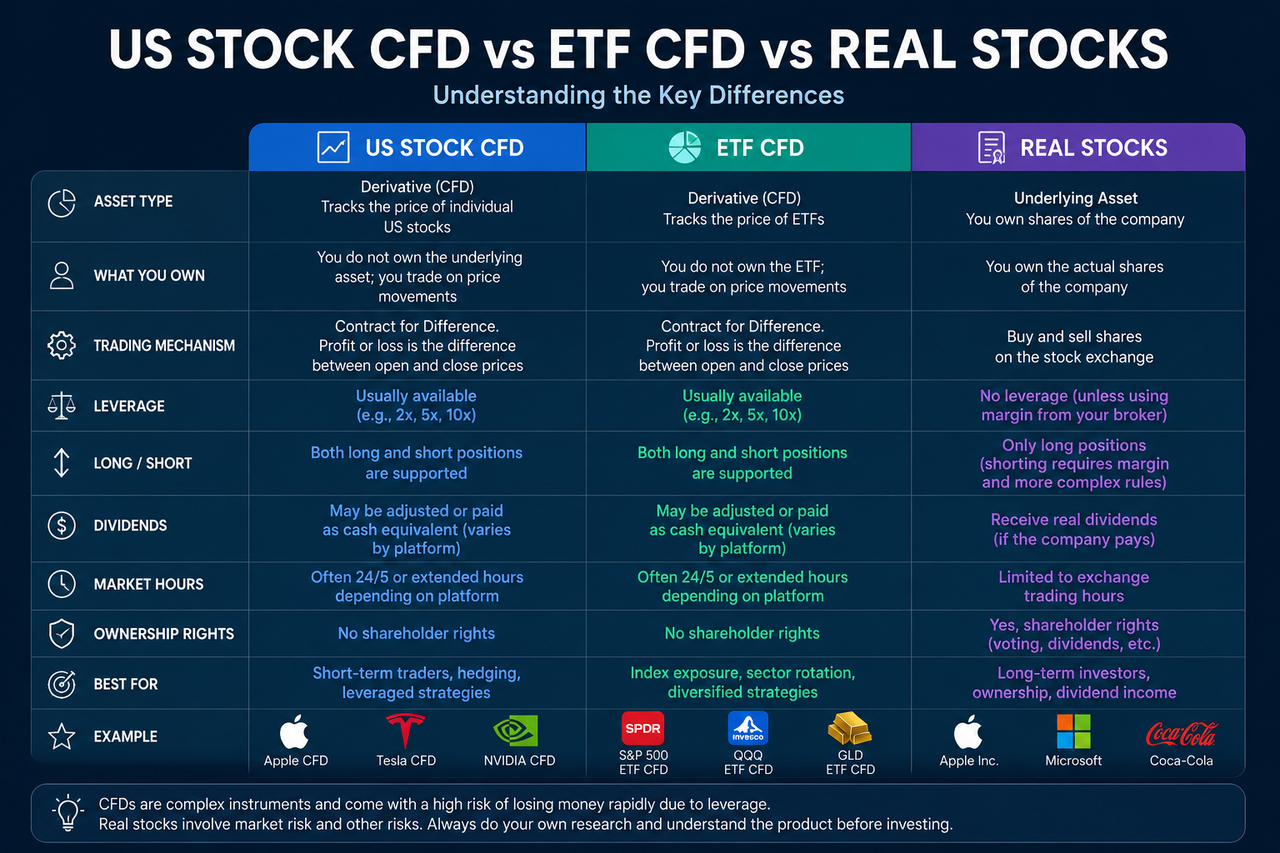
US stock CFDs, ETF CFDs, and real stocks all offer investors exposure to the US capital market, but they differ significantly in asset ownership, trading structure, risk mechanisms, and use cases. Real stocks represent actual equity ownership in a company, typically providing shareholder rights and long-term holding benefits. In contrast, stock and ETF CFDs are price derivatives—users trade the price fluctuations of the underlying asset rather than the actual securities. CFDs generally support leverage and two-way trading, making them better suited for short-to-medium-term trading strategies.

Historically, most investors purchased real stocks and ETFs directly through traditional brokerages. But with crypto platforms expanding their TradFi offerings and global demand for US equities surging, more users are now turning to Stock CFDs, ETF CFDs, and on-chain asset structures.

Meanwhile, the rise of stablecoins and RWAs (Real World Assets) is reshaping how global assets are traded. Today, investors can not only buy Apple, NVIDIA, or S&P 500 ETFs through traditional brokerages, but also trade these assets using USDT on crypto platforms.

US Stock CFDs vs ETF CFDs vs Real Stocks

What Are Real Stocks?

Real stocks represent partial ownership in a listed company. For instance, buying Apple or Microsoft shares through a brokerage means you hold actual equity in those companies.

Key characteristics of real stocks:

  • Shareholder rights
  • Potential dividends
  • Voting rights (in some markets)
  • Suited for long-term holding
  • Traded via traditional securities accounts

For long-term investors, real stocks serve as a classic asset allocation vehicle.

However, trading real stocks typically involves brokerage accounts, bank settlement, and exchange trading hours, which can create a higher barrier to cross-border investing.

What Are US Stock CFDs?

US Stock CFDs (Contracts for Difference) are derivatives that let you trade stock price movements without owning the underlying shares.

For example, you can trade CFDs on:

  • Apple (AAPL)
  • NVIDIA (NVDA)
  • Tesla (TSLA)
  • Amazon (AMZN)

In a CFD setup, you and the platform settle the price difference—not the stock itself. So stock CFDs are about price speculation, not equity ownership.

Because CFDs often support leverage and short selling, they appeal to short- to medium-term traders.

What Are ETF CFDs?

ETF CFDs work like stock CFDs, but the underlying assets are ETFs (Exchange-Traded Funds) instead of single stocks.

Examples of ETF CFDs:

  • S&P 500 ETF
  • Nasdaq ETF
  • Gold ETF
  • Energy ETF

The core idea is the same: trade price movements, not actual ETF shares.

Since ETFs are inherently diversified, ETF CFDs are commonly used for index trading and gaining macro market exposure.

What Are the Biggest Differences Between US Stock CFDs, ETF CFDs, and Real Stocks?

The key difference is asset ownership.

Real stocks give you actual ownership of a security, while CFDs are price derivatives.

This distinction affects:

  • Shareholder rights
  • Voting rights
  • Dividend structure
  • Leverage mechanics
  • Risk profile
  • Trading approach

Essentially, real stocks are about long-term ownership; CFDs are short-term price trading tools.

How Do ETF CFDs Differ From Stock CFDs?

Both are CFDs, but their different underlying assets lead to different use cases.

Stock CFDs track a single company’s price, so volatility is more concentrated. For example, NVIDIA or Tesla prices can swing on earnings, AI news, or sector developments.

ETF CFDs follow an index or portfolio. For instance, S&P 500 ETFs reflect the broader market, so volatility tends to be more diversified.

In short:

  • Stock CFDs: focused on individual stocks
  • ETF CFDs: aimed at broader market allocation

That’s why many traders use ETF CFDs for macro-level market exposure.

How Do Risks Differ Among US Stock CFDs, ETF CFDs, and Real Stocks?

Real stocks, stock CFDs, and ETF CFDs each have distinct risk structures.

Real stocks carry company-specific and market risks, but typically no forced leverage.

CFDs are different. Because many CFDs support leverage, market moves can amplify both gains and losses. Also, CFDs don’t represent actual ownership, so you miss out on traditional securities benefits.

ETF CFDs offer some diversification, but their leverage can still magnify risk.

So before trading, understanding the product structure is more critical than just watching prices.

Summary

US stock CFDs, ETF CFDs, and real stocks all provide exposure to US capital markets, but they differ fundamentally in ownership, trading mechanics, and risk.

Real stocks suit long-term holding and equity investment; stock CFDs emphasize price trading and leverage; ETF CFDs are ideal for index and macro market allocation.

FAQs

Are stock CFDs the same as real stocks?

No. Stock CFDs are price derivatives—you trade price fluctuations, not actual shares.

What's the difference between ETF CFDs and ETFs?

ETF CFDs are contracts for difference on ETF prices—they don't represent ownership in the ETF.

Why do crypto platforms offer CFDs more often?

Because CFDs integrate easily with existing crypto derivatives systems, and support stablecoin margin and leveraged trading.

Can I receive dividends with CFDs?

Some CFD products may offer price adjustments or simulated dividends, but these are not equivalent to real stock dividends.

Are real stocks definitely safer than CFDs?

Their risk profiles differ. Real stocks lack leverage risk, while CFDs—with leverage—carry higher volatility risk.

Why are ETF CFDs better for index trading?

Because ETFs represent a basket of assets, ETF CFDs are ideal for trading overall markets or industry trends.

Author: Jayne
Disclaimer
* The information is not intended to be and does not constitute financial advice or any other recommendation of any sort offered or endorsed by Gate.
* This article may not be reproduced, transmitted or copied without referencing Gate. Contravention is an infringement of Copyright Act and may be subject to legal action.

Related Articles

How Does PAXG Work? In-Depth Overview of the Physical Gold Tokenization Mechanism
Beginner

How Does PAXG Work? In-Depth Overview of the Physical Gold Tokenization Mechanism

PAXG (Pax Gold) is a tokenized asset backed by physical gold, issued by the fintech company Paxos and traded on the Ethereum blockchain as an ERC-20 token. The core concept is to tokenize physical gold on-chain, with each PAXG token representing ownership of a certain amount of gold. This structure enables investors to hold and trade gold in the form of a digital asset.
2026-03-24 19:12:51
How is the price of PAXG determined? Pegging mechanism, trading depth, and influencing factors
Beginner

How is the price of PAXG determined? Pegging mechanism, trading depth, and influencing factors

PAXG (Pax Gold) is a tokenized asset backed by physical gold reserves, launched by fintech firm Paxos and issued as an ERC-20 token on the Ethereum blockchain. The core concept is to digitally represent real-world gold assets, allowing investors to hold and trade gold via the blockchain network. Because each PAXG token corresponds to a specific quantity of physical gold, its price is theoretically expected to closely track the global gold market.
2026-03-24 19:11:40
Gate Research: 2024 Cryptocurrency Market  Review and 2025 Trend Forecast
Advanced

Gate Research: 2024 Cryptocurrency Market Review and 2025 Trend Forecast

This report provides a comprehensive analysis of the past year's market performance and future development trends from four key perspectives: market overview, popular ecosystems, trending sectors, and future trend predictions. In 2024, the total cryptocurrency market capitalization reached an all-time high, with Bitcoin surpassing $100,000 for the first time. On-chain Real World Assets (RWA) and the artificial intelligence sector experienced rapid growth, becoming major drivers of market expansion. Additionally, the global regulatory landscape has gradually become clearer, laying a solid foundation for market development in 2025.
2026-03-24 11:56:16
What Are the Risks of TSLA? Understanding Tesla’s Competitive Landscape and Investment Challenges
Intermediate

What Are the Risks of TSLA? Understanding Tesla’s Competitive Landscape and Investment Challenges

The main investment risks of TSLA come from intensifying industry competition, pricing pressure, swings in profitability, and changes in market valuation. As one of the global leaders in the new energy vehicle industry, Tesla has strong brand and technology advantages, but it still faces mounting competition from both traditional automakers and emerging EV brands. When evaluating TSLA, investors should pay close attention to Tesla’s market share, margin trends, technological progress, and the broader market environment in order to form a more complete view of its long-term investment value and risk.
2026-04-21 06:59:56
GoldFinger Use Cases in DeFi: How Gold Assets Enter the On-chain Financial System
Beginner

GoldFinger Use Cases in DeFi: How Gold Assets Enter the On-chain Financial System

Through asset tokenization and a Proof of Reserve mechanism, GoldFinger brings gold into the DeFi ecosystem, allowing it to take part in on-chain financial activity as collateral, a liquidity tool, and a component of yield strategies. Once tokenized, gold assets such as ART can function as collateral, liquidity instruments, and building blocks in yield strategies across lending markets, decentralized exchanges, and structured returns, turning a traditional store of value into composable on-chain financial infrastructure.
2026-04-15 03:47:31
How Does GoldFinger Work? Gold Asset Tokenization, Proof of Reserve, and on-chain Circulation Explained
Beginner

How Does GoldFinger Work? Gold Asset Tokenization, Proof of Reserve, and on-chain Circulation Explained

GoldFinger operates through a process that includes asset custody, Proof of Reserve, token minting, and on-chain circulation. By placing physical gold within a compliant custody framework and mapping it on-chain through ART tokens, GoldFinger turns gold into a digital, programmable asset. At the same time, its Proof of Reserve mechanism ensures that on-chain tokens correspond to the underlying assets, supporting trading, collateralization, and redemption in DeFi scenarios.
2026-04-15 03:01:54