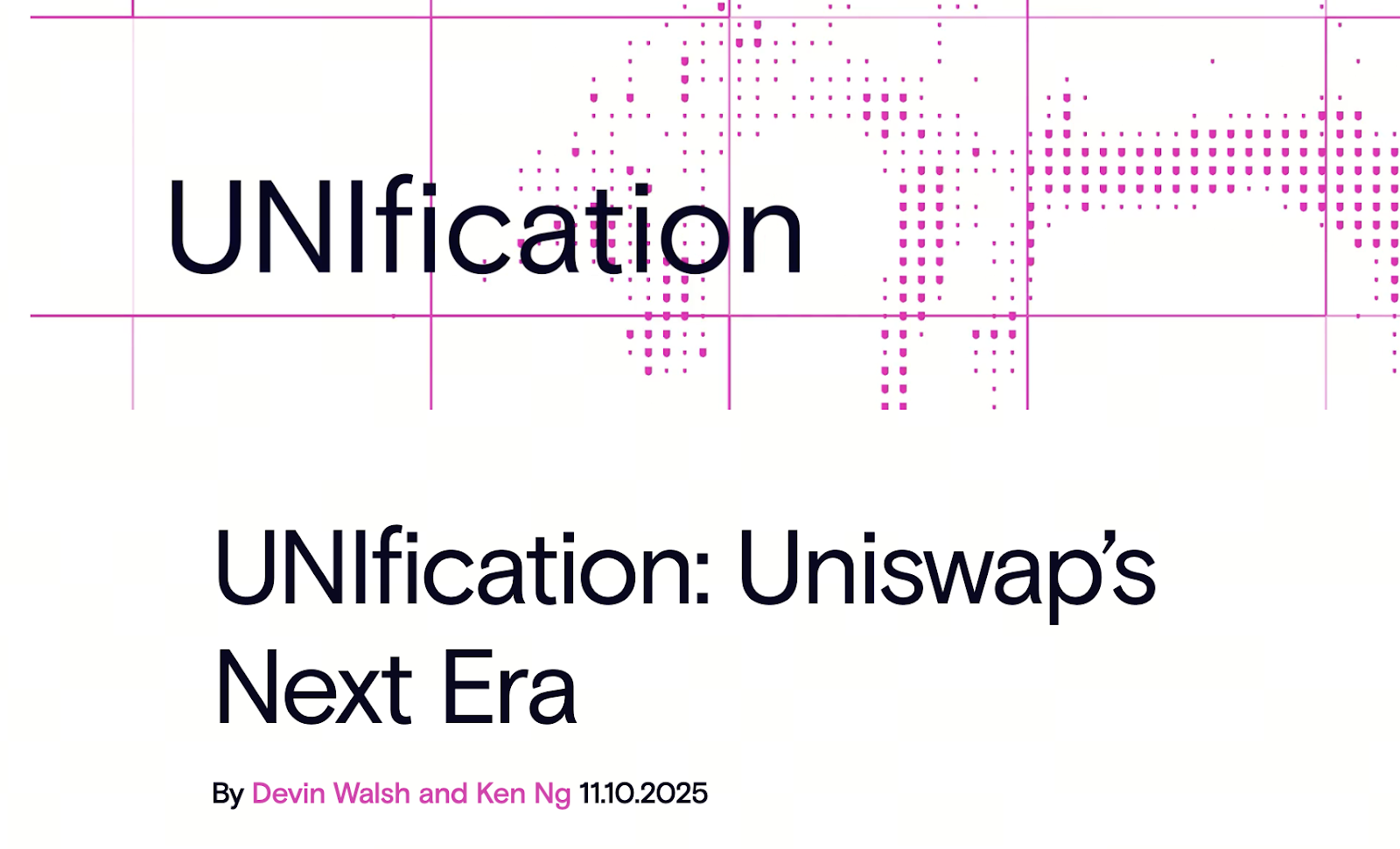
Uniswap Activates Protocol Fee Switch: A New Era for Decentralized Trading

Beginner
Quick Reads
Last Updated 2026-03-27 21:36:14
Reading Time: 1m
Uniswap has proposed activating protocol fees and standardizing ecosystem incentive mechanisms, triggering a surge in UNI prices and marking a structural upgrade for decentralized exchanges.


Image: https://www.uniswapfoundation.org/blog/unification

On November 11, 2025, Devin Walsh, Executive Director and Co-Founder of the Uniswap Foundation, together with Hayden Adams (Uniswap Founder), jointly submitted a governance proposal to enable protocol fees and standardize incentive mechanisms across the Uniswap ecosystem. This move is widely seen as a pivotal step for Uniswap in advancing as a decentralized exchange platform for tokenized value.

Overview of Uniswap’s Latest Proposal

This proposal seeks to activate the protocol fee function via governance voting, allowing the Uniswap protocol to collect a portion of trading fees dedicated to protocol development and ecosystem expansion. Additionally, the proposal aims to unify incentive mechanisms, enhancing transparency and fairness in yield calculations for liquidity providers across different pools.

Analysis of the Protocol Fees Mechanism

Protocol fees refer to a set percentage of each trade on Uniswap collected as a fee. These fees are deposited into the protocol fund and allocated for ecosystem development, R&D, and potentially buyback mechanisms. Previously, trading fees on Uniswap were distributed primarily to liquidity providers, with the protocol itself earning no direct revenue. With the introduction of protocol fees, the platform can generate self-sustaining revenue, enhancing its long-term viability.

Impact on Traders and Liquidity Providers

For traders, enabling protocol fees may result in a modest increase in transaction costs; however, this impact is expected to be limited and unlikely to significantly dampen trading activity. For liquidity providers, unified incentive mechanisms will make returns more transparent, reduce imbalances among pools, and strengthen incentives for long-term participation.

Significance of Unified Ecosystem Incentives

Standardizing ecosystem incentives means Uniswap will implement a consistent rewards structure throughout the protocol. Liquidity providers, regardless of the pool they participate in, will earn rewards based on the same criteria. This approach is designed to attract more users and capital, curb arbitrage activities, and foster a healthier, more resilient platform.

UNI Price Performance and Market Reaction
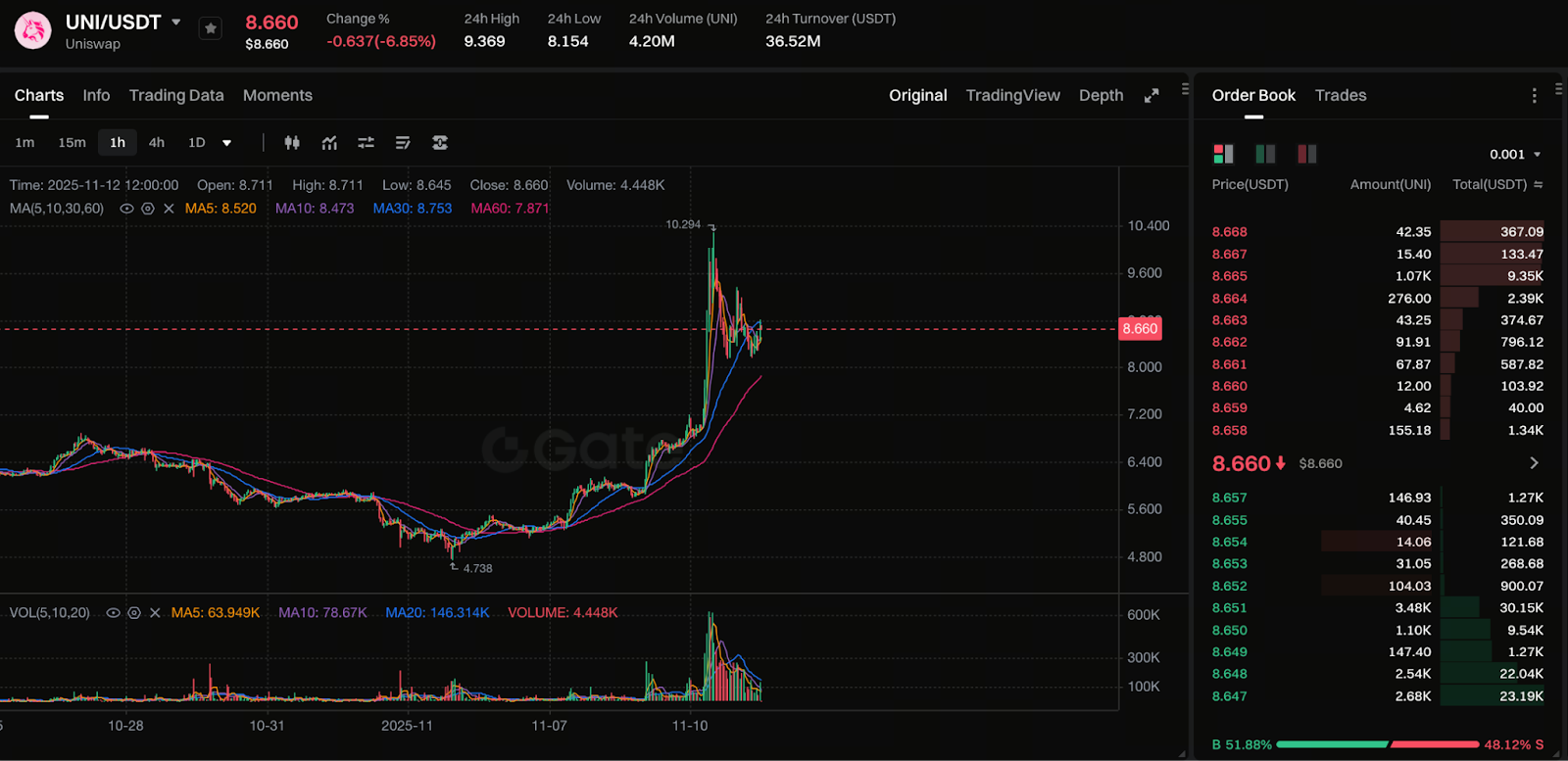

Image: https://www.gate.com/trade/UNI_USDT

Notably, UNI experienced a significant surge in market activity. According to multiple crypto news sources, UNI jumped more than 35%–40% within 24 hours after the proposal was announced, soaring from approximately $4.95 to around $9.70 in a short span. The rapid price movement underscores how closely investors are monitoring the proposal.

Investor Outlook and Strategies

From an investment standpoint, enabling protocol fees and standardizing ecosystem incentives could serve as key medium- and long-term drivers for UNI price appreciation. Investors should pay attention to:

  • Progress of governance voting and whether the proposal is approved
  • The specific implementation details and rates for protocol fees
  • Changes in liquidity provider participation
  • Shifts in UNI supply (such as planned token burns)

In the short term, price volatility may be pronounced due to market sentiment, but over the long term, these changes are expected to reinforce Uniswap’s competitiveness in the decentralized exchange space.

Conclusion

Uniswap’s latest governance proposal represents not just a protocol upgrade, but a major milestone in ecosystem development. By enabling protocol fees and unifying incentives, Uniswap aims to create a healthier environment for liquidity providers, traders, and the ecosystem at large—further solidifying its position as a leading decentralized exchange platform.

Author: Max
Disclaimer
* The information is not intended to be and does not constitute financial advice or any other recommendation of any sort offered or endorsed by Gate.
* This article may not be reproduced, transmitted or copied without referencing Gate. Contravention is an infringement of Copyright Act and may be subject to legal action.

Related Articles

What is Fartcoin? All You Need to Know About FARTCOIN
Intermediate

What is Fartcoin? All You Need to Know About FARTCOIN

Fartcoin (FARTCOIN) is a representative meme coin within the Solana ecosystem based on an AI-driven narrative. Its core concept originated from an experiment aimed at exploring the "boundaries between AI Agents and humor." More than just a digital asset with social attributes, the project deeply couples absurd humor culture with on-chain financial logic by integrating autonomous AI interaction models.
2026-04-04 22:01:19
Gold Price Forecast for the Next Five Years: 2026–2030 Trend Outlook and Investment Implications, Could It Reach $6,000?
Beginner

Gold Price Forecast for the Next Five Years: 2026–2030 Trend Outlook and Investment Implications, Could It Reach $6,000?

Analyze current gold price trends alongside authoritative five-year forecasts, integrating an evaluation of market risks and opportunities. This gives investors insight into the potential trajectory of gold prices and the main drivers expected to shape the market over the next five years.
2026-03-25 18:13:30
Aster vs Hyperliquid: Which Perp DEX Will Prevail?
Beginner

Aster vs Hyperliquid: Which Perp DEX Will Prevail?

Aster and Hyperliquid are the two representative protocols of the "purpose-built L1 path" within the current decentralized perpetual exchange (Perp DEX) sector. As a pioneer in the field, Hyperliquid has built a deep liquidity moat through its highly mature order book architecture and strong community consensus. Conversely, Aster, as a rising challenger, seeks to leapfrog the competition in high-performance trading through more aggressive multi-chain aggregation logic, private transaction modules, and an underlying execution environment optimized for 2026 market demands.
2026-03-24 11:58:33
AI-Native Settlement Layers: How United Stables Is Building the Next Financial Rail
Beginner

AI-Native Settlement Layers: How United Stables Is Building the Next Financial Rail

Stablecoins were originally designed as dollar substitutes within exchanges, primarily used for asset pricing and trade settlement. As on-chain financial ecosystems have matured, their role has expanded beyond simple payments to include collateral assets, cross-chain liquidity mediums, and unified settlement units. In particular, as AI systems and automated agents begin to participate directly in economic activity, demand has risen sharply for programmable value units capable of instant settlement. This shift is pushing stablecoins toward the role of foundational financial infrastructure.
2026-03-25 03:16:17
ASTER Tokenomics: Buybacks, Burns, and Staking as the Value Foundation of ASTER in 2026
Beginner

ASTER Tokenomics: Buybacks, Burns, and Staking as the Value Foundation of ASTER in 2026

ASTER is the native equity and governance token of the Aster ecosystem, with its core value built upon a radical "Deflationary Engine." Beyond serving as a governance tool, ASTER integrates multiple utilities including staking rewards, trading fee discounts, and liquidity incentives. Through its deep integration with the upcoming dedicated Layer 1 mainnet, it enables direct value capture from protocol cash flow to token holders.
2026-03-25 07:38:07
2026 Silver Price Forecast: Bull Market Continuation or High-Level Pullback? In-Depth Analysis of Silver Candlestick Chart
Beginner

2026 Silver Price Forecast: Bull Market Continuation or High-Level Pullback? In-Depth Analysis of Silver Candlestick Chart

2026 Silver Price Forecast: Latest Outlook This article integrates current market trends, silver candlestick chart analysis, and momentum factors to assess the potential key support and resistance levels, upside targets, and pullback risks for silver prices. The goal is to help investors make informed, rational decisions.
2026-03-25 16:08:59





