Understanding Supply and Demand in Financial Markets

Last Updated 2026-05-28 11:01:52
Reading Time: 2m
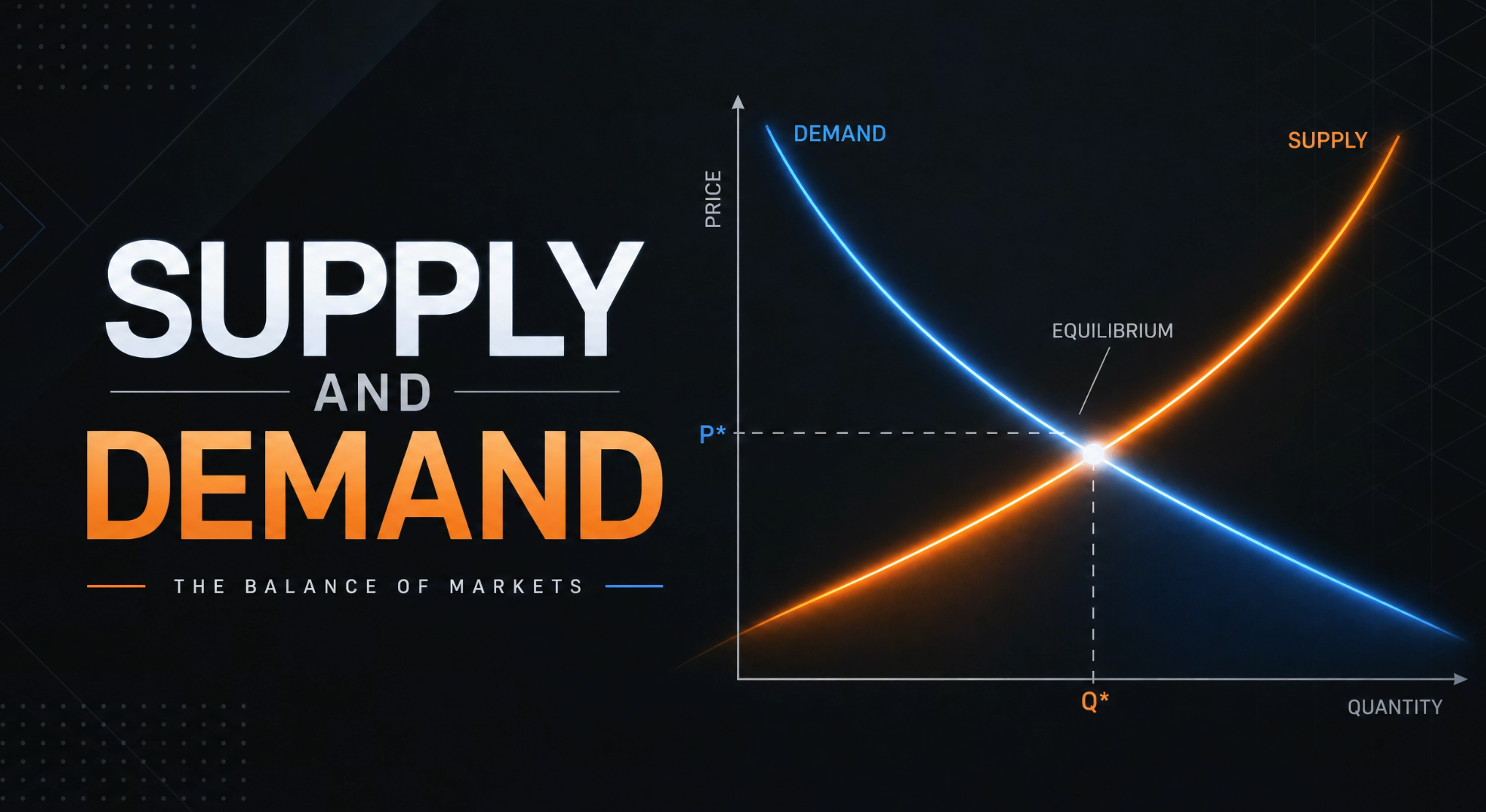
Supply and demand is one of the most fundamental principles in financial markets. Across stocks, forex, bonds, and cryptocurrencies, price movements are almost always driven by shifts in supply and demand. When buying pressure outweighs selling pressure, prices generally rise; conversely, when selling pressure intensifies, prices tend to decline.

What Is Supply and Demand?

What Is Supply and Demand

Supply and demand are cornerstone concepts in economics and the fundamental drivers of price formation in financial markets.

Simply put:

  • Supply refers to the number of participants and the quantity of assets they are willing to sell in the market.
  • Demand refers to the number of participants and the amount of capital they are willing to spend to buy assets.

When demand outstrips supply, prices typically rise; when supply exceeds demand, prices tend to fall.

This dynamic governs not only commodity markets but also equities, forex, gold, cryptocurrencies, and bonds alike.

How Are Prices Formed in Financial Markets?

The Buyer-Seller Equilibrium

Financial markets function as trade-matching platforms where prices emerge from the interplay of buying and selling forces. When buyers are willing to pay higher prices and sellers refuse to sell at lower levels, prices usually climb steadily. Conversely, when sell-side pressure builds and buying power wanes, prices can drop sharply.

Why Do Prices Swing So Rapidly?

Market prices are shaped by a host of factors: economic data, interest rate policy, corporate earnings, global events, market sentiment, and investor expectations. Optimism about the future can accelerate demand, while rising panic can trigger a flood of sell orders, leading to violent swings. This is a key reason why bull and bear markets are common in financial markets.

How Do Supply and Demand Affect the Stock Market?

When Demand Increases

When a company beats earnings expectations, the market may revise its growth outlook upward, attracting more capital to buy shares. As demand and buying pressure rise, the stock price is generally more likely to appreciate.

When Supply Increases

Conversely, if concerns emerge about a company’s prospects—such as a slowing economy, declining revenue, or rising rates—investors may rush to sell. When selling pressure intensifies and supply overtakes demand, the stock price can fall or undergo a correction.

Supply and Demand in the Cryptocurrency Market

Cryptocurrency markets tend to be more sensitive to supply-demand shifts than traditional markets. This is largely due to their smaller size, higher volatility, and the outsized influence of market sentiment. The 24/7 trading cycle and high leverage ratios further amplify price movements.

Take Bitcoin as an example: a surge of capital inflows can quickly push prices higher as demand rises; conversely, panic can trigger dramatic selloffs in a very short time.

Additionally, some cryptocurrencies use mechanisms like halving, token burns, or staking lock-ups to reduce supply, further impacting price and the supply-demand structure.

Market Sentiment and Supply-Demand Dynamics

FOMO and Panic

Supply and demand in financial markets are not purely numerical—they are deeply tied to human psychology. When markets rise, investors often succumb to FOMO (Fear of Missing Out), driving additional buying demand. When markets plunge, fear can trigger massive sell-offs. Thus, market sentiment tends to amplify supply-demand swings.

Why Markets Overreact

Because investors are not entirely rational, markets can display:

  • Excessive optimism
  • Excessive pessimism
  • Irrational chasing of highs
  • Panic selling

These behaviors can cause short-term supply-demand imbalances, pulling prices away from their intrinsic value.

So financial markets are not just a reflection of economic data—they are also a manifestation of collective psychology.

Supply and Demand in Technical Analysis

Many technical analysis tools are grounded in supply-demand logic. For instance, support levels typically mark zones where demand is strong, while resistance levels indicate areas where selling pressure is concentrated. Volume helps gauge whether supply and demand are active, and trend breakouts often signal a shift in the balance of power between buyers and sellers.

Traders frequently use price and volume patterns to assess capital flows and detect changes in supply-demand dynamics.

Why Should Investors Understand Supply and Demand?

Grasping supply and demand allows investors to better understand the real reasons behind price movements. Market rises and falls are rarely caused by a single news item—they result from the combined effect of expectations, capital flows, buying and selling forces, and investor sentiment.

Mastering supply-demand logic helps investors look beyond surface-level headlines and focus on the true drivers of market behavior.

Can Supply and Demand Predict the Market?

While supply-demand analysis is central to market theory, financial markets remain inherently uncertain.

This is because markets are influenced by numerous factors, including:

  • The global economy
  • Policy shifts
  • Geopolitical events
  • Interest rate environments
  • Capital liquidity
  • Investor psychology

Therefore, supply-demand analysis is best used as a framework for understanding markets, not as a guaranteed method for price prediction.

Conclusion

Supply and demand are the most fundamental forces driving financial markets. Almost every price movement can be traced back to shifts in supply or demand. Whether in stocks, forex, or crypto, market prices ultimately reflect the equilibrium between buyers and sellers.

For investors, understanding supply and demand is not just an academic exercise—it’s a practical tool to interpret market sentiment, price action, and capital flows. Viewing markets through the lens of supply and demand helps cultivate rational thinking and long-term judgment.

Author:  Allen
Disclaimer
* The information is not intended to be and does not constitute financial advice or any other recommendation of any sort offered or endorsed by Gate.
* This article may not be reproduced, transmitted or copied without referencing Gate. Contravention is an infringement of Copyright Act and may be subject to legal action.

Related Articles

Exploring 8 Major DEX Aggregators: Engines Driving Efficiency and Liquidity in the Crypto Market
Beginner

Exploring 8 Major DEX Aggregators: Engines Driving Efficiency and Liquidity in the Crypto Market

DEX aggregators integrate order data, price information, and liquidity pools from multiple decentralized exchanges, helping users find the optimal trading path in the shortest time. This article delves into 8 commonly used DEX aggregators, highlighting their unique features and routing algorithms.
2026-04-05 18:15:50
What Is Copy Trading And How To Use It?
Beginner

What Is Copy Trading And How To Use It?

Copy Trading, as the most profitable trading model, not only saves time but also effectively reduces losses and avoids man-made oversights.
2026-04-09 06:04:24
What Is Technical Analysis?
Beginner

What Is Technical Analysis?

Learn from the past - To explore the law of price movements and the wealth code in the ever-changing market.
2026-04-09 10:30:57
How to Do Your Own Research (DYOR)?
Beginner

How to Do Your Own Research (DYOR)?

"Research means that you don’t know, but are willing to find out." - Charles F. Kettering.
2026-04-09 10:20:26
What Is Fundamental Analysis?
Intermediate

What Is Fundamental Analysis?

Suitable indicators and tools combined with crypto news make up the best possible fundamental analysis for decision-making
2026-03-24 11:52:13
What Are Altcoins?
Beginner

What Are Altcoins?

An altcoin is also known as a Bitcoin Alternative or Alternative Cryptocoin, which refers to all cryptocurrencies other than Bitcoin. Most of the cryptocurrencies in the early stage were created through forking (copying Bitcoin codes).
2026-04-09 10:51:50