Digital identity is becoming an important part of Web3 infrastructure. As blockchain applications expand from asset trading into governance, social networks, collaboration, and the AI Agent ecosystem, networks increasingly need to identify real participants and build sustainable trust relationships. In this process, identity verification is evolving from a simple account management tool into critical infrastructure for the digital economy.
Trusta.AI and World are two of the most representative projects in the identity sector today. Both aim to address bot accounts, Sybil attacks, and identity trust issues, but they take very different technical approaches. World focuses on verifying unique identity through biometrics, while Trusta.AI focuses on building on-chain reputation and identity networks. This difference also reflects two distinct development paths for Web3 identity systems.
What Is Trusta.AI?
As an identity and reputation infrastructure network for Web3 users and AI Agents, Trusta.AI’s core goal is to establish trusted digital identities in open networks and use long-term behavioral records to create an on-chain reputation system that can accumulate over time.
Trusta.AI focuses not only on identity verification itself, but also on reputation building after identity is established. Through products such as Proof of Humanity, TrustScan, TrustGo, and AgentGo, Trusta.AI aims to build a Trust Layer covering real users, organizations, and AI Agents.
What Is World?
World is a digital identity network built on biometric technology, with World ID as its core product.
World aims to solve the problem of identity uniqueness on the open internet. After users complete an iris scan with a dedicated device, they can receive a corresponding digital identity credential, proving that they are a real and unique human individual.
Because the iris is naturally unique, World’s design focuses on preventing duplicate registrations, identity forgery, and bot abuse. Its goal is to build a globally verifiable human identity network.
What Is the Core Difference Between Trusta.AI and World?
The biggest difference between Trusta.AI and World lies in their identity verification logic.
World focuses on answering the question: “Is this person real and unique?”
Trusta.AI, by contrast, focuses on answering: “Is this identity trustworthy, and how has it behaved over time?”
As a result, World’s core asset is unique identity, while Trusta.AI’s core asset is the combination of identity and reputation.
From the perspective of the digital economy, unique identity solves the problem of participation eligibility, while reputation systems go further by addressing trust and collaboration.
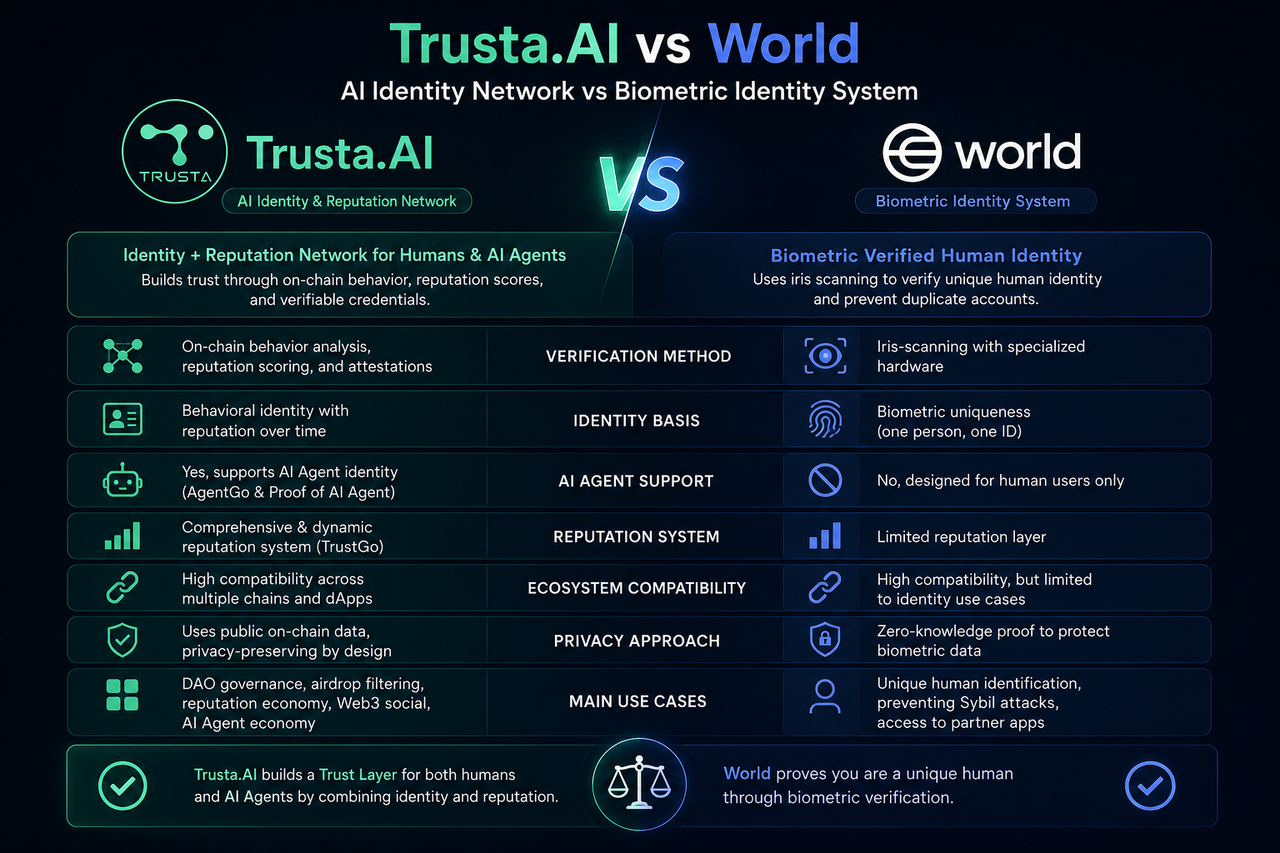
How Do Trusta.AI and World Differ in Identity Verification Mechanisms?
How Does World Verify Identity?
World uses a biometric verification model.
Users need to complete an iris scan with a dedicated device. The system uses the uniqueness of the iris to generate a corresponding identity credential. The entire process emphasizes identity uniqueness, ensuring that the same user cannot repeatedly create multiple identities.
This model can effectively prevent duplicate identities, but the verification process depends on dedicated hardware infrastructure.
How Does Trusta.AI Verify Identity?
Trusta.AI mainly relies on on-chain behavior analysis.
The system builds an identity profile by analyzing wallet history, interaction behavior, fund flows, protocol participation, social activity, and other data. It then combines this with a reputation model to judge account authenticity and trustworthiness.
This approach does not rely on real-world biometric features. Instead, it builds identity trust through digital behavior.
How Do Trusta.AI and World Differ in Building Reputation Systems?
Identity verification is only the first step in establishing trust.
World’s main task is to prove user authenticity at the identity entry point, so its core value is concentrated at the identity authentication layer.
Trusta.AI extends further into reputation infrastructure. The system continuously tracks account performance and dynamically updates reputation status based on activity, contributions, ongoing participation, and historical on-chain behavior.
Therefore, the two play different roles in the trust system. World is more like an identity authentication platform, while Trusta.AI is closer to an identity and reputation network.
How Do Trusta.AI and World Differ in Privacy Protection Models?
World’s Privacy Design
World uses cryptographic technologies such as zero-knowledge proofs to protect user data.
The system aims to verify identity uniqueness without directly exposing users’ biometric information, thereby reducing privacy leakage risks.
However, because the verification process involves biometric data, privacy remains a major concern across the industry.
Trusta.AI’s Privacy Design
Trusta.AI relies more on publicly available on-chain data for analysis.
Because it mainly uses wallet behavior and on-chain activity records, it does not need to collect real-world identity information at scale. This approach preserves openness while reducing the need to process sensitive personal information.
Its privacy focus is more centered on the data analysis process and the transparency of reputation models.
How Do Trusta.AI and World Differ in Use Cases?
World is better suited to scenarios that require strict verification of identity uniqueness. Examples include global digital identity networks, inclusive finance identity authentication, and incentive campaigns that need to prevent repeated participation.
Trusta.AI is better suited to scenarios that depend on long-term reputation accumulation. Examples include DAO governance, on-chain credit systems, Web3 social networks, airdrop screening, and AI Agent collaboration networks.
The two projects solve different problems, so in practice they are often not direct substitutes.
Key Differences Between Trusta.AI and World
| Comparison Dimension |
Trusta.AI |
World |
| Core Positioning |
Identity and reputation network |
Digital identity authentication network |
| Core Goal |
Build trusted identities and reputation |
Establish unique identity |
| Verification Method |
On-chain behavior analysis |
Iris scanning |
| Identity Basis |
Behavior and reputation |
Biometrics |
| AI Agent Support |
Supported |
Not supported |
| Reputation System |
Full support |
Limited support |
| Hardware Requirement |
No dedicated device required |
Dedicated device required |
| Main Use Cases |
DAO, reputation economy, AI Agent |
Identity authentication, duplicate registration prevention |
Conclusion
Trusta.AI and World both seek to solve identity challenges in open networks, but their goals and implementation paths are significantly different. World uses biometric technology to establish unique digital identities and focuses on human verification. Trusta.AI builds a long-term trusted identity network through behavior analysis, reputation scoring, and identity attestation mechanisms, while also expanding into the AI Agent ecosystem. As Web3 gradually evolves from an asset network into an identity and reputation network, both models may become important components of the future digital trust system.
FAQs
What is the biggest difference between Trusta.AI and World?
Trusta.AI mainly builds an identity and reputation network, using on-chain behavior analysis to establish trusted identities. World verifies identity uniqueness through iris scanning, focusing on a “one person, one identity” system.
Why does World use iris scanning?
The iris is naturally unique and can effectively prevent duplicate identity registrations and bot impersonation, which is why it is used to establish unique digital identities.
Does Trusta.AI require biometric verification?
Trusta.AI’s core mechanism mainly relies on on-chain behavior analysis and reputation models. It does not use biometrics as its primary verification method.
Can AI Agents use World ID?
World’s identity system is mainly designed for human users, so it cannot be directly used for AI Agent identity authentication. Trusta.AI provides a dedicated identity and reputation framework for AI Agents.
Are Trusta.AI and World competitors?
The two overlap in parts of the digital identity sector, but they do not solve exactly the same problem. World focuses more on identity uniqueness, while Trusta.AI focuses more on identity trustworthiness and reputation building.