Eli Lilly (LLY) is a stock that can be directly searched by code in Gate Stocks. For a comprehensive understanding of its business model, growth strategy, and risk framework, refer to the LLY Stock Overview. This guide focuses solely on the trading process and does not repeat company analysis.
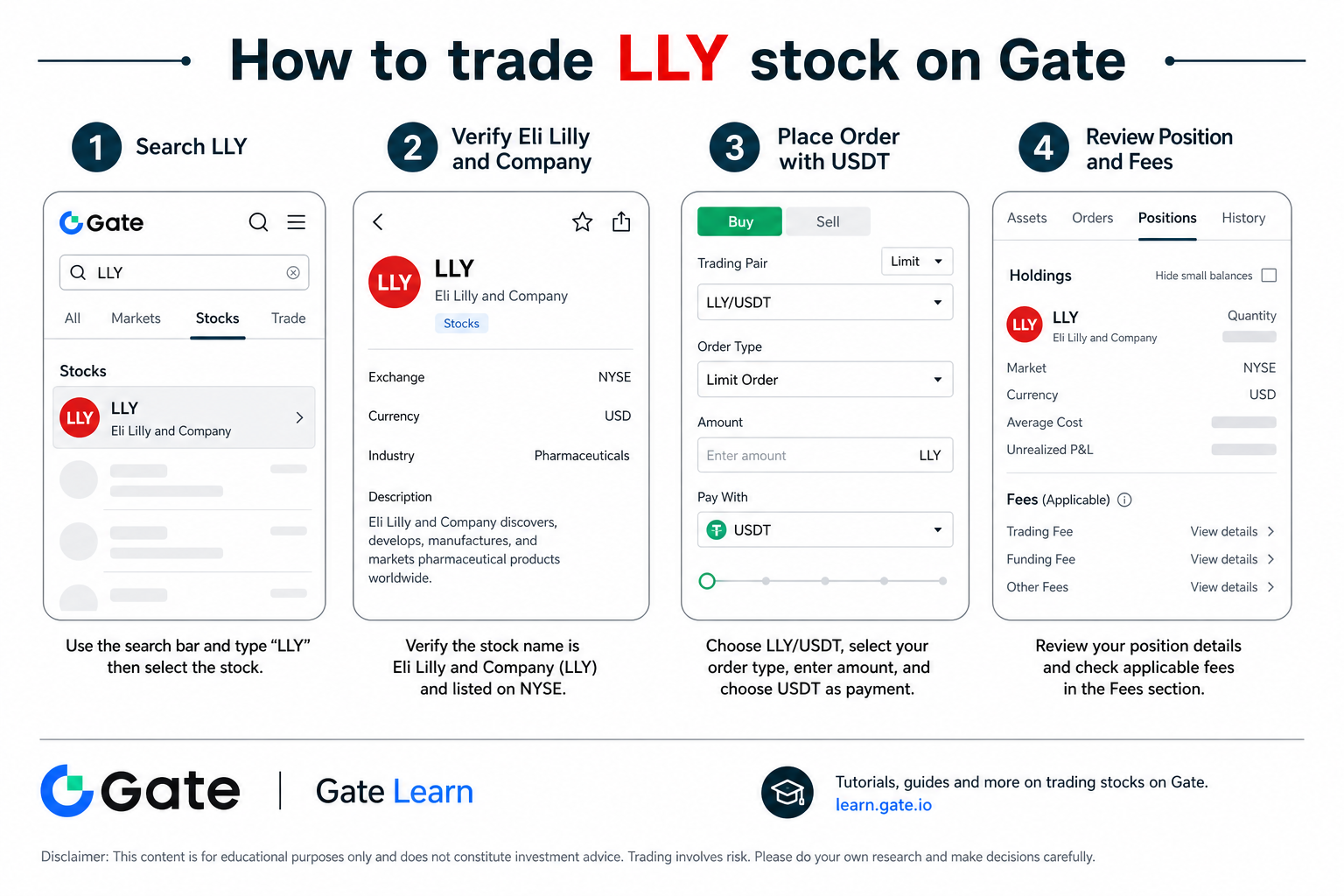 Figure 1. LLY trading flow on Gate: search code, verify entity, select order, and review positions.
What should you prepare before trading LLY stock on Gate?
Before trading, confirm your account’s availability, stock trading permissions, and funding requirements, then check whether you have sufficient available USDT. The platform page, order rules, and company entity must be checked separately.
A common mistake during preparation is assuming that “having researched the company” means “ready to place an order.” Company research resolves understanding, while account and fund preparation address execution. Only after both are complete should you proceed to search and verification.
| Preparation Item |
What to Confirm |
Purpose |
| Account permissions |
Whether stocks can be traded |
Ensure feature availability |
| Funds |
Whether available USDT is present |
Ensure order placement capability |
| Asset |
Whether LLY is confirmed |
Avoid code selection errors |
| Rules |
Order types and trading hours |
Prevent execution mistakes |
Step 1: How do you prepare USDT and your stock trading account?
First, confirm that your account is enabled for stock trading, then check if you have enough available USDT in your funds account. Fund preparation and company research are two distinct tasks: the former determines “can you place an order,” the latter clarifies “do you understand the asset logic.”
If funding requirements, account status, or permission prompts are unclear, rely strictly on what is displayed on the platform, not external experience. Once preparation is complete, proceed to asset search—do not place orders and then go back to verify.
USDT preparation should be divided into two steps: first, confirm that your balance is visible; second, confirm that your balance is available for stock trading. Sometimes, the total account balance exists, but available balance, frozen amounts, or product permissions restrict order placement. Using platform fields as the standard reduces execution errors.
Step 2: How do you search for LLY in Gate Stocks?
Enter Gate Stocks and input the code LLY. After searching, confirm the company name is Eli Lilly and Company, not another similar asset. The most direct access is the Gate LLY stock page.
| Verification Item |
Correct Signal |
Common Mistake |
| Code |
LLY |
Placing orders based on vague names |
| Company name |
Eli Lilly and Company |
Skipping entity verification |
| Page |
Stocks page |
Mistaking futures or other products for stocks |
Once search is confirmed, proceed to the order area. If you are unsure about the business background, refer to the LLY Stock Overview; this is a research step and should not be mixed with order fields.
The core principle for searching is: correct code, correct name, correct product type. If any of these are missing, do not proceed. Most stock trading mistakes stem from incomplete asset verification rather than complex strategies.
Step 3: How do you place an order to trade LLY stock?
In the order area, select buy or sell, then confirm order type, quantity, and price conditions. Before placing the order, double-check: is the code still LLY, are funds sufficient, and does the order type comply with current trading hour rules?
After placing the order, don’t just rely on the “submitted” notification; return to the order and position page to confirm status. Platform execution is based on page records—research conclusions cannot replace trade and position verification.
If the page prompts validation failure, insufficient funds, or unavailable trading hours during the order process, stop and read the prompt instead of repeatedly changing the quantity and force submitting. Prompts are part of the process, indicating a verification item is unmet.
What fees and order rules should you confirm when trading LLY stock?
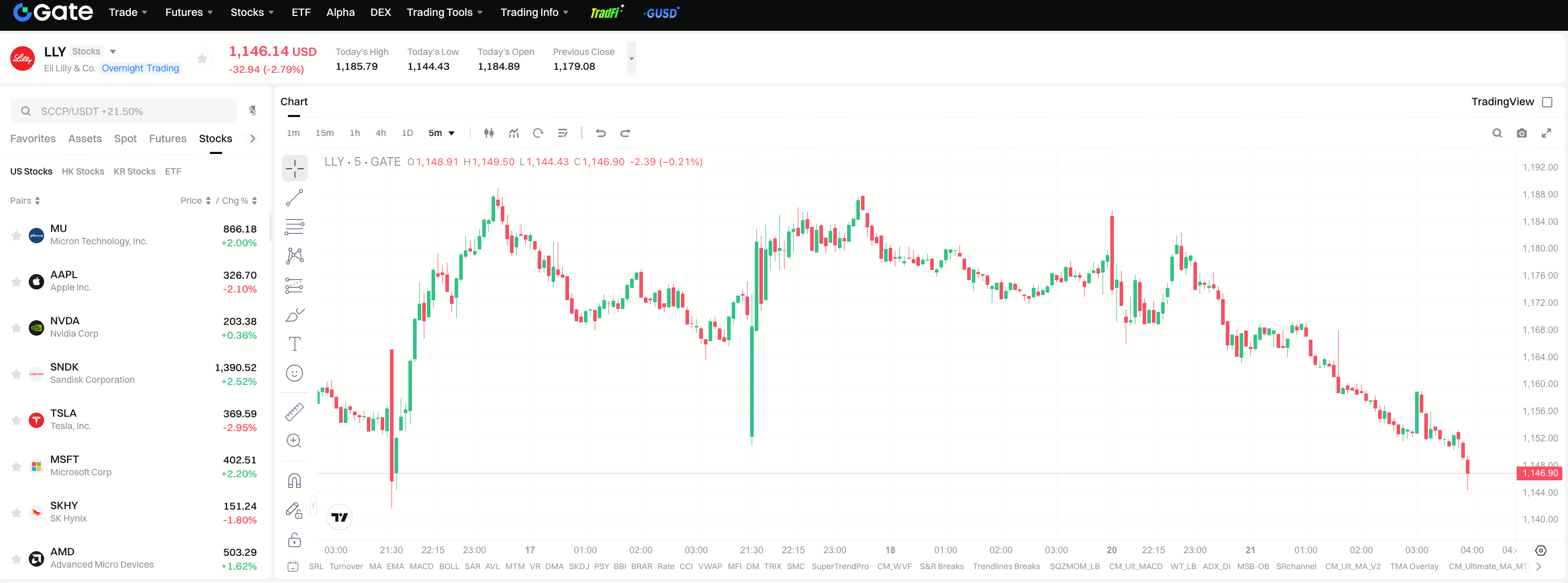
Fees, spreads, and related trading costs, as well as available order types, must be based on what’s displayed in real time on the trading page. Different order types have distinct requirements for price, execution method, and trading hours—never assume “any time, any method can execute.”
| Rule Item |
What to Check |
Why Important |
| Fees |
Trading costs shown on the page |
Impact actual execution cost |
| Order type |
Available types such as Limit/Market |
Impact execution method |
| Trading hours |
Whether within tradable hours |
Impact ability to execute |
| Funding requirements |
Available USDT and frozen status |
Impact ability to submit order |
For insights into valuation and risk factors driving asset volatility, see Why LLY Valuation Is High and LLY Stock Overview.
Fee and rule verification should be performed both before and after trading: before trading, confirm order eligibility and cost calculation; after trading, verify trade records, fee deductions, and position changes are consistent. Dual verification—before and after—offers greater reliability than only checking at the order moment.
What risks should you understand before trading LLY stock?
Trading risks fall into at least three categories. First, asset risk: pharmaceutical growth stocks are sensitive to competition, patents, regulation, and growth realization. Second, execution risk: code selection errors, incorrect trading hours, mismatched order types. Third, funding and rule risk: available balance, fees, and position status not verified.
The purpose of risk explanation is to list observation items, not to provide buy or sell recommendations. Fundamental company analysis and Gate trading workflow should always be handled separately.
Risk verification may be written as a pre-trade checklist: asset confirmed, trading hours allowed, funds sufficient, order type matched, position review path clear. The shorter the checklist, the easier to remember, but each item must be identifiable on the platform. Risk discussions without field verification often remain conceptual.
Summary
The core workflow for trading LLY stock on Gate is: prepare permissions and USDT → search and confirm LLY entity → place orders per platform rules → verify fees, orders, and positions. Separating research and trading execution helps minimize operational errors.
If you condense the process into a single verification phrase: confirm LLY first, confirm rules second, confirm results last. Completing all three steps marks the end of the trading process.
FAQ
How does trading LLY stock on Gate differ from traditional brokers?
Gate Stocks relies on platform rules, USDT funding requirements, and stock product fields; traditional brokers have their own account systems, settlement, and trading channels. Experience cannot be directly transferred—always follow the current platform before placing orders.
Is there a fixed minimum quantity for buying LLY stock on Gate?
Follow the real-time quantity rules and available funds shown on the trading page. Orderable quantities may vary depending on trading hours and order conditions; external fixed numbers cannot replace platform prompts.
What industry does LLY stock belong to?
LLY represents pharmaceutical company Eli Lilly and Company, categorized under pharmaceuticals and innovative drug sectors. Industry attributes aid fundamental analysis but do not substitute asset verification on the trading page.
Can you sell after buying? How do you check trading hours?
The ability to sell and trading hours depend on the order status, position status, and trading hour rules shown on the Gate Stocks page. After submitting an order, always return to the order and position page for verification, not just rely on the immediate prompt.