Participating in CXMT Pre-IPO contracts on Hyperliquid is a repeatable on-chain derivatives trading process: from wallet and USDC preparation, to locating the ticker, opening a position, managing margin, then closing and verifying on-chain. CXMT tracks the anticipated A-share price of ChangXin Technology (the listed entity), settles in USDC, and provides equity-like derivatives exposure—not Sci-Tech Innovation Board registered shares. Compared to the three participation paths outlined for ChangXin Technology (CXMT), the Hyperliquid path is tailored for global users with on-chain accounts and supports 24/7 bidirectional trading.
On-chain CXMT contracts are launched as IPOP products under the HIP-3 framework, with pre-listing mark prices primarily determined by order book supply and demand. The Hyperliquid CXMT mechanism provides a detailed explanation of mark pricing and funding rates. For differences among the three participation paths, refer to How Investors Participate in ChangXin Technology.
What Should You Prepare Before Trading CXMT on Hyperliquid?
Hyperliquid CXMT Pre-IPO trading begins once your account and funds are ready. Prerequisites include: an on-chain wallet compatible with Hyperliquid, available USDC margin in your Hyperliquid L1 account, and an understanding that CXMT contracts are derivatives—not registered equities. CXMT contracts do not offer IPO allocation, dividends, or voting rights, and cannot be directly converted into A-share holdings after listing.
Key pre-trade checklist:
| Preparation Item |
Requirement |
Checklist Points |
| On-chain wallet |
Supports Hyperliquid connection |
Private key security, correct network selection |
| USDC margin |
Deposit into Hyperliquid account |
Balance covers position opening and maintenance margin |
| Product understanding |
Know Pre-IPO perpetual attributes |
Not an A-share, no shareholder rights |
| Ticker identification |
Confirm CXMT and IPOP category |
Avoid selecting other HIP-3 assets |
| Leverage setting |
Choose based on risk tolerance |
High leverage increases liquidation risk |
Once these conditions are met, you can follow the standard steps to open a position, manage it, and close it. This process is not limited to a specific event window and can be repeated at any time.
Step 1: How to Prepare Your Wallet and USDC Margin?
First, connect your on-chain wallet and bridge USDC into your Hyperliquid L1 account as margin. Higher leverage allows greater notional exposure with the same USDC, but also lowers the liquidation threshold. It is recommended to reserve a buffer to account for funding rate deductions and unrealized losses.
Step 2: How to Find the CXMT Ticker on Hyperliquid?
CXMT is found in the IPOP category under HIP-3. When searching, confirm the ticker is CXMT, the category label is IPOP, the underlying description references ChangXin Technology’s expected A-share price, the settlement asset is USDC, and both long and short positions are supported. The contract tracks the expected price of one A-share in RMB, converted to USD at the prevailing exchange rate. Pre-listing mark price is set by the order book, with no external A-share oracle.
Step 3: How to Open a Long or Short Position in CXMT?
After confirming the CXMT ticker, traders select direction (long or short), leverage, order type (market or limit), and quantity, then submit the order to open a position. A long position expresses a bullish view on ChangXin Technology’s pre- and post-listing price; a short position expresses a bearish view. Once filled, Hyperliquid records the position, entry price, and margin used on-chain.
Typical steps for opening a position:
| Step |
User Action |
System Response |
| 1 |
Select CXMT trading pair |
Load IPOP contract parameters |
| 2 |
Set leverage and direction |
Calculate required initial margin |
| 3 |
Enter quantity and select order type |
Verify margin sufficiency |
| 4 |
Submit order to open position |
Order book matches or executes immediately |
| 5 |
Confirm fill |
On-chain position record created |
After the trade is filled, the interface displays position size, unrealized PnL, margin ratio, and estimated liquidation price. Once the position is opened, you move into the position management phase.
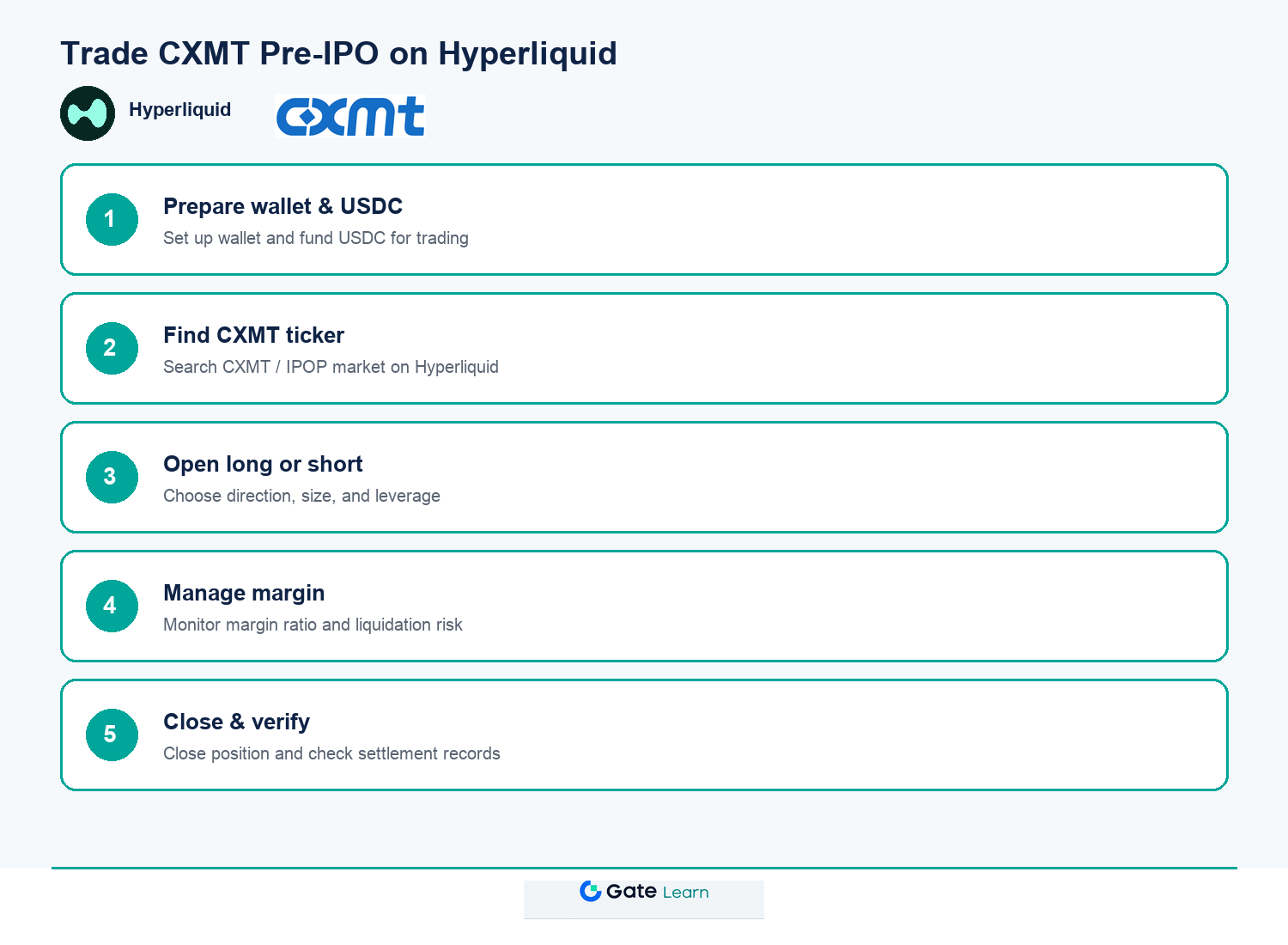 Figure 1. Hyperliquid CXMT Pre-IPO trading—seven steps: connect wallet, deposit USDC, locate ticker, set leverage, open position, monitor margin, verify closing.
During a Position: How Do Margin and Liquidation Work?
While holding a position, unrealized PnL fluctuates with the mark price, and the funding rate is periodically deducted from margin. If the margin ratio falls below the maintenance threshold, the system will automatically liquidate the position. Holders can add USDC or proactively reduce their position to lower liquidation risk. Hyperliquid trading is not subject to A-share market hours; after listing, the external A-share price expectation factors into index pricing, but positions remain USDC-settled derivatives.
Step 4: How to Close a Position and Verify Results On-Chain?
After submitting a closing order, the system matches the trade and settles realized PnL on-chain, releasing margin and returning the USDC balance. After closing, confirm your CXMT position is zero, review USDC balance changes and trade details, and, if needed, verify account status via a block explorer.
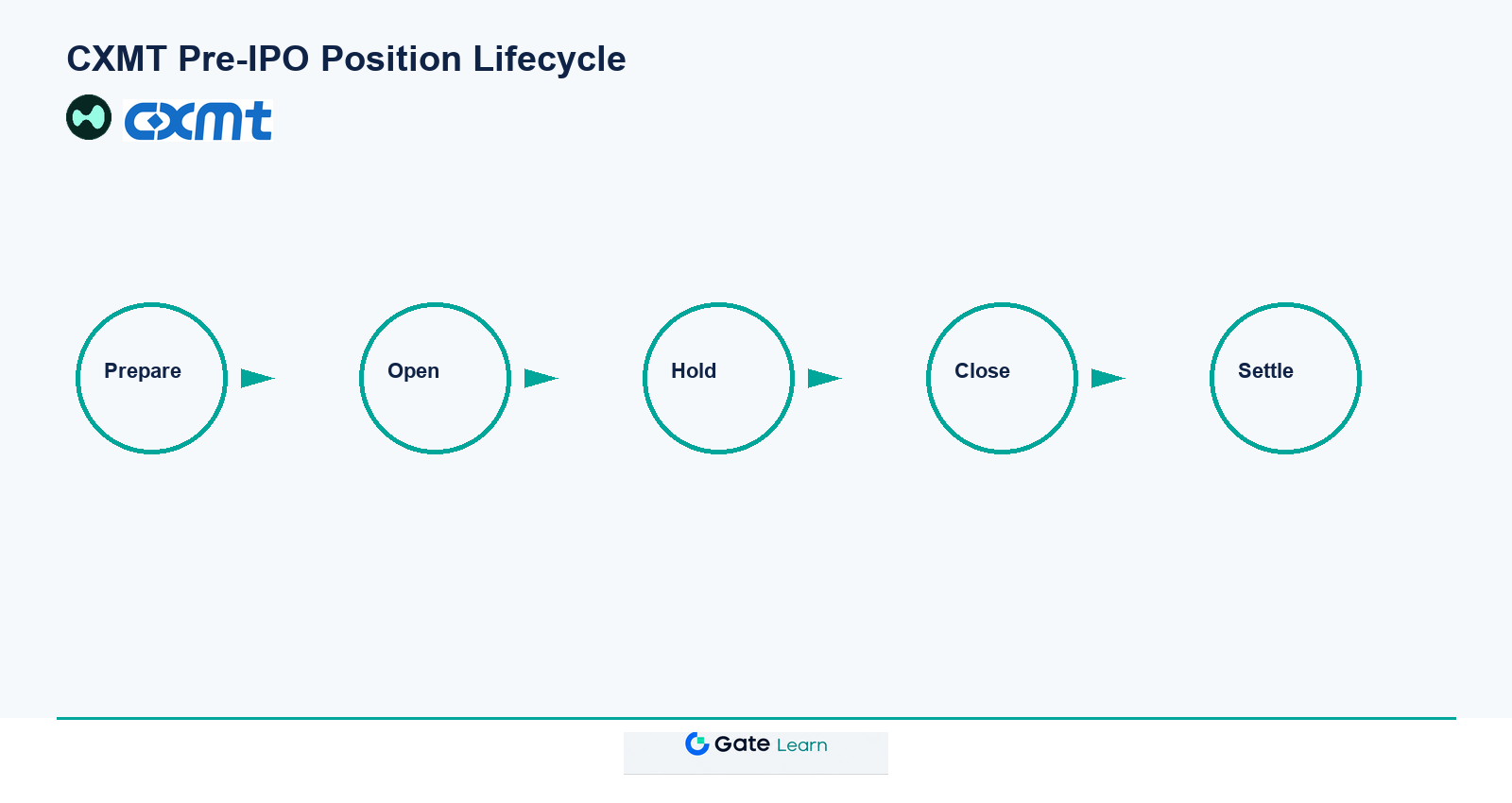 Figure 2. CXMT Pre-IPO position lifecycle—five stages: preparation, opening, holding, closing, and on-chain settlement verification.
What Fees and Trading Hours Should You Confirm When Trading CXMT?
Key fees include Maker/Taker trading fees, funding rate while holding a position, and cross-chain bridging gas. Hyperliquid supports 24/7 trading, unaffected by A-share market hours. Pre-listing mark price is determined by order book supply and demand; spreads may widen if liquidity is thin. Always check the fee tier and contract parameters shown on the frontend before placing an order.
What Are the Operational Risks of Participating in Hyperliquid CXMT Contracts?
The Hyperliquid CXMT path offers 24/7 on-chain access and bidirectional trading, but also entails various operational and systemic risks.
| Risk Type |
Main Manifestation |
| Pricing deviation |
Contract mark price may diverge significantly from A-share IPO or post-listing spot price |
| Liquidity |
Insufficient order book depth can cause increased slippage and make limit orders hard to fill |
| Leverage liquidation |
Insufficient margin triggers forced liquidation, losses can exceed initial margin |
| Ticker selection error |
Confusion between CXMT and other HIP-3 assets |
| Rule changes |
HIP-3 parameters, regional restrictions, or contract specification adjustments |
| Cross-chain operations |
Incorrect bridging path or insufficient gas causing deposit delays |
These risks are independent of DRAM industry fundamentals; the contract path does not eliminate sector cycles or IPO process impacts.
Summary
Participating in CXMT Pre-IPO contracts on Hyperliquid follows a repeatable process: "prepare wallet and USDC → locate CXMT ticker → open position → manage margin and funding rate → close and verify on-chain." CXMT, as a USDC-settled HIP-3 perpetual, provides derivatives exposure to ChangXin Technology's expected share price, not A-share registered equity. Understanding each step’s system response and verification points helps distinguish Hyperliquid from A-shares and Gate pre-market contracts at the operational level.
FAQ
What Are the Requirements for Trading CXMT on Hyperliquid?
You need an on-chain wallet compatible with Hyperliquid, sufficient USDC margin in your account, and an understanding that CXMT is a Pre-IPO derivative, not an A-share stock. Once funded, locate the CXMT ticker in the HIP-3 IPOP category to open a long or short position.
How Do I Find the CXMT Ticker on Hyperliquid?
Browse or search the IPOP (Pre-IPO) category under HIP-3 on the Hyperliquid trading interface. Confirm the ticker is CXMT, the underlying description references ChangXin Technology’s expected A-share price, and the settlement asset is USDC. Verify the category and contract parameters before proceeding to the order page.
How Does Margin Change After Opening a CXMT Position on Hyperliquid?
After opening a position, unrealized PnL fluctuates with the mark price, and the funding rate is periodically deducted from margin. If the margin ratio drops below the maintenance threshold, the system will automatically liquidate the position. Holders can add USDC margin to increase their margin ratio or proactively close to reduce exposure.
When Can the Hyperliquid CXMT Contract Be Traded?
Hyperliquid is an on-chain perpetual platform; CXMT contracts support 24/7 trading and are not subject to Shanghai or Shenzhen exchange hours. Pre-listing mark prices are mainly determined by order book supply and demand; after listing, the external A-share price expectation factors into index pricing, but settlement remains in USDC.
How Do I Verify Results After Closing a CXMT Position On-Chain?
After closing, confirm your CXMT position is cleared from your position list and review USDC balance changes and realized PnL details. If needed, use a block explorer to verify your Hyperliquid account status and ensure on-chain records match the frontend display.
What Operational Risks Exist When Trading Hyperliquid CXMT?
Key risks include divergence between contract and A-share spot prices, insufficient order book liquidity, leverage liquidation, ticker selection errors, HIP-3 rule changes, and cross-chain deposit errors. The derivatives path does not eliminate uncertainties related to DRAM industry fundamentals or the IPO process.