Beyond the ANSEM token, The Black Bull (ANSEM) comes with three front-end tools: Ansem-call Radar, LP Pods, and Market Terminal. Together, they form the tooling layer of blackbullsol.com, designed to break narrative signals, liquidity organization, and market data display into reusable modules—rather than cramming everything into a single page.
When users first encounter The Black Bull's tooling, common misconceptions include treating Radar as a trading bot, Pods as fixed-income products, or Terminal quotes as wallet balances. These three interpretations blur the lines between information display, liquidity modules, and SPL holdings. A clearer approach is to first identify each tool's data sources and output formats, then assess how they relate to the ANSEM contract 9cRCn9rGT8V2imeM2BaKs13yhMEais3ruM3rPvTGpump.
All three tools operate within the Solana ecosystem but do not replace wallet functions like signing or transferring (e.g., Phantom). The tooling layer addresses "what to see and how to organize liquidity views." On-chain holdings and DEX swaps must still be completed via wallet and PumpSwap trading interfaces.
What Is Ansem-call Radar? What Signals Does It Track?
Ansem-call Radar is The Black Bull's information-layer tool, aggregating on-chain activity and community narrative signals related to Ansem. blackbullsol.com describes Ansem's wallet activity as a high-frequency observation point in Solana culture. Accordingly, the Radar module caters to the need to track public wallet trails and related token dynamics, rather than offering order placement or custody services.
A typical Radar workflow: Open the Radar section on blackbullsol.com → Read on-chain event summaries linked to target wallets or narratives → Cross-check raw transactions on explorers like Solscan. Radar outputs a signal view—it does not directly alter the ANSEM balance in your wallet, nor does it constitute official endorsement of any individual's actions.
| Dimension |
Ansem-call Radar |
| Primary Input |
Solana on-chain transactions & public wallet activity |
| Primary Output |
Signal summary, timeline view |
| Wallet Connection Required? |
Varies by page design; reading signals typically does not require holding ANSEM |
| Relationship with ANSEM |
Information layer; no mint, burn, or forced swap |
Radar's value lies in reducing the cost of manually scanning block explorers. Its limitations include potential delays in signal aggregation, methodological differences, or over-reliance on a single narrative. Radar page content should not replace contract address verification, nor should it be interpreted as a guaranteed execution tool.
Radar's information-layer positioning differs from POPCAT's taptap interaction site or BONK DAO's portal. Differences in issuance paths and transparency between ANSEM and Solana meme coins like BONK, WIF, POPCAT are already comprehensively compared at the tooling dimension. Radar does not create the illusion that "participation grants on-chain rights." Users can treat Radar as an observation layer: first check signals, then verify raw transactions on Solscan, and only then decide whether to execute swaps or transfers in their own wallet. This sequence helps separate narrative hype from contract-layer facts.
How Do LP Pods Operate Non-Custodially on PumpSwap?
LP Pods are a community liquidity organization module launched by The Black Bull on PumpSwap. blackbullsol.com describes Pods as non-custodial community liquidity, meaning liquidity is provided by community members under DEX rules, and the project frontend does not hold private keys or assets on behalf of users.
The operational logic of Pods can be summarized as follows: Community members select or create ANSEM-related liquidity positions in PumpSwap pools → The frontend displays pod-level liquidity depth and participation methods → Trading activity generates swap fees, which flow according to pool rules and page descriptions. Terms like "protocol-owned liquidity" and "trading fees" appearing on The Black Bull page belong to the "liquidity + index layer" narrative; specific parameters must be confirmed via PumpSwap pool contracts and on-chain records.
| Step |
Participant Action |
System-Layer Change |
| 1 |
Connect Solana wallet |
Read wallet address and balance |
| 2 |
Select ANSEM-related Pod/Pool |
Display pool address, pair, depth |
| 3 |
Add or remove liquidity |
PumpSwap contract updates LP position |
| 4 |
Swap occurs |
Pool asset ratio changes; fees distributed per rules |
Pods emphasize non-custodial: after users sign, asset changes occur at the DEX contract layer, not a centralized custody account. Adding liquidity exposes users to impermanent loss, insufficient pool depth, and smart contract risk. Removing liquidity also depends on pool state and market depth. Any fee routing or buyback concepts described on the Pods page must be verified through on-chain transaction records; marketing copy should not be taken as an active mechanism.
What On-Chain Fields Does Market Terminal Read?
Market Terminal is a browser-based market data module on blackbullsol.com. Its frontend-first design allows it to read ANSEM's price, liquidity, volume, market cap, and holder distribution directly from Solana and DEX aggregation layers. Terminal requires no login and collects no user identity data; it is positioned as a "publicly readable market dashboard."
Typical fields in Terminal include: USD-denominated price, 24h volume, pool liquidity, market cap, top holder distribution, etc. These fields may use different aggregation sources or refresh frequencies compared to third-party sites like CoinMarketCap or Dexscreener, so short-term numerical discrepancies are not unusual. When verifying Terminal data, users should fix the contract address 9cRCn9rGT8V2imeM2BaKs13yhMEais3ruM3rPvTGpump and record the pool state at the same timestamp.
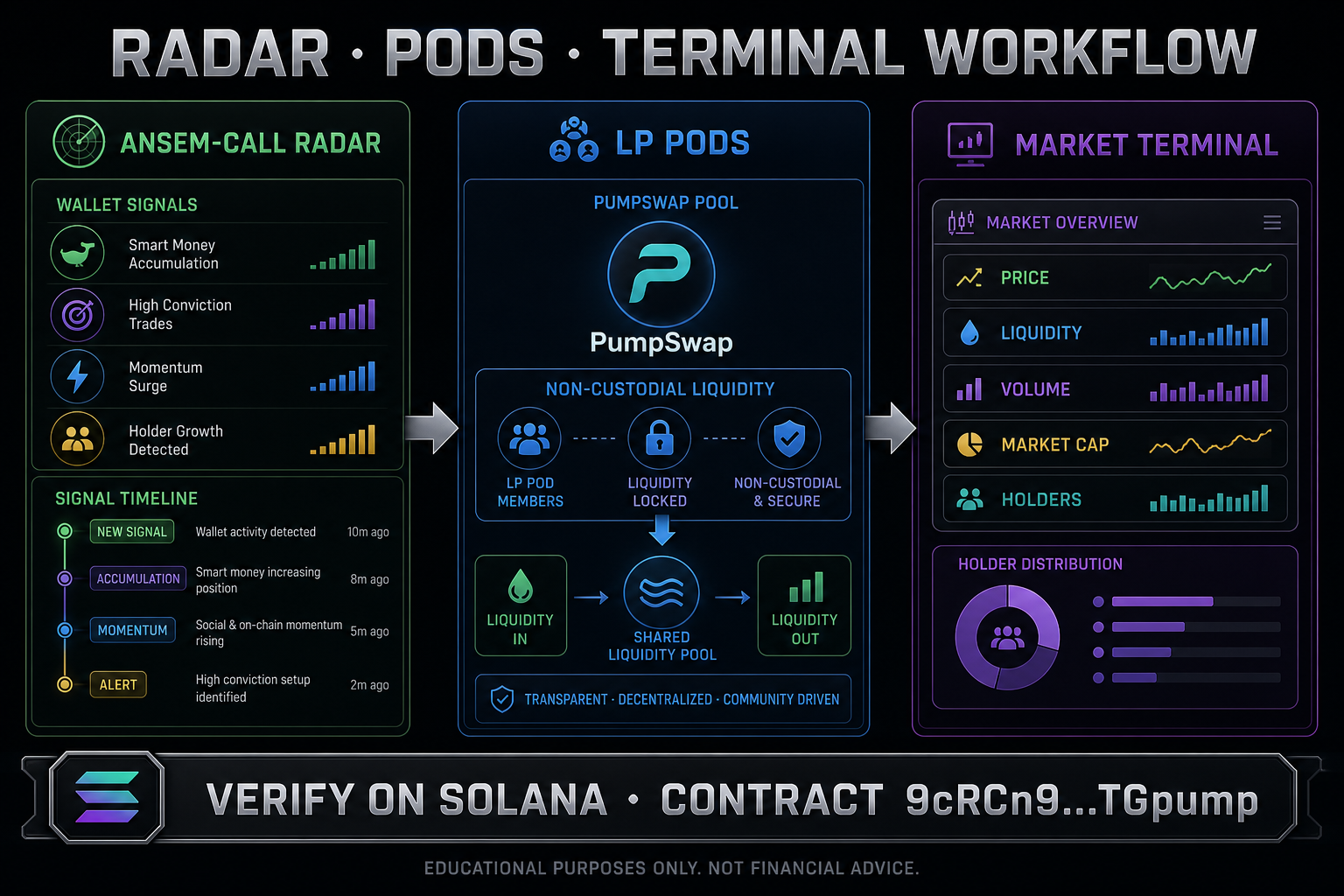 Figure 1. The Black Bull three-tool workflow: Radar reads signals, Pods organizes PumpSwap liquidity, Terminal displays on-chain market fields.
How Should the "Liquidity + Index Layer" Flywheel Be Understood?
blackbullsol.com uses a flywheel to describe the relationship among ANSEM, LP Pods, protocol-owned liquidity, trading fees, and Bull Index: community liquidity → protocol holds LP positions → swaps generate fees → some fees flow back to ANSEM-related pools or staker modules. The page also notes "concept only," "not a live product," and "not a dividend or yield promise."
Thus, the flywheel diagram should be understood as a conceptual mechanism illustration, not a committed return path. Whether a live Bull Index, staker rewards, or protocol fee distribution exists must be confirmed by the deployment of corresponding contracts and on-chain transactions. The gap between concept-layer narrative and live on-chain state is a critical demarcation when reading The Black Bull's tooling layer.
ANSEM is the SPL token itself; Radar/Pods/Terminal are information and liquidity tools built around the ANSEM ecosystem. The division of labor is as follows:
| Object |
Role |
Does User Need to Hold ANSEM? |
| ANSEM (SPL) |
On-chain transferable asset |
Holding depends on user choice |
| Radar |
Signal tracking |
No |
| LP Pods |
Liquidity module |
Adding LP typically requires ANSEM or pair assets |
| Market Terminal |
Data display |
No |
Holding ANSEM does not automatically unlock Radar privileges or grant Pods participation. Conversely, using Terminal to view data does not require ANSEM in your wallet. The only overlapping scenario: users who want to provide ANSEM/SOL or ANSEM/USDC liquidity must prepare the corresponding assets in their wallet and sign on PumpSwap.
If a user opens both Terminal and Pods pages simultaneously, a common approach is to first read the liquidity and holder fields in Terminal, then go to PumpSwap to check pool depth and pair asset ratios. Terminal offers a read-only view, while Pods involve signing and LP position changes—they should not be conflated into a single operation step.
First, verify the contract address—do not rely solely on the ticker displayed on Pods or Terminal pages as the identifier. Second, distinguish between a fan account and personal endorsement: @BlackBullSol is a community page and does not equate to any individual's official product. Third, Pods and flywheel copy may contain "experimental" or "concept only" labels and must be read separately from live contract states. Fourth, Terminal and Radar data refreshes may have delays; perform secondary confirmation on Solscan before major operations.
The global disclaimer on blackbullsol.com states that the project is in the high-risk Solana meme ecosystem and that nothing here is financial advice. No matter how complete the tooling layer, it cannot eliminate the inherent risks of meme coins, including volatility, liquidity contraction, and counterfeit contracts.
Summary
The Black Bull's Radar, Pods, and Market Terminal respectively handle signal tracking, non-custodial liquidity organization on PumpSwap, and on-chain market data display. They are interrelated with the ANSEM SPL token but have independent mechanisms: Terminal and Radar lean toward reading and display, while Pods involve DEX signing and LP position changes. When reading the tooling layer, start with contract address verification, Solscan records, and page "experimental" labels, and avoid treating the narrative flywheel as guaranteed utility.
FAQ
Does Radar automatically trade ANSEM on behalf of users?
No. Radar provides signal and timeline views and does not replace wallet signing or constitute an auto-trading service. Any swap or transfer must be manually confirmed in your wallet and DEX interface.
Are LP Pods equivalent to staking yields?
No. Pods involve providing liquidity on PumpSwap; potential returns come from swap fees, accompanied by impermanent loss and pool risks. If the page is marked "concept only," do not treat the marketing flywheel as fixed yield.
Why does Market Terminal data differ from CMC?
Different sites use different aggregation sources, refresh frequencies, and circulating supply methodologies. When verifying, use the same contract address and treat the Solana ledger and pool state as the ultimate reference.
Do I need to connect my wallet to use Terminal?
Market Terminal's core functionality is reading public on-chain data; it typically does not require a wallet connection. Wallet signing is only needed for operations like adding liquidity or swapping.
Are the three tools officially affiliated with Ansem personally?
blackbullsol.com and @BlackBullSol state that they are not affiliated with Ansem and belong to a community-built fan account system. The tooling layer does not constitute an individual official product.
What is the ANSEM contract address?
The official ANSEM contract address for The Black Bull is 9cRCn9rGT8V2imeM2BaKs13yhMEais3ruM3rPvTGpump. Before any Pods, Radar, or Terminal operations, verify this address first.