In the context of Korean stock investing, the "Samsung Group" often mentions both companies together, but confusion from abbreviated names can easily lead to cognitive bias. To clarify the differences between Samsung Electro-Mechanics and Samsung Electronics in terms of business structure, stock codes, and customer positioning, one must start with an accurate understanding of Samsung Electro-Mechanics's corporate definition, its three major business divisions, and its listing structure on the Korean stock market.
What is Samsung Electro-Mechanics?
Samsung Electro-Mechanics, a comprehensive manufacturer of electronic components under the Samsung Group, was founded in 1973 in South Korea. Its main products include multilayer ceramic capacitors (MLCCs), package substrates (such as FC-BGA), camera modules, and communication modules. The company serves as an "upstream component supplier" in the global electronic supply chain, with products widely used in smartphones, data center servers, automotive electronics, and network equipment.
Samsung Electro-Mechanics is organized into three business divisions based on products and processes: Components, Package Solutions, and Optical Solutions. The Components division provides passive component product lines required for MLCC component operations, including MLCCs, inductors, and chip resistors. The Package Solutions division handles substrate requirements for advanced semiconductor packaging. The Optical Solutions division integrates various components into modules with imaging and communication functions. Samsung Electro-Mechanics is listed on the KOSPI market of the Korea Exchange, under the stock code 009150.KS.
What is Samsung Electronics?
Samsung Electronics is a comprehensive technology company under the Samsung Group, centered on semiconductors, consumer electronics, and display businesses. The company's main products include memory chips, logic chips (including foundry services), smartphones, televisions, home appliances, and display panels, covering multiple segments of the industrial chain from chip design and manufacturing to end-brand sales.
Samsung Electronics is listed on the KOSPI market under the stock code 005930.KS and is one of the largest companies by market capitalization in South Korea. Unlike Samsung Electro-Mechanics' component supply role, Samsung Electronics both produces chips and display panels and directly sells end products such as Galaxy series smartphones to consumers. Its business scope spans B2B semiconductor supply and B2C consumer electronics brands.
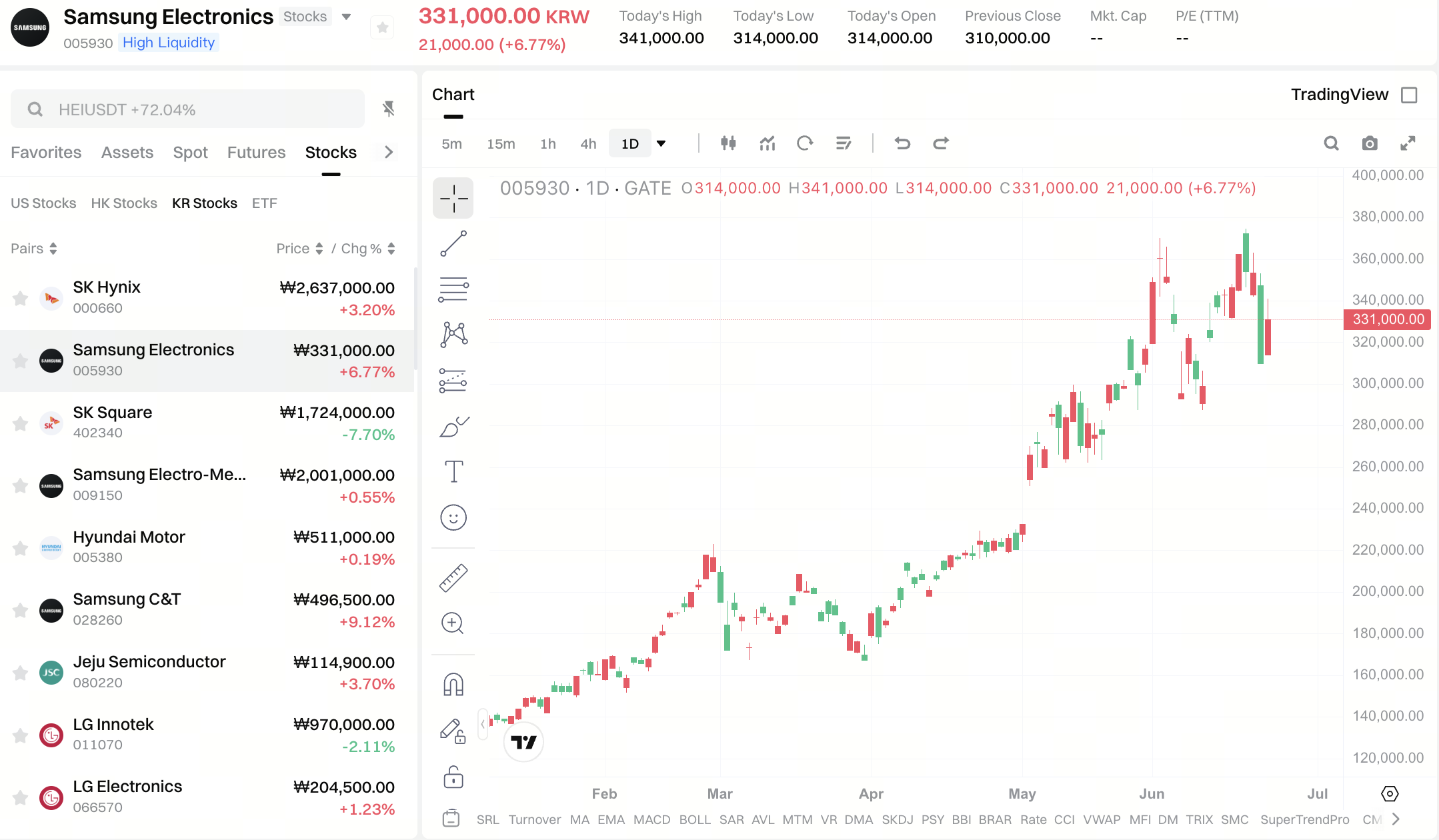 How to Buy Samsung Electronics Stock Through Gate, Screenshot Source: Gate Stocks
Business Structure Comparison
The differences in business structure between Samsung Electro-Mechanics and Samsung Electronics are primarily reflected in two dimensions: "supply chain position" and "product form." Samsung Electro-Mechanics focuses on upstream components such as passive components, package substrates, and optical modules, whereas Samsung Electronics covers semiconductor manufacturing (memory and logic), complete smartphones, televisions, and display panels—chips and end products.
| Comparison Dimension |
Samsung Electro-Mechanics (009150.KS) |
Samsung Electronics (005930.KS) |
| Core Positioning |
Electronic components and module supplier |
Semiconductor + consumer electronics comprehensive company |
| Main Product Lines |
MLCC, FC-BGA substrates, camera modules |
Memory chips, logic chips, smartphones, display panels |
| Business Division Structure |
Components, Package Solutions, Optical Solutions |
Device Experience (DX), Device Solutions (DS), etc. |
| Technology Focus |
Passive components, advanced package substrates, optical integration |
Semiconductor processes, end-product design, display technology |
The table above shows that Samsung Electro-Mechanics' business is concentrated on "component manufacturing and module integration," while Samsung Electronics extends to "chip manufacturing" and "end-brand" levels. Samsung Electro-Mechanics can supply some of its products to Samsung Electronics and other global customers. However, the two companies' revenue structures and profit drivers differ significantly due to their distinct business boundaries.
Listing Entity and Stock Code Comparison
Samsung Electro-Mechanics and Samsung Electronics are independent listed entities on the Korea Exchange. Their stock codes, full company names, and disclosure documents must be consulted separately and not used interchangeably.
| Item |
Samsung Electro-Mechanics |
Samsung Electronics |
| Full English Name |
Samsung Electro-Mechanics Co., Ltd. |
Samsung Electronics Co., Ltd. |
| Korea Stock Code |
009150.KS |
005930.KS |
| Trading Market |
KOSPI |
KOSPI |
| Quotation Currency |
South Korean Won (KRW) |
South Korean Won (KRW) |
| Primary Business Classification |
Electronic component manufacturing |
Semiconductors, consumer electronics, displays |
The suffix ".KS" in both 009150 and 005930 indicates listing on the KOSPI market. International investors verifying price data or financial reports must double-check the full company name and code to avoid ambiguity—for instance, referring to "Samsung Electro-Mechanics" simply as "Samsung stock," which could be misinterpreted as 005930. Both companies are affiliates of the Samsung Group, but their financial statements, shareholder meetings, and disclosures are handled independently as separate listed entities.
Downstream Customers and Market Positioning
The downstream customer structures of Samsung Electro-Mechanics and Samsung Electronics differ significantly due to their B2B and B2C characteristics. Samsung Electro-Mechanics, as a component supplier, serves global electronic equipment manufacturers, including smartphone makers, server and data center equipment providers, automotive electronics Tier 1 suppliers, and communication equipment firms. Its sales model is primarily B2B component supply, with industry exposure tied to the electronic component cycle and AI server component demand. Samsung Electronics, on the other hand, serves both B2B customers (chip and panel buyers) and end consumers (smartphone and home appliance purchasers), with industry exposure covering the semiconductor cycle, smartphone shipments, and the display panel market.
Samsung Electro-Mechanics plays an upstream component supply role within the group ecosystem, supplying MLCCs, substrates, and modules to affiliates such as Samsung Electronics. Samsung Electronics holds a dual role as a component buyer and an end brand owner. However, internal group synergy does not imply business convergence: Samsung Electro-Mechanics also supplies products to global customers outside of Samsung Electronics. Market positioning must be understood according to each company's independent business boundaries.
Comparison Table
The following table summarizes the key differences between Samsung Electro-Mechanics and Samsung Electronics in terms of industrial chain position, products, and listing—useful for Korean stock investors to quickly reference:
| Comparison Item |
Samsung Electro-Mechanics (009150.KS) |
Samsung Electronics (005930.KS) |
| Industrial Chain Position |
Upstream: electronic components and modules |
Midstream to downstream: chip manufacturing + end brand |
| Representative Products |
MLCC, FC-BGA, camera modules |
DRAM/NAND, Exynos, Galaxy phones, OLED panels |
| Revenue Driver Logic |
Component shipment volume, specification upgrades, capacity utilization |
Chip price cycle, end-product sales, display panel demand |
| Stock Code |
009150.KS |
005930.KS |
| Relationship with the Group |
Component supply subsidiary |
Core technology and consumer brand platform of the group |
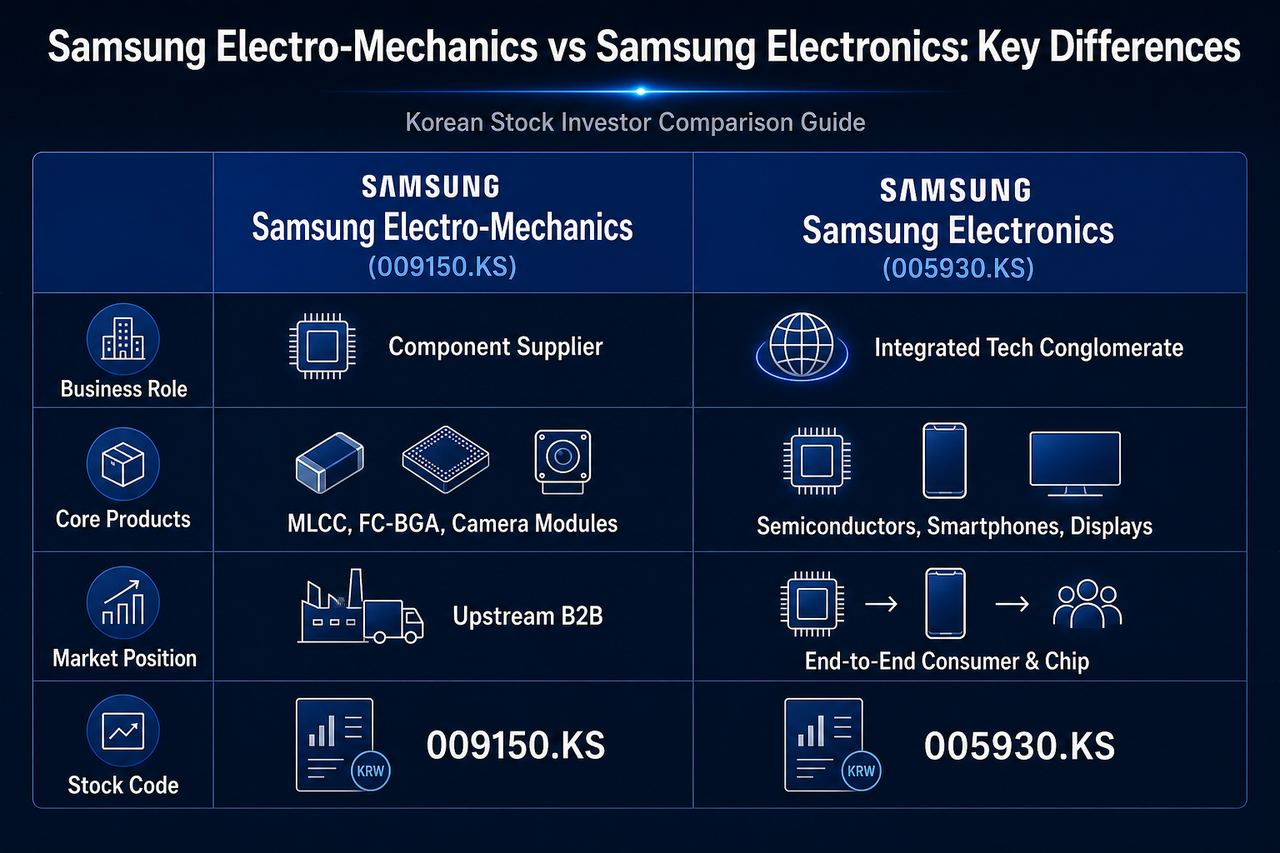
The table and accompanying image summarize the structural differences between the two companies across four dimensions: industrial chain position, representative products, revenue drivers, and stock codes. Samsung Electro-Mechanics and Samsung Electronics each have distinct business logics and industry exposures. The purpose of comparison is to clarify conceptual boundaries, not to form a judgment on the merits of either entity.
Conclusion
Samsung Electro-Mechanics (009150.KS) and Samsung Electronics (005930.KS) both belong to the Samsung Group, but their core difference lies in the division of labor within the industrial chain. Samsung Electro-Mechanics is positioned as an upstream component supplier of MLCCs, FC-BGA substrates, and optical modules, while Samsung Electronics covers semiconductor manufacturing and end businesses such as smartphones. They are separate listed entities, and their Korean stock codes, business divisions, downstream customers, and market positioning must each be understood independently. Samsung Electro-Mechanics provides a more systematic explanation of its roles in MLCC and FC-BGA technology and its listing mechanism on the Korean stock market, while the MLCC component business focuses on the technology and competitive structure of the passive component sector.
FAQ
Are Samsung Electro-Mechanics and Samsung Electronics the same company?
No. Samsung Electro-Mechanics (009150.KS) and Samsung Electronics (005930.KS) are independent listed entities under the Samsung Group. Their full company names, stock codes, primary businesses, and financial statements are all separate and should not be conflated.
What are the stock codes for Samsung Electro-Mechanics and Samsung Electronics?
The stock code for Samsung Electro-Mechanics on the KOSPI market is 009150.KS. The code for Samsung Electronics is 005930.KS. The suffix ".KS" indicates listing on the KOSPI market, and both are traded in South Korean Won.
Which company makes phones: Samsung Electro-Mechanics or Samsung Electronics?
Samsung Electronics manufactures consumer electronics such as Galaxy series smartphones, selling directly to consumers. Samsung Electro-Mechanics does not produce or sell complete phones, but it can supply upstream components like MLCCs and camera modules to phone manufacturers.
What is the business relationship between Samsung Electro-Mechanics and Samsung Electronics?
Samsung Electro-Mechanics can supply some of its products to Samsung Electronics for end-product manufacturing, creating supply chain synergy within the group. However, Samsung Electro-Mechanics also supplies global customers outside of Samsung Electronics. The two companies maintain independent business boundaries and listing entities.
Why do Korean stock investors easily confuse Samsung Electro-Mechanics and Samsung Electronics?
Both belong to the "Samsung Group" and have similar names, leading to ambiguity when using the abbreviated term "Samsung." Samsung Electronics (005930.KS) has a larger market capitalization and higher brand recognition, so some investors may default to referring to "Samsung stock" as 005930, overlooking the component supplier Samsung Electro-Mechanics (009150.KS). When researching, one must use the full company name and stock code to differentiate.
Which is better: Samsung Electro-Mechanics or Samsung Electronics?
Samsung Electro-Mechanics and Samsung Electronics have fundamentally different business positions, industry exposures, and revenue drivers. No simple comparison of superiority is possible. Understanding their division of labor within the industrial chain is a prerequisite for independently reviewing each company's business materials and risk factors.