Russia approaches cryptocurrency through a combination of separate laws, restrictions and experimental regimes that apply to specific activities. The European Union takes a more unified approach under the Markets in Crypto-Assets Regulation, which sets common rules for token issuers and crypto service providers. Russian regulation places greater emphasis on payment restrictions and supervised access, whereas MiCA establishes detailed requirements for authorisation, disclosure and market conduct.
TL;DR
-
Russia applies different rules to ownership, payments, mining, investment access and cross-border settlements rather than using one comprehensive crypto law.
-
MiCA establishes common requirements for crypto-asset issuers and authorised crypto-asset service providers across the European Union.
-
Russia generally restricts domestic cryptocurrency payments, although selected foreign-trade settlements can occur within experimental arrangements.
-
MiCA contains detailed rules for asset-referenced and e-money tokens, while Russia has no directly equivalent stablecoin classification.
-
A Russian crypto exchange does not receive the EU-style cross-border market access available to an authorised MiCA service provider.
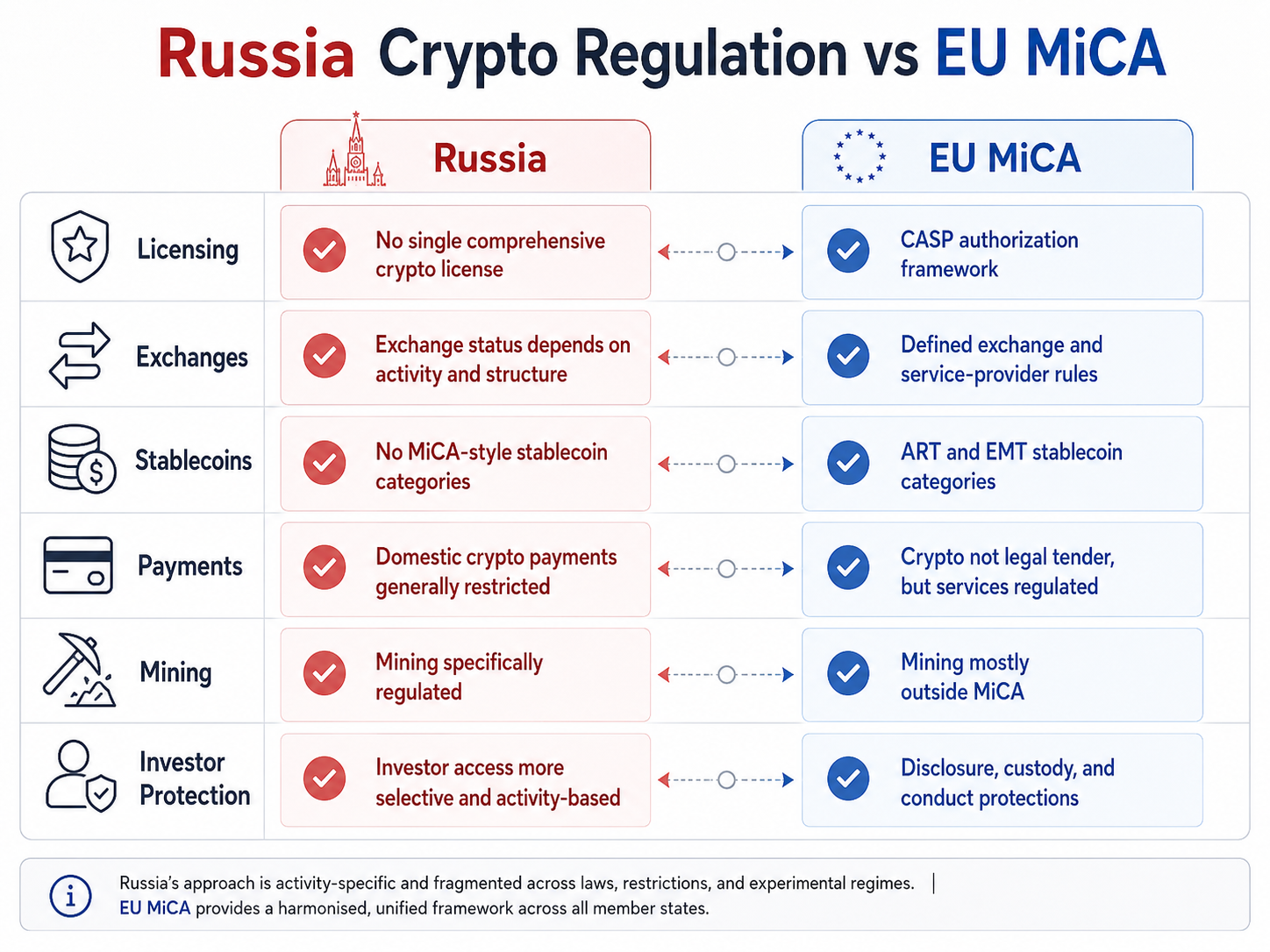
Russia Crypto Regulation vs MiCA at a Glance
The main difference is regulatory design. MiCA creates uniform requirements for crypto-asset issuers, offerors, trading applicants and crypto-asset service providers. Russia distributes crypto regulation across laws governing digital currency, digital financial assets, mining, taxation, payments and experimental transactions.
| Regulatory area |
Russia |
European Union under MiCA |
| Legal structure |
Separate laws and experimental regimes |
Harmonised EU regulation |
| Exchange authorisation |
No general MiCA-equivalent licence |
CASP authorisation |
| Cross-border access |
No regulatory passport |
EU-wide service access subject to MiCA procedures |
| Domestic payments |
Generally restricted |
MiCA does not make crypto legal tender |
| Stablecoins |
No equivalent ART and EMT structure |
Dedicated ART and EMT requirements |
| Mining |
Specifically regulated |
Mostly outside MiCA |
| Investor protection |
Activity-specific |
Disclosure, custody and conduct requirements |
| Foreign-trade settlements |
Controlled experimental use |
Covered through wider EU crypto and financial rules |
MiCA is therefore a market-entry and conduct framework. Russia operates more like a controlled-permission system in which the legality of each activity must be assessed separately.
How Does Russia Regulate Cryptocurrency?
Russia permits cryptocurrency ownership and certain transfers but maintains a restrictive position on its use as a domestic payment method. This distinction is fundamental to understanding whether cryptocurrency is legal in Russia.
Russia’s framework evolved through multiple legislative stages rather than one comprehensive act. Federal Law No. 259-FZ established key definitions for digital currency and digital financial assets, while subsequent measures addressed mining, taxation and experimental foreign-trade settlements. The sequence is set out in the Russia crypto regulation timeline.
The Bank of Russia has supported the use of cryptocurrency for selected foreign-trade transactions within an experimental legal regime. It has nevertheless maintained that private cryptocurrency should not become a general means of payment between Russian residents.
How Does EU MiCA Regulate Cryptocurrency?
MiCA regulates crypto-assets not already covered by other EU financial-services laws and establishes common rules for their issuance, public offering, admission to trading and related services. It distinguishes between ordinary crypto-assets, asset-referenced tokens and e-money tokens.
The stablecoin-related provisions began applying on June 30, 2024, while MiCA entered into full application on December 30, 2024.
Businesses providing covered services, including custody, exchange, order execution and trading-platform operation, generally require authorisation as crypto-asset service providers, or CASPs. MiCA also introduces governance, capital, custody, conflict-management and complaint-handling obligations.
Exchange Licensing and Market Access
MiCA gives cryptocurrency exchanges a defined authorisation pathway. An authorised CASP can provide covered services across EU member states through MiCA’s cross-border framework, subject to the applicable notification and supervisory procedures.
Russia has no directly comparable passporting system. The term Russian crypto exchange may refer to an offshore platform accessible to Russian users, a domestic operator handling permitted digital assets, or a participant in a restricted experimental regime. These models do not have the same legal status.
Platform availability alone therefore does not establish regulatory approval. A cryptocurrency exchange serving Russian users may need to consider restrictions involving domestic solicitation, financial products, payment activity, sanctions and anti-money-laundering controls. The wider Russia cryptocurrency legal framework must be analysed according to the service being offered.
Stablecoins and Token Issuance
MiCA provides much more detailed rules for token issuance. Issuers of many crypto-assets must publish a compliant white paper and disclose information about the project, rights attached to the token and material risks.
Asset-referenced tokens and e-money tokens are subject to additional requirements involving authorisation, reserves, redemption and supervision. MiCA also establishes registers and reporting structures for relevant issuers and white papers.
Russia distinguishes digital currency from regulated digital financial assets but does not replicate MiCA’s ART and EMT categories. The legal treatment of a token depends on its characteristics, issuing structure and whether it qualifies as a regulated financial instrument.
Payments and Cross-Border Settlements
Russia imposes a clearer separation between domestic payments and international settlements. Cryptocurrency generally cannot be used as an ordinary payment method for goods and services inside Russia, while approved businesses may test crypto-based foreign-trade settlements through experimental arrangements.
The Bank of Russia has also proposed prohibiting cryptocurrency settlements between residents outside an experimental legal regime. This remained a regulatory proposal in the cited materials and should not be presented as a completed general reform without checking the final enacted text.
MiCA does not make Bitcoin, stablecoins or other crypto-assets legal tender. Instead, it regulates issuance and service provision. Crypto payments and transfers may also fall under other EU rules concerning payment services, sanctions, anti-money-laundering controls and transfer traceability.
Mining and Investor Access
Mining is one area where Russia is more explicit than MiCA. Russian rules address who may conduct mining activities and allow authorities to restrict mining in designated regions. MiCA does not function as an EU-wide mining licence, so miners remain subject mainly to national corporate, energy, environmental and tax rules.
Russia has also considered tightly controlled direct investment access. In March 2025, the Bank of Russia proposed a three-year experimental regime for “especially qualified” investors. The proposed eligibility thresholds included more than ₽100 million in securities and deposits or more than ₽50 million in annual income. These figures came from a proposal, not a general retail-access rule.
MiCA does not impose an equivalent wealth threshold for all crypto investors. It instead places compliance duties on issuers and service providers, although eligibility, marketing and suitability rules may vary by product and other applicable laws.
The different treatment of investors, miners, exchanges and financial institutions shapes the broader Russia crypto law market impact.
Which Framework Is More Comprehensive?
MiCA is more comprehensive as a unified framework for crypto-asset issuance and service-provider supervision. It defines covered services, establishes authorisation routes and applies shared conduct requirements across the European Union.
Russia is more prescriptive in selected areas, especially domestic payment restrictions, mining and controlled cross-border settlement experiments. However, these provisions do not form a complete market framework comparable to MiCA.
The practical distinction depends on the participant:
-
Exchanges receive a clearer authorisation route under MiCA.
-
Token issuers face more detailed disclosure and stablecoin requirements in the EU.
-
Mining businesses encounter more explicit crypto-specific rules in Russia.
-
Russian investors face narrower and less standardised regulated access.
-
Cross-border businesses may use Russian experimental arrangements only under defined conditions.
Neither framework removes legal risk. MiCA must be read alongside EU anti-money-laundering, tax, sanctions and financial-services rules. Russian activities remain affected by secondary legislation, regulator decisions and the distinction between enacted law and policy proposals.
Summary
The Russia cryptocurrency legal framework regulates crypto through separate laws, restrictions and experimental regimes, while EU MiCA provides a unified system for token issuers and crypto service providers. MiCA offers clearer rules for exchange authorisation, stablecoin issuance, custody and investor protection across the European Union. Russia is more restrictive on domestic crypto payments but more explicit in areas such as mining and controlled cross-border settlements. The practical impact depends on the activity, since exchanges, issuers, miners and investors face different legal requirements in each jurisdiction.
FAQ
Is Russia’s cryptocurrency regulation similar to EU MiCA?
No. Russia uses separate laws, restrictions and experimental regimes, while MiCA establishes a harmonised framework for crypto-asset issuers and service providers across the European Union.
Can a Russian cryptocurrency exchange obtain MiCA authorisation?
A Russian-founded business may seek MiCA authorisation through an eligible EU legal entity that meets the relevant substance, governance and compliance requirements. Operating in Russia or providing a Russian-language interface does not itself provide EU market access.
Does MiCA make cryptocurrency legal tender?
No. MiCA regulates crypto-assets and related services but does not make Bitcoin or other privately issued crypto-assets legal tender in the European Union.
Can cryptocurrency be used for payments in Russia?
Cryptocurrency is generally restricted as a payment method for domestic goods and services. Certain foreign-trade settlements may be conducted within approved experimental arrangements.







