From a market perspective, stablecoin payments and cross-chain settlements accelerated between 2025 and 2026, with businesses showing clearly higher demand for low-cost, auditable, and programmable payment infrastructure. According to official figures from Request Network, the network's cumulative processed volume has surpassed $2 billion, and continuous updates have been rolling out since March 2026 around merchant migration and new product launches, putting REQ's token model back in the market spotlight.
From an industry value standpoint, REQ matters not just for "pay once, use once," but for linking payment flow, on-chain financial data, protocol governance, and developer ecosystem. Only if the tokenomic model achieves both usage efficiency and value retention can Request Network evolve from a payment tool into a core layer of Web3 financial infrastructure.
Core Functions and Use Cases of the REQ Token
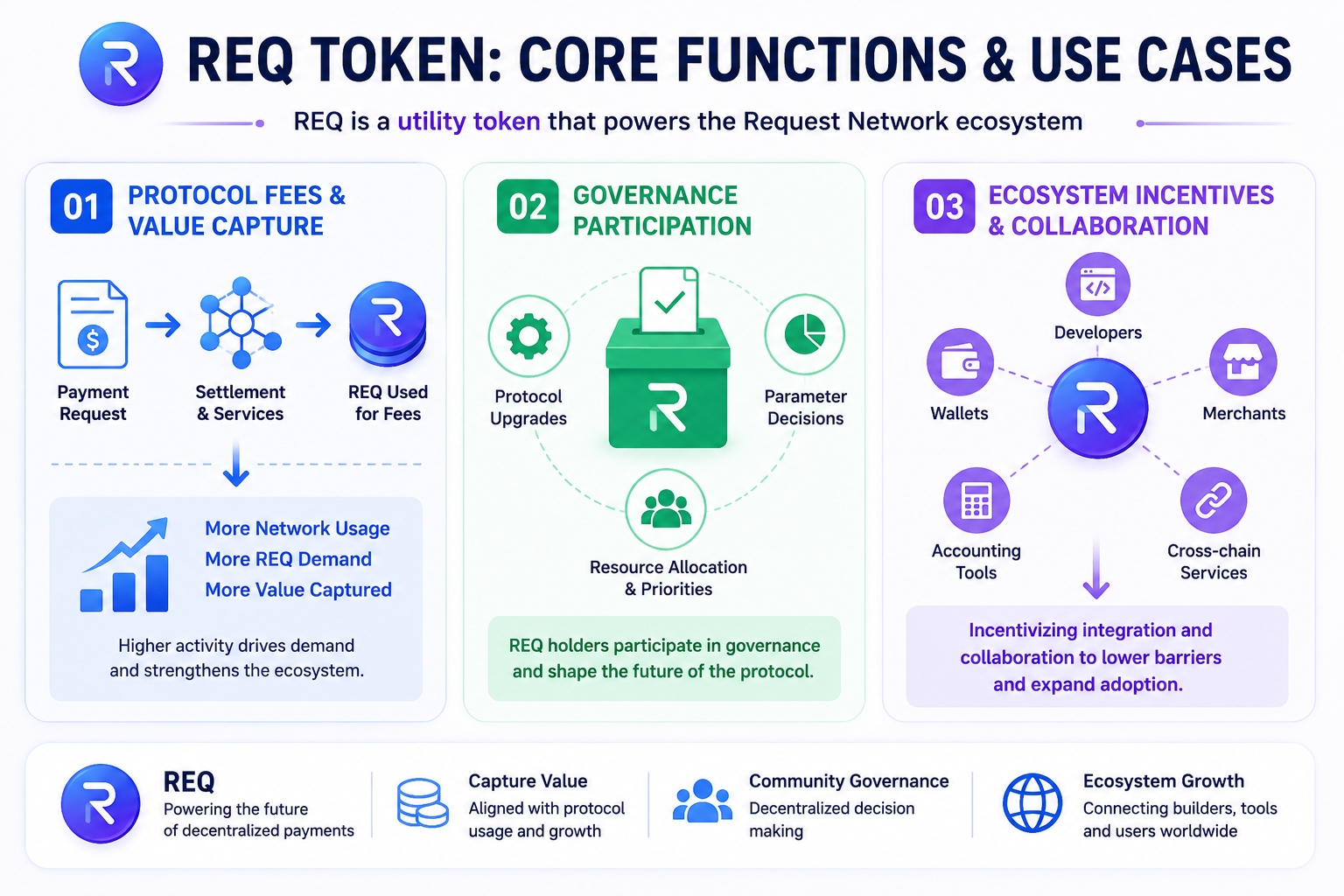
REQ is designed as a utility token, not a pure security token. Based on the protocol's public documentation and ecosystem practices, REQ serves three main use cases.
First, protocol fees and value capture. When Request Network processes payment requests and related services, protocol fees and settlement routes come into play. REQ plays a critical role in this fee mechanism. As usage rises, a tighter correlation forms between token demand and network activity.
Second, governance participation. As the protocol expands into multi-chain payments, merchant tools, and API services, parameter and roadmap decisions require community governance. REQ acts as a governance vehicle, empowering token holders to influence protocol upgrade directions, resource allocation priorities, and more.
Third, ecosystem incentives and coordination. REQ also serves as an incentive mechanism connecting developers, integrators, and ecosystem participants. For a payment protocol to scale, it needs not only end users but also wallets, accounting tools, merchant systems, and cross-chain services. Token incentives reduce friction for early integration.
REQ Token Distribution and Incentive Mechanism
Evaluating a payment protocol token requires more than total supply; you must also examine whether the distribution structure supports long-term network growth. For REQ, the distribution logic should focus on three aspects: initial allocation, circulation pace, and incentive direction.
At the initial allocation level, the market typically looks at shares held by the team, foundation, early investors, and community. A reasonable structure balances "long-term commitment from builders" with "community liquidity," avoiding excessive concentration that harms governance or excessive dispersion that lowers execution efficiency.
At the circulation pace level, unlock schedules and release paths directly impact secondary market pressure. If releases are too fast before real payment demand emerges, token prices get suppressed by supply. If releases align with product milestones, partnership wins, and transaction volume growth, markets form more stable expectations.
At the incentive direction level, the key for REQ isn't "how many rewards are given" but "whether rewards translate into actual payment behavior and developer retention." Quality incentives typically tie to verifiable metrics like merchant activity, payment success rate, integration depth, and long-term retention, not short-term volume farming.
Role of REQ in Payment Protocols and Governance Systems
Within Request Network, REQ functions as the "coordinator of the payment network." Payment protocols naturally involve multiple parties: payers, payees, merchant systems, cross-chain routers, accounting tools, and tax tools. Without a unified economic coordination mechanism, sustained network expansion is difficult.
At the payment protocol layer, REQ bridges programmable fees and settlement logic. The more real payments and enterprise accounting scenarios the network handles, the clearer the protocol's functional demand for the token becomes. In other words, REQ's value foundation leans more toward a "network effect amplifier" than a one-time narrative driver.
At the governance layer, REQ's significance lies in binding long-term participants to protocol decisions. Official updates from 2026 show Request Network advancing merchant migration and payment product expansion while strengthening the decentralized product direction. Such phases require governance to balance efficiency and decentralization. The quality of REQ holder participation directly influences protocol roadmap stability.
How REQ Drives Web3 Financial Ecosystem Growth
The core question for the Web3 financial ecosystem isn't "can we transfer?" but "can we build scalable financial processes?" Request Network's growth path extends from payment requests to financial automation.
First, payment standardization. On-chain payments without standard fields and verifiable records make enterprise reconciliation, auditing, and tax processing difficult. Request Network's request layer design turns payments from simple address transfers into data flows with business context, which is critical for enterprise adoption.
Second, enhanced cross-chain availability. According to official migration documents, Request has been expanding multi-chain payment coverage in recent years, emphasizing accessibility for major stablecoin users. With better cross-chain capabilities, merchant integration barriers drop, making it easier for the payment network to achieve scale.
Third, merchant migration and product iteration. In March 2026, the team released merchant-facing alternatives following Coinbase Commerce's shutdown, along with updates on decentralized products and infrastructure partnerships. Such "real business migrations" validate the protocol's commercial capacity more effectively than pure marketing and are more likely to drive long-term REQ demand.
Key Factors Influencing REQ Token Value
REQ's short-term price is swayed by market sentiment, but medium to long-term performance depends on fundamentals. The main factors can be grouped into six.
- Protocol real usage – payment count, settlement volume, merchant retention, active addresses, etc., form the most direct value base.
- Fee mechanism and token capture efficiency – whether protocol fees effectively flow back into the tokenomic model determines if "business growth" maps to "token value growth."
- Ecosystem integration breadth – more integrations with wallets, exchanges, accounting SaaS, payment plugins, and enterprise APIs strengthen the network effect.
- Governance efficiency – persistently low participation or high fragmentation slows product iteration; high governance quality gives token governance rights real value.
- Macro and regulatory environment – changes in stablecoin regulation, cross-border payment compliance, and on-chain financial audit requirements all affect growth space for Request-like protocols.
- Market liquidity and trading structure – liquidity depth, concentration of holdings, unlock schedule, and market cycles affect valuation ranges.
Community and Developer Incentive Models of Request Network
A payment protocol's long-term competitiveness ultimately depends on whether developers and merchants stick around. Request Network's incentive model can be observed from two angles.
From the community angle, the focus is on participation barrier and contribution feedback. If governance proposals, educational content, and ecosystem activities involve non-technical users in value creation, community quality becomes more stable and less dependent on short-term price swings.
From the developer angle, the focus is on documentation, SDK, API experience, and incentive transparency. In public updates during 2025-2026, Request has steadily advanced documentation, product releases, and infrastructure collaborations, signaling a focus not only on token narrative but also on developer usability. For REQ, such investments expand the "integratable" surface area, thereby driving real payment demand rather than just trading demand.
Key Risks to Consider When Investing in REQ
First, business adoption risk. Payment protocol valuation relies on real transaction volume. If merchant growth and retention fall short, token value capture weakens.
Second, competitive risk. The crypto payments space includes exchange-built payments, independent gateways, stablecoin-native payment layers, and more. Request must continuously prove differentiation.
Third, regulatory and compliance risk. Cross-border payments, stablecoin settlements, and enterprise financial data processing are under regulatory flux. Policy changes could impact expansion speed.
Fourth, tokenomic execution risk. If allocation, unlock, and incentive parameters are mismatched with the business phase, selling pressure and misaligned community expectations may arise.
Fifth, technical and security risk. Payment protocols involve multi-chain, routing, and infrastructure dependencies. Smart contract bugs, service outages, or third-party component issues can harm ecosystem trust.
Long-Term Development Potential of the REQ Ecosystem
In the long run, REQ's potential lies not in "whether it becomes the next hot token" but in whether Request Network can hold its position as Web3 financial infrastructure. If the protocol steadily expands merchant scenarios, improves cross-chain payment experience, strengthens developer tools, and closes the loop between the tokenomic model and real usage, REQ's long-term value foundation will be stronger.
Official updates in 2026 send two positive signals: first, the ability to address real merchant pain points via migration support; second, continued building around decentralized payment products and infrastructure partnerships. For medium-to-long-term observers, these signals are more worth tracking than short-term price fluctuations, as they directly relate to network usage depth and token capture efficiency.
Summary
REQ's tokenomic model essentially answers one question: how does a payment protocol's growth translate into sustainable token value? Around core functions, distribution incentives, governance participation, and ecosystem expansion, REQ has built a relatively complete structural framework. Its future performance still depends on the balance among real payment demand, developer adoption, regulatory environment, and execution efficiency. Evaluating REQ from a "Web3 financial infrastructure" lens brings you closer to its long-term value logic than focusing on short-term market moves.