Record 327,000 New Ethereum Addresses Added Daily as On-Chain Demand Heats Up Across the Network

Last Updated 2026-03-25 22:07:34
Reading Time: 1m
Daily new Ethereum wallet creation has exceeded 327,000, marking an all-time high. This article examines the fundamental drivers behind the rapid increase in ETH addresses, focusing on on-chain data, market demand, fee structure, and industry trends. It further discusses the potential implications for DeFi, Layer 2 scaling, and ETH price.

Recent on-chain monitoring data reveals that Ethereum has reached an all-time high in new wallet addresses, with daily additions nearing 394,000 and a weekly average holding steady at a record 327,000. This milestone not only surpasses previous years’ records but also prompts the industry to reconsider the genuine growth in demand on the Ethereum network.

Ethereum Wallet Growth Sets New Record

The number of new wallets serves as a crucial indicator of network activity and potential user expansion. A single-day increase of over 327,000 wallets signals that more users are engaging with the Ethereum ecosystem—creating self-custody wallets, utilizing L2 networks, deploying smart contracts, and participating in on-chain applications.

Historically, this metric has spiked during bull markets. However, the current surge appears driven by expanding use cases rather than price speculation alone. Many analysts now believe Ethereum’s fundamentals are entering a new growth phase.

Key Drivers of Increased On-Chain Activity

On-chain analysis suggests that several demand factors are converging to fuel this growth:

  • Stablecoin transfer demand is rising: USDT and USDC on-chain circulation has climbed steadily over the past two months, while L2 scaling has reduced transfer costs, encouraging more users to create new addresses.
  • Smart contract activity is increasing: NFTs, DeFi, and blockchain gaming have seen renewed activity, with popular projects attracting large user inflows.
  • New accounts for L2 network interaction: The expansion of L2 solutions like Arbitrum, Optimism, and Base has led users to create numerous new addresses to interact with rollups in early phases.

These developments show that the surge in wallet creation is not the result of a single driver, but rather the simultaneous expansion of multiple segments within the Ethereum ecosystem.

Fee Reductions and L2 Application Expansion as Catalysts

The Fusaka upgrade has optimized transaction costs, further lowering base-layer fees and making on-chain operations more accessible. Previously, high fees discouraged new users from creating wallets, making small transfers, or testing applications. Now, reduced costs are much more conducive to broad adoption.

Simultaneously, the widespread rollout of L2 scaling has shaped the Ethereum ecosystem into a model where large user activity occurs on L2, with settlement on L1. The explosive growth in new addresses aligns with this trend.

Does the Surge in New Addresses Signal a Price Upside?
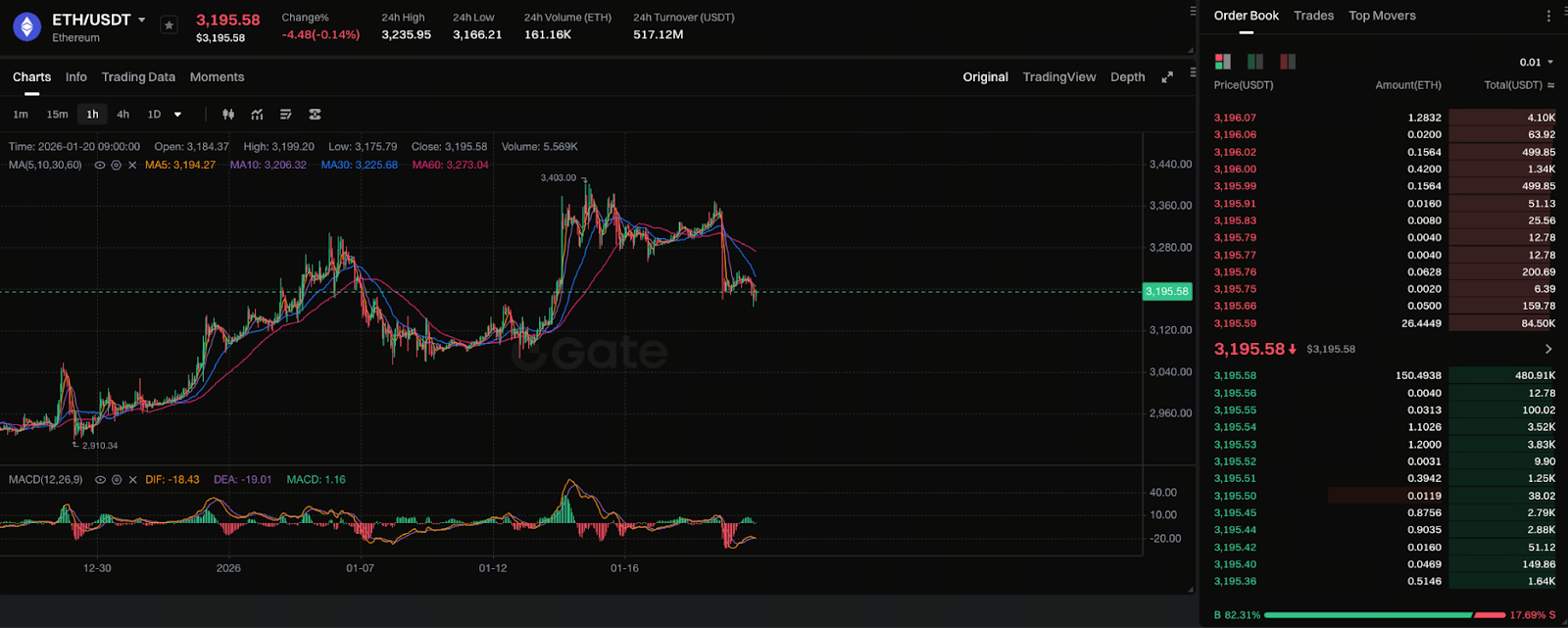

Chart: https://www.gate.com/trade/ETH_USDT

While wallet growth is typically a bullish fundamental indicator, ETH’s price has not responded with a significant rally, and the market remains in a consolidation phase. Three main factors explain this:

  • Not all new wallets represent active users—some addresses are generated by applications, bots, or algorithmic trading systems.
  • Macroeconomic sentiment outweighs fundamentals: Even with strong fundamentals, Ethereum remains subject to broader macro conditions and risk appetite.
  • Market reaction to upgrades and narratives often lags: Historically, major ETH rallies have emerged months after improvements in network metrics.

As a result, the surge in new addresses signals fundamental improvement rather than serving as a short-term price catalyst.

Potential Impact on ETH’s Future Market

If record wallet growth continues, several outcomes are possible:

  • Enhanced value capture for the network, supporting ETH’s long-term valuation
  • Greater activity in DeFi, NFT, and blockchain gaming sectors
  • Increased capital inflows into the Ethereum ecosystem
  • Foundation for future price breakthroughs

Overall, this represents “usage-driven growth” rather than speculative momentum.

Summary: Ethereum Network Fundamentals Enter a New Phase

Ethereum wallet creation has reached an all-time high. The recent surge in new addresses results from a combination of structural factors—lower fees, L2 scaling, renewed application activity, and rising stablecoin demand. While short-term price movement remains muted, the Ethereum ecosystem is showing stronger fundamental demand, and sustained network usage growth will be a critical pillar for long-term valuation.

Author:  Max
Disclaimer
* The information is not intended to be and does not constitute financial advice or any other recommendation of any sort offered or endorsed by Gate.
* This article may not be reproduced, transmitted or copied without referencing Gate. Contravention is an infringement of Copyright Act and may be subject to legal action.

Related Articles

The ve(3,3) Flywheel Explained: How AERO Tokenomics Powers Aerodrome’s DeFi Economy
Beginner

The ve(3,3) Flywheel Explained: How AERO Tokenomics Powers Aerodrome’s DeFi Economy

In the competition for DeFi liquidity, high-inflation mining alone is no longer enough to build lasting advantages. Aerodrome applies the ve(3,3) economic model to redesign token emissions, voting mechanisms, and revenue distribution, creating a liquidity flywheel centered on governance and cash flow. This article examines AERO tokenomics, the veAERO locking mechanism, and protocol revenue models to explain how Aerodrome builds a sustainable DeFi economic system.
2026-03-25 06:41:58
AI-Native Settlement Layers: How United Stables Is Building the Next Financial Rail
Beginner

AI-Native Settlement Layers: How United Stables Is Building the Next Financial Rail

Stablecoins were originally designed as dollar substitutes within exchanges, primarily used for asset pricing and trade settlement. As on-chain financial ecosystems have matured, their role has expanded beyond simple payments to include collateral assets, cross-chain liquidity mediums, and unified settlement units. In particular, as AI systems and automated agents begin to participate directly in economic activity, demand has risen sharply for programmable value units capable of instant settlement. This shift is pushing stablecoins toward the role of foundational financial infrastructure.
2026-03-25 03:16:17
Aerodrome Tokenomics: How ve(3,3) Powers Base's Most Profitable DEX
Beginner

Aerodrome Tokenomics: How ve(3,3) Powers Base's Most Profitable DEX

AERO is the native token of Aerodrome Finance, a core decentralized exchange and liquidity protocol in the Base ecosystem. It is primarily used for liquidity incentives and ecosystem operations. veAERO is a governance NFT that users receive by locking AERO, representing both voting power and the right to share protocol revenue. Through a dual track structure of AERO as a utility token and veAERO as a governance credential, Aerodrome separates liquidity usage value from long term governance power, allowing participants to act as liquidity providers, governance decision makers, and revenue sharers within the same system.
2026-03-25 06:40:31
How Does PAXG Work? In-Depth Overview of the Physical Gold Tokenization Mechanism
Beginner

How Does PAXG Work? In-Depth Overview of the Physical Gold Tokenization Mechanism

PAXG (Pax Gold) is a tokenized asset backed by physical gold, issued by the fintech company Paxos and traded on the Ethereum blockchain as an ERC-20 token. The core concept is to tokenize physical gold on-chain, with each PAXG token representing ownership of a certain amount of gold. This structure enables investors to hold and trade gold in the form of a digital asset.
2026-03-24 19:12:51
How is the price of PAXG determined? Pegging mechanism, trading depth, and influencing factors
Beginner

How is the price of PAXG determined? Pegging mechanism, trading depth, and influencing factors

PAXG (Pax Gold) is a tokenized asset backed by physical gold reserves, launched by fintech firm Paxos and issued as an ERC-20 token on the Ethereum blockchain. The core concept is to digitally represent real-world gold assets, allowing investors to hold and trade gold via the blockchain network. Because each PAXG token corresponds to a specific quantity of physical gold, its price is theoretically expected to closely track the global gold market.
2026-03-24 19:11:40
Aster vs Hyperliquid: Which Perp DEX Will Prevail?
Beginner

Aster vs Hyperliquid: Which Perp DEX Will Prevail?

Aster and Hyperliquid are the two representative protocols of the "purpose-built L1 path" within the current decentralized perpetual exchange (Perp DEX) sector. As a pioneer in the field, Hyperliquid has built a deep liquidity moat through its highly mature order book architecture and strong community consensus. Conversely, Aster, as a rising challenger, seeks to leapfrog the competition in high-performance trading through more aggressive multi-chain aggregation logic, private transaction modules, and an underlying execution environment optimized for 2026 market demands.
2026-03-24 11:58:33





