From traditional banking and securities markets to the insurance industry, risk transfer mechanisms have long been a fundamental pillar of financial stability. Within the blockchain ecosystem, however, infrastructure development has historically focused on trading, lending, and yield-generating products, while the insurance sector has remained relatively underdeveloped.
As the scale of DeFi, stablecoins, and Real-World Assets (RWAs) continues to expand, the on-chain economy is increasingly facing challenges similar to those encountered in traditional finance. Smart contract vulnerabilities, protocol exploits, custody risks, and extreme market events can all result in significant losses for users and institutions. Against this backdrop, insurance is gradually emerging as a critical component of blockchain infrastructure.
Re seeks to address more than the risks faced by individual protocols. By bringing the real-world reinsurance market on-chain, it aims to provide the broader digital asset ecosystem with more mature and scalable risk management capabilities. To understand the value of Re, it is necessary to examine its practical use cases.
Re's Core Products
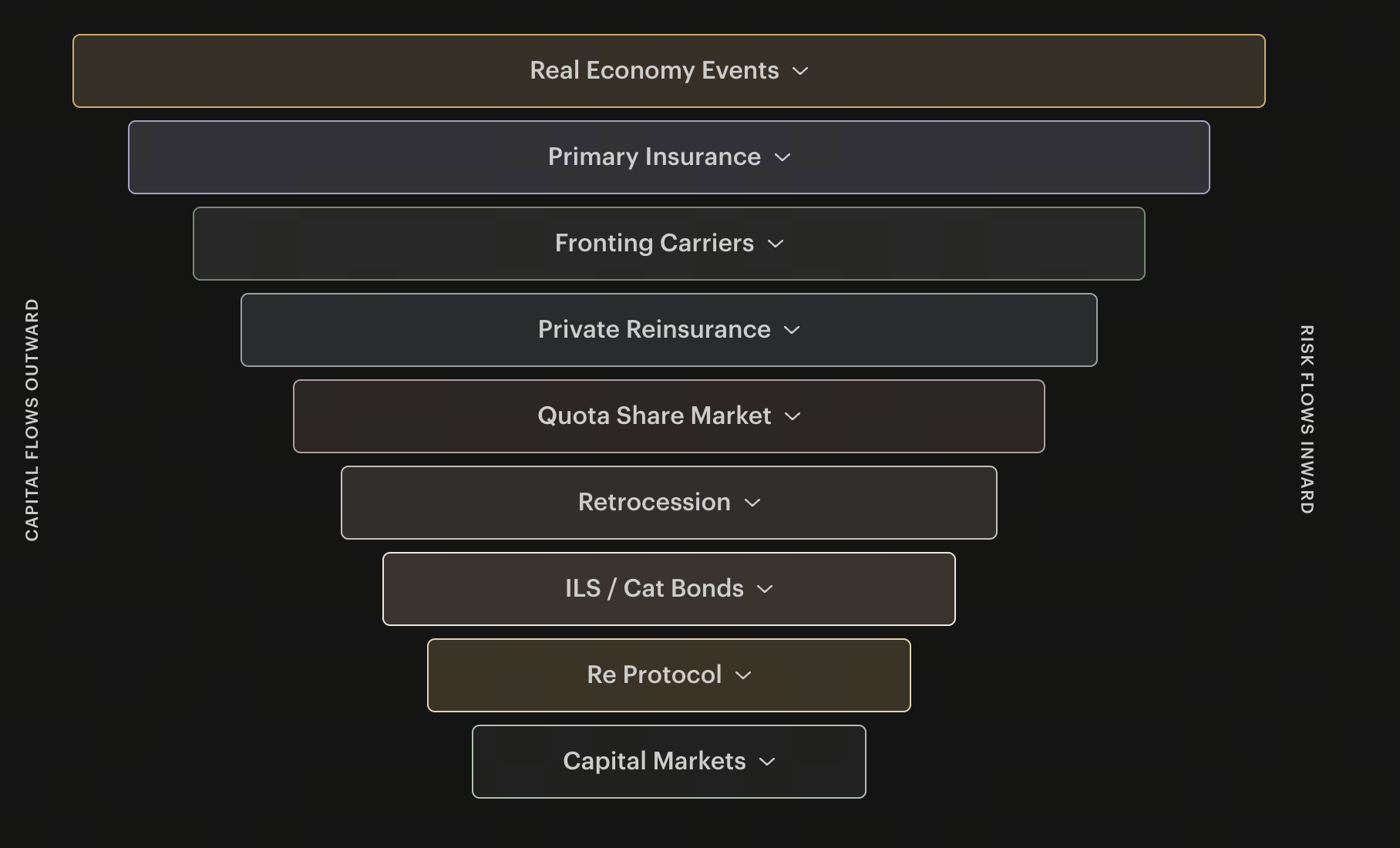
In traditional insurance markets, reinsurers play an essential role in risk diversification and capital support. As insurance companies expand their underwriting activities, they often rely on reinsurance providers to reduce concentrated risk exposure. Re introduces this model to the blockchain ecosystem by using its Insurance Capital Layer to attract on-chain capital into reinsurance markets.
Re is a blockchain protocol focused on the reinsurance market, designed to connect on-chain capital with the traditional insurance industry. Unlike many insurance-focused crypto projects that primarily provide smart contract coverage, Re focuses on the insurance capital market itself, seeking to improve the liquidity, transparency, and accessibility of insurance capital through blockchain technology.
The protocol's core products include reUSD and reUSDe, two insurance capital assets representing different risk tranches within the capital structure. Both generate returns through exposure to real-world reinsurance activities. Because their underlying yield is derived from insurance markets rather than cryptocurrency trading activity, Re offers on-chain participants an asset allocation approach that is more closely aligned with traditional financial markets.
From a practical perspective, Re is not merely an insurance protocol but a broader risk management infrastructure designed for the blockchain ecosystem.
Source: re.xyz
Why Do DeFi Protocols Need Insurance Mechanisms?
The rapid growth of DeFi has introduced unprecedented openness to blockchain-based finance, but increased openness also brings greater risk exposure. Users can freely participate in lending, trading, staking, and derivatives markets, yet losses resulting from smart contract vulnerabilities are often difficult to recover.
Over the past several years, numerous smart contract exploits have resulted in losses ranging from hundreds of millions to billions of dollars. These incidents demonstrate that even audited protocols remain vulnerable to code risks, oracle failures, and governance-related issues. For users, higher yields often come with substantial uncertainty.
Insurance mechanisms help transfer a portion of these risks to specialized capital providers. Through insurance markets, users and protocols can obtain protection against certain risks in exchange for a premium, thereby increasing confidence in market participation. The development of traditional financial markets has demonstrated that insurance is an indispensable component of a mature financial system.
As DeFi continues to evolve toward greater institutional adoption and scale, the importance of insurance is likely to increase. The on-chain insurance capital model represented by Re provides DeFi participants with a risk management framework that more closely resembles those found in traditional financial markets.
How Does Re Support Smart Contract Risk Coverage?
Smart contract risk remains one of the most common sources of risk within the blockchain ecosystem. Code vulnerabilities, logic errors, access control weaknesses, and oracle failures can all result in substantial losses.
Traditional insurance models often struggle to cover on-chain risks because many insurers lack the expertise required to evaluate smart contract security. At the same time, many crypto-native insurance projects face capital constraints that limit their ability to underwrite large-scale risks.
Re's innovation lies in combining on-chain capital with real-world insurance markets. Through its Insurance Capital Layer, the protocol can provide underwriting capacity for insurance-related activities, enabling support for larger and more sophisticated risk management needs. Insurance capital pools allow risk to be distributed across a broader group of market participants.
For DeFi protocols, this model helps establish a more sustainable risk management framework. As insurance capital pools grow, the capacity to provide coverage for blockchain-based projects may increase as well, contributing to a more resilient ecosystem.
How Does Re Support Digital Asset Holders?
Digital asset holders face risks that extend beyond market volatility. Custody failures, protocol vulnerabilities, infrastructure breakdowns, and systemic market events can all lead to losses. Even users who avoid high-risk DeFi activities may be affected by exchange failures, cross-chain bridge exploits, or stablecoin-related incidents.
In traditional financial markets, insurance serves as an important risk management tool. Deposit insurance, investor protection programs, and corporate insurance products all play significant roles in mitigating financial risks. As digital asset markets mature, similar forms of protection are likely to become increasingly important.
The insurance capital market established by Re provides a potential capital foundation for future digital asset protection products. While specific insurance products may be offered by various institutions, the Insurance Capital Layer can supply the underwriting capacity necessary to support such products. As insurance markets continue to mature, digital asset holders may gain access to a broader range of protection solutions.
From a long-term perspective, the development of insurance infrastructure may improve both the credibility and stability of digital asset markets.
Re's Role in Institutional Risk Management
As institutional investors enter the digital asset market, the demand for comprehensive risk management solutions continues to increase. Compared with retail investors, institutions are often required to comply with stricter regulatory standards and establish systematic risk control frameworks.
Asset managers, trading platforms, and financial service providers entering the digital asset industry must evaluate custody risks, operational risks, and technology-related risks. The absence of a mature insurance market has long been considered a major barrier to large-scale institutional participation in the crypto sector.
Re's model introduces a new source of capital for institutional insurance markets. By bringing insurance capital on-chain, the protocol seeks to improve capital efficiency while increasing underwriting capacity. This approach follows the core logic of traditional reinsurance markets while offering enhanced transparency and liquidity.
As RWAs and institutional capital continue to enter the blockchain industry, the importance of insurance infrastructure is likely to increase. The reinsurance network developed by Re serves as a bridge between traditional financial risk management systems and digital asset markets.
How Can On-Chain Insurance Expand the Blockchain Ecosystem?
The blockchain industry has traditionally developed around trading, lending, and payment services. However, mature financial systems encompass far more than these functions. Insurance, risk management, and capital allocation are equally important components of a comprehensive financial ecosystem.
Insurance markets can improve capital efficiency by providing risk protection. Investors who are protected against certain risks may be more willing to participate in innovative financial products and emerging projects. For protocol developers, insurance mechanisms can also reduce systemic risk and strengthen user confidence.
Re is not merely advancing a single insurance product but promoting the tokenization of the broader insurance capital market. By transforming insurance capital into composable on-chain assets, the protocol can create synergies with lending platforms, yield management systems, and asset management applications.
This model suggests that insurance may evolve from a standalone industry into an integrated component of blockchain finance. As insurance capital markets continue to expand, blockchain financial infrastructure may become increasingly complete and sophisticated.
What Challenges Limit the Growth of Re's Use Cases?
Despite the significant potential of on-chain insurance, the sector continues to face numerous challenges. Insurance is fundamentally a risk management business that depends on long-term data accumulation, actuarial expertise, and robust capital management frameworks.
For Re, one of the primary challenges lies in balancing blockchain-based openness with real-world regulatory requirements. Reinsurance involves complex legal structures, capital regulations, and compliance frameworks, meaning that many critical processes still depend on traditional financial institutions and regulatory systems.
Additionally, insurance markets generally develop at a slower pace than other crypto sectors. Unlike trading or lending products, insurance requires long-term trust and extensive historical data to validate risk models. As a result, insurance capital markets often expand more conservatively, resulting in longer growth cycles.
For on-chain insurance to become a mainstream component of financial infrastructure, challenges related to capital scale, regulatory coordination, and market education must still be addressed. Nevertheless, as DeFi, RWAs, and institutional participation continue to grow, the importance of insurance is becoming increasingly evident.
Conclusion
Re is a protocol that connects blockchain-based capital with the real-world reinsurance market. Its applications span DeFi risk management, smart contract protection, digital asset coverage, and institutional risk management. Unlike traditional blockchain insurance projects, Re focuses on the insurance capital market itself, using capital layers such as reUSD and reUSDe to provide underwriting capacity across the ecosystem.
As on-chain finance continues to mature, insurance infrastructure is likely to become an increasingly important foundation for the long-term development of digital asset markets.
FAQ
What are the primary use cases of Re?
Re is primarily used in DeFi risk management, smart contract protection, digital asset insurance, institutional risk management, and the development of on-chain insurance capital markets.
How does Re differ from traditional insurance protocols?
Re focuses on reinsurance and insurance capital markets rather than solely offering individual insurance products. The protocol uses on-chain capital to support real-world insurance activities while improving market transparency and liquidity.
Why does DeFi need insurance mechanisms?
DeFi protocols face risks such as smart contract vulnerabilities, oracle failures, and governance-related issues. Insurance mechanisms help users and protocols transfer some of these risks, improving overall market stability.
How does Re support institutional participation in digital asset markets?
Re introduces additional capital into insurance markets and enhances underwriting capacity, helping institutions establish more comprehensive risk management frameworks.
Will on-chain insurance become part of blockchain infrastructure?
As digital asset markets continue to expand and institutional participation increases, insurance is gradually becoming an important component of blockchain-based financial systems. On-chain insurance capital markets represent a key development within this broader trend.







