As AI Agents, InfoFi, and autonomous economic networks continue to develop, prediction markets are evolving from simple on-chain betting tools into important information coordination systems for the AI era. Markets are no longer just venues for trading. They are beginning to support real-time probability discovery, collective consensus aggregation, and autonomous decision-making.
Polymarket is currently one of the best-known on-chain prediction market platforms. Its main goal is to let everyday users trade on event outcomes across politics, economics, sports, and crypto markets. Rain, by contrast, focuses more on protocol-layer capabilities. It aims to help developers, creators, and AI Agents create prediction markets on their own and embed them into the AI-native internet.
What Is Rain?
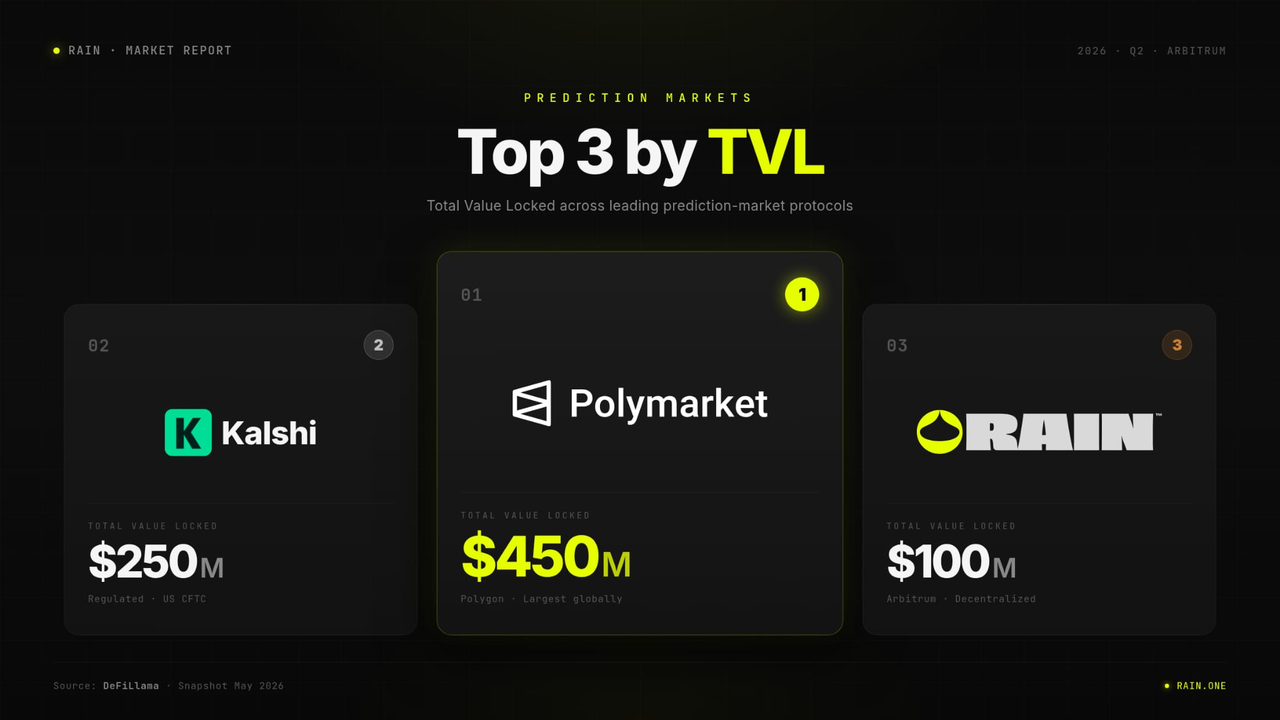
Rain is closer to a prediction market infrastructure protocol than a single application platform. Its core goal is to allow any developer to quickly create their own prediction market product, while also enabling AI Agents to connect directly to the prediction market ecosystem.
Rain is designed around modular market creation, AI-native interaction, and composability. Developers can use Rain to build AI Forecasting Products, DAO Governance Markets, SocialFi markets, and Autonomous Markets.
This structure makes Rain feel more like an operating system for prediction markets than a standalone consumer application.
What Is Polymarket?
Polymarket is more oriented toward end users.
Users can enter the platform directly and trade on the outcomes of future events. Its markets are usually built around trending news, political elections, cryptocurrency prices, and sports events, with trading activity forming real-time probability prices.
Polymarket’s strengths lie in its mature market experience, large user base, and event market liquidity. Compared with an infrastructure protocol, it is more like a large-scale prediction market application platform.
How Do Rain and Polymarket Differ in Positioning?
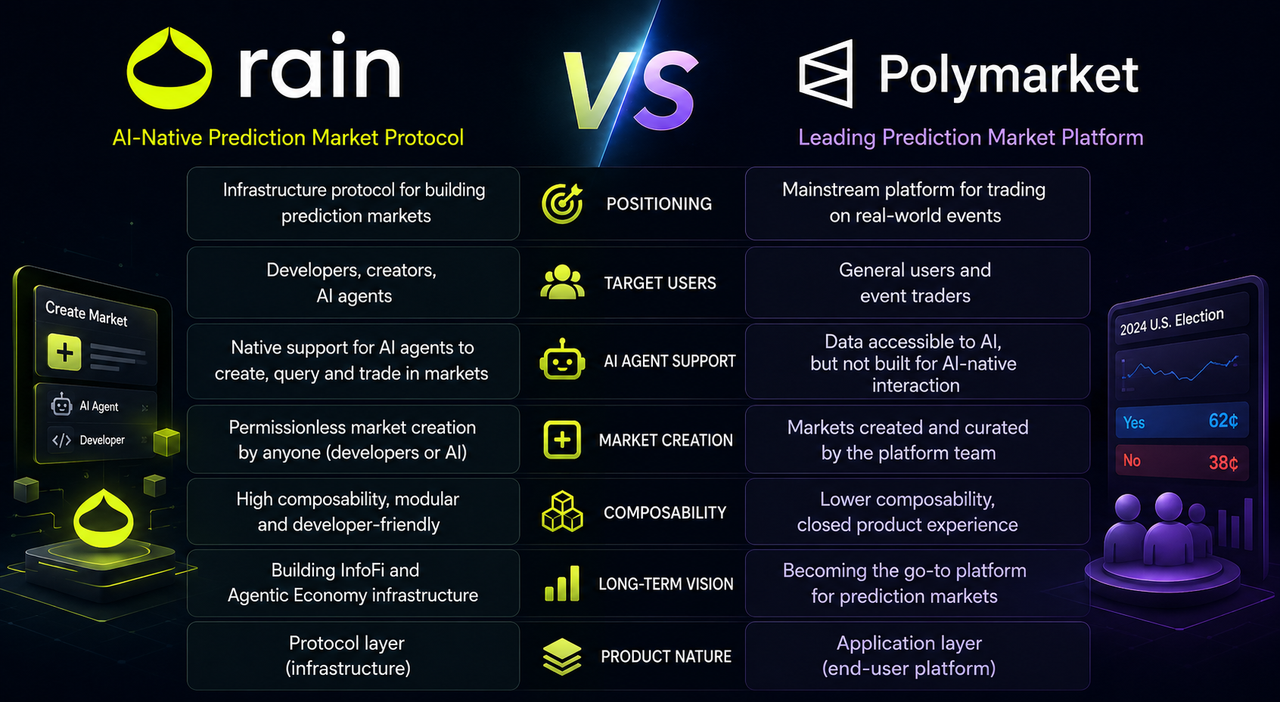
The biggest difference between the two lies in their positioning at the protocol layer and application layer.
Polymarket’s core goal is to operate a prediction market platform, so it places greater emphasis on user experience, trending event operations, market liquidity, and trading activity.
Rain, on the other hand, focuses on AI Agent Integration, developer tools, market creation capabilities, Forecasting Infrastructure, and a composable protocol layer.
Put simply, Polymarket mainly serves everyday users, while Rain is built more for developers and AI Systems.
How Do Rain and Polymarket Differ in Market Creation?
Polymarket’s markets are usually created by the platform operator, with a focus on current trending events.
Rain places more emphasis on Permissionless Market Creation. In theory, any developer, community, or even AI Agent can create new prediction markets using Rain.
This open structure is more aligned with the development logic of Web3 protocols, and it is also better suited to a future in which large numbers of AI Agents automatically generate prediction markets.
As AI automation advances, prediction markets may no longer be operated manually. Instead, they may be continuously created and adjusted by autonomous Agent networks.
How Do Rain and Polymarket Differ in Liquidity Structure?
One of Polymarket’s biggest advantages today is that it has already built strong user scale and market liquidity.
During major political events or market热点 periods, Polymarket can often form deep trading markets and attract significant attention.
By comparison, Rain is currently more focused on the protocol and infrastructure development stage. Its priority is not entirely short-term liquidity scale, but long-term protocol capabilities, AI Agent integration, and developer ecosystem expansion.
The two clearly focus on different priorities at different stages.
How Do Rain and Polymarket Differ in Their Developer Ecosystems?
Rain places greater emphasis on the developer ecosystem and protocol composability.
Developers can use Rain to create independent prediction market products and integrate them into:
This structure means Rain is not just a standalone platform. It can also become a foundational module within the broader AI and Web3 ecosystem.
Polymarket, by contrast, is more like a unified operating platform, where developers have relatively limited participation in the underlying market structure.
Rain vs Polymarket Comparison Table
| Comparison Dimension |
Rain |
Polymarket |
| Project Positioning |
Infrastructure protocol |
Consumer-facing application |
| Core Users |
Developers, AI Agents |
Everyday users |
| AI Agent Support |
Native support |
Limited |
| Market Creation |
Open creation |
Platform-led |
| Developer Tools |
Strong |
Medium |
| Composability |
High |
Relatively low |
| Main Direction |
InfoFi, Agent Economy |
Trending prediction markets |
| Protocol Structure |
Modular infrastructure |
Platform-style application |
Conclusion
Although Rain and Polymarket both belong to the prediction market sector, their long-term development paths are not the same.
Polymarket is more like a large prediction market platform, with its focus on user experience, trending events, and market trading scale. Rain, on the other hand, leans more toward AI-native prediction market infrastructure. It aims to allow developers and AI Agents to create prediction markets independently and build autonomous forecasting networks.
FAQs
What Is the Biggest Difference Between Rain and Polymarket?
Rain is more focused on AI-native prediction market infrastructure, while Polymarket is more focused on being a consumer-facing prediction market platform.
Why Does Rain Emphasize AI Agents?
Rain aims to enable AI Agents to automatically create, analyze, and participate in prediction markets, which makes its architecture better suited to the Agentic Economy.
Is Polymarket a Decentralized Protocol?
Polymarket uses on-chain infrastructure, but overall, it is closer to a unified prediction market platform.
Are Rain and Polymarket Competitors?
There is some overlap between the two, but they are more like products at different layers. Rain is closer to the protocol layer, while Polymarket is closer to the application layer.