As the Ethereum ecosystem continues to develop, on-chain data analytics tools, MEV systems, and address profiling platforms have begun widely tracking user behavior. Wallet balances, transaction records, and fund flows are almost entirely public.
Against this backdrop, privacy protocols have gradually evolved from niche anonymity tools into important infrastructure for open finance. Railgun and Tornado Cash have therefore become two of the most representative types of solutions in the on-chain privacy sector.
What Is Tornado Cash?
As an Ethereum-based on-chain mixer protocol, Tornado Cash is mainly used to break the link between public addresses.
Users first deposit fixed-denomination assets into Tornado Cash’s anonymity pool, such as 1 ETH, 10 ETH, or 100 ETH. They can then withdraw the corresponding amount from another address, reducing the traceability between the sending address and the receiving address.
The core logic of Tornado Cash is to expand the anonymity set by allowing multiple users to enter the same anonymity pool. Because all users’ assets are mixed within the same pool, it becomes difficult for external observers to determine the true flow of funds accurately.
However, Tornado Cash is more of an anonymous transfer tool. Its focus is on breaking address links, rather than building a long-term private financial account system.
What Is Railgun?
As a Private DeFi protocol built on EVM networks, Railgun achieves continuous on-chain privacy through zk-SNARKs, Private Balance, and 0zk addresses.
Unlike Tornado Cash, Railgun does not emphasize one-time anonymous withdrawals. Instead, it builds a long-term privacy account system. Users can move assets into Railgun’s Private Balance through a Shield operation, then continue making anonymous transfers, private swaps, liquidity management actions, and other on-chain financial operations.
Railgun’s goal is not simply to break links between funds. It aims to build a sustainable privacy financial layer within the native Ethereum ecosystem. Users do not need to exit the privacy system frequently. Instead, they can maintain a private account state over the long term.
What Are the Core Differences Between Railgun and Tornado Cash?
The biggest difference between Railgun and Tornado Cash lies in how they define privacy.
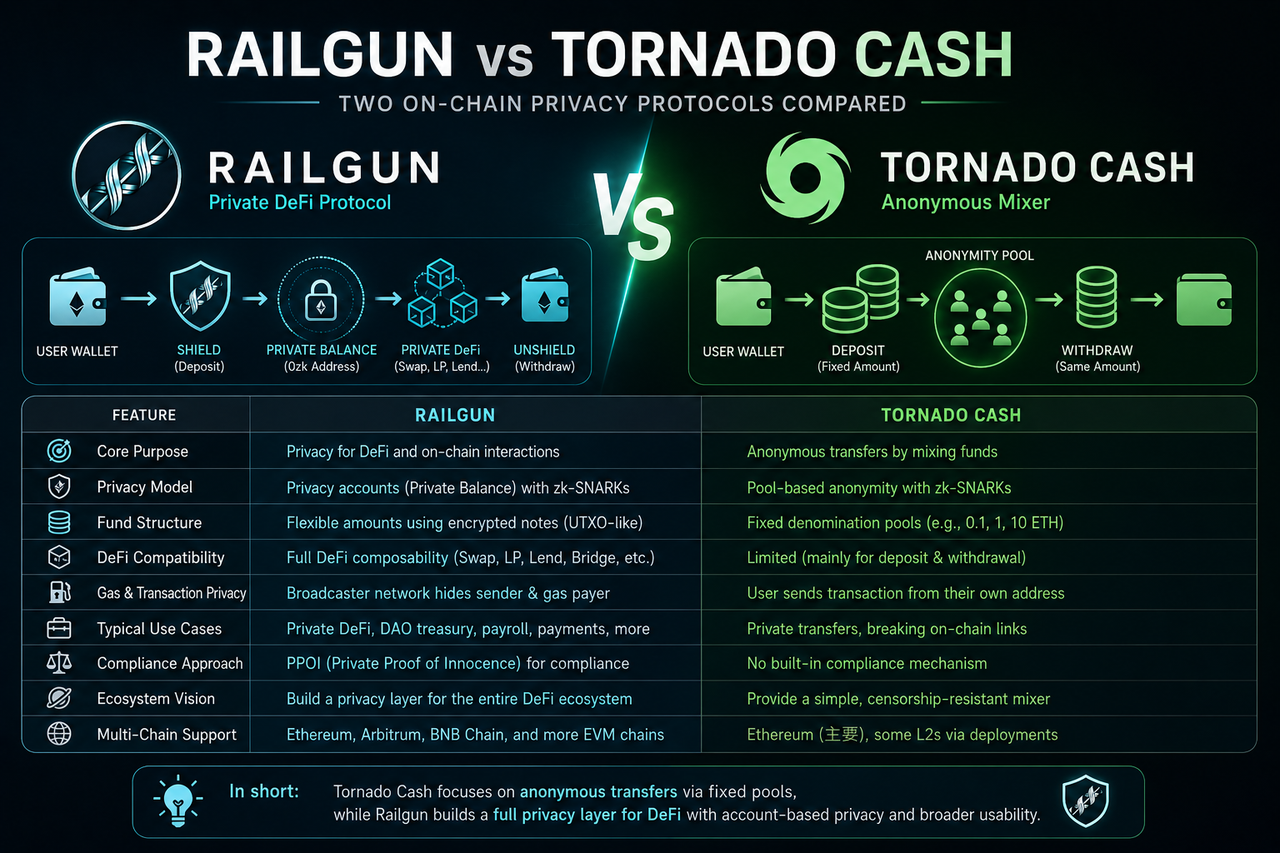
Tornado Cash is built around an anonymity pool model. Users hide the source of funds by entering a fixed-denomination pool and completing a one-time anonymous withdrawal. This model is more suitable for simple anonymous transfers.
Railgun uses a privacy account model. After assets enter Private Balance, they remain in the privacy system over the long term in the form of encrypted Notes, allowing users to continuously make anonymous transactions and private DeFi interactions.
From a product logic perspective:
This difference also determines the very different directions of their ecosystems.
Why Does Railgun Support Private DeFi?
Tornado Cash’s main function is anonymous transfers, so funds typically need to go through a “deposit, wait, withdraw” process.
Railgun, on the other hand, was designed with DeFi composability in mind from the beginning.
Railgun’s Private Balance can interact directly with external protocols, allowing users to call protocols such as Uniswap, 1inch, and SushiSwap in a private state to complete swaps or liquidity operations.
This means users can hide not only the source of their assets, but also their trading behavior.
For example, when a public address buys a large amount of a token on-chain, it can easily be tracked by MEV bots or arbitrage systems. Railgun can reduce the risk of transaction path exposure, helping limit alpha leakage.
This structure, combining privacy with DeFi composability, is one of the clearest differences between Railgun and traditional mixers.
How Are Railgun and Tornado Cash Fund Structures Different?
Tornado Cash uses fixed-denomination anonymity pools.
For example:
-
1 ETH Pool
-
10 ETH Pool
-
100 ETH Pool
Fixed amounts can strengthen the anonymity set because all users’ amounts are identical, improving the effect of fund mixing.
However, this structure also has limitations. For example, fund flexibility is lower, withdrawal amounts are fixed, and the model is not well suited to complex DeFi interactions.
Railgun instead uses a Private Balance and encrypted Notes structure. Users can flexibly manage assets in different amounts without relying on fixed-denomination pools.
By comparison, Railgun is better suited to long-term asset management and continuous on-chain financial activity.
How Is Broadcaster Different From Ordinary Transaction Broadcasting?
In Tornado Cash, users generally still need to use a public address to pay gas. This means that although the transaction content is anonymized, the wallet address broadcasting the transaction may still expose some information.
Railgun introduces the Broadcaster and Relayer networks.
The Broadcaster submits transactions to the blockchain on behalf of users, so external observers cannot directly see the real transaction initiator. At the same time, the Relayer can help users handle relay fees and reduce the association between gas-paying addresses and transaction behavior.
This structure further expands the scope of privacy. Railgun not only hides fund flows, but also tries to hide the source of transaction broadcasting.
Railgun vs Tornado Cash Comparison Table
| Comparison Dimension |
Railgun |
Tornado Cash |
| Core Positioning |
Private DeFi protocol |
Anonymous mixer |
| Privacy Model |
Privacy account system |
Fixed-denomination anonymity pool |
| Supports Long-Term Privacy Accounts |
Yes |
No |
| Supports Private DeFi |
Yes |
Limited |
| Supports Anonymous Swaps |
Yes |
No |
| Asset Structure |
Private Balance + Notes |
Fixed-denomination pools |
| Gas Privacy |
Broadcaster + Relayer |
Ordinary wallet broadcasting |
| Main Use Case |
Private DeFi and private asset management |
Anonymous transfers |
| Composability |
High |
Relatively low |
| zk Technology |
zk-SNARK |
zk-SNARK |
How Do Railgun and Tornado Cash Differ From a Regulatory Perspective?
On-chain privacy protocols have long faced regulatory pressure because anonymous structures may be used for illegal fund flows.
Tornado Cash has historically triggered broad regulatory discussion because of its anonymous mixing function, with its structure of indistinguishable fund sources becoming one of the main points of controversy.
Railgun, by contrast, attempts to find a balance between privacy and compliance. For example, Railgun launched the PPOI, Private Proof of Innocence, mechanism to help users prove the legitimate source of funds when necessary.
The core goals of PPOI are:
-
Preserve privacy capabilities
-
Reduce the risk of illicit fund use
-
Provide partial compliance proof capabilities
This means Railgun leans more toward verifiable privacy, rather than pure anonymity alone.
Which Use Cases Are Railgun and Tornado Cash Best Suited For?
Tornado Cash is better suited to one-time anonymous withdrawals and simple address separation scenarios.
When users only want to break the link between public wallets, the mixer model can already meet that need.
Railgun is more suitable for complex scenarios such as long-term privacy account management, Private DeFi, DAO treasury management, and anonymous trading strategies.
Because Railgun can continuously interact with DeFi protocols in a private state, it is closer to a complete on-chain privacy finance infrastructure.
Conclusion
Railgun and Tornado Cash are both on-chain privacy protocols, but their core logic is not the same.
Tornado Cash is more of an anonymous fund mixer, using fixed-denomination pools to break links between funds. Railgun places more emphasis on long-term privacy accounts and a Private DeFi structure.
Compared with traditional mixers, Railgun extends privacy capabilities to full on-chain financial activity, allowing users to continuously conduct anonymous transactions and private DeFi operations within open ecosystems such as Ethereum.
FAQs
Why Does Railgun Support Private DeFi?
Railgun’s Private Balance can interact directly with external DeFi protocols, supporting private swaps and anonymous smart contract calls.
Do Both Protocols Use zk-SNARK?
Yes. Both Railgun and Tornado Cash use zk-SNARK zero-knowledge proof technology.
What Is Private Balance?
Private Balance is Railgun’s privacy account structure, used to hide user assets and transaction states.
Why Does Tornado Cash Use Fixed-Denomination Pools?
Fixed amounts can increase the size of the anonymity set, strengthening the effect of fund mixing.