How does Pharos enable RWA to go on-chain? A detailed look at the logic behind its RealFi infrastructure

Last Updated 2026-04-28 10:28:02
Reading Time: 2m
Pharos (PROS) enables the on-chain integration of real-world assets (RWA) with its high-performance Layer1 architecture and financial scenario-optimized infrastructure. By utilizing parallel execution, modular design, and scalable financial modules, Pharos addresses asset issuance, trade settlement, and institutional capital flow demands, streamlining the connection of real assets to the on-chain financial system. At its core, Pharos constructs RealFi infrastructure to bridge traditional assets with on-chain liquidity, delivering a stable and efficient foundational network for the RWA marketplace.

As blockchain technology matures, the industry's focus is shifting from native crypto assets to the on-chain mapping of Real World Assets (RWA). Bonds, funds, notes, and real estate income rights—traditional financial assets—are gaining traction in blockchain finance because bringing them on-chain enables greater liquidity, lower settlement costs, and enhanced transparency.

However, RWA tokenization is not just about digitizing assets. It requires the underlying network to deliver financial-grade performance, robust asset management capabilities, and mechanisms for sustained long-term value. While general-purpose public blockchains are open, they often fall short in throughput, business adaptability, and support for advanced financial use cases.

Pharos (PROS) positions itself as a high-performance Layer1 network purpose-built for RealFi scenarios. Its core mission is to provide foundational infrastructure for bringing real world assets on-chain. Unlike generic public blockchains, Pharos is engineered to deliver high throughput, low latency, and scalability for asset issuance, payment settlement, and institutional-grade financial operations—addressing the unique requirements of real financial assets on-chain.

Why Do Real World Assets Need Specialized On-Chain Infrastructure?

Tokenizing real world assets is fundamentally different from standard on-chain asset trading. RWA involves complex processes like asset issuance, return distribution, cross-border transfers, and clearing, all of which demand higher network performance and stability. For instance, when the blockchain carries bonds or notes, transaction confirmation speed, settlement efficiency, and system scalability directly impact asset circulation.

Moreover, RWA tokenization typically involves institutional participation and long-term capital flows. This means the underlying network must have sustainable incentive mechanisms, not just short-term user activity. While general-purpose public blockchains are suitable for open application deployment, they often struggle to deliver consistent performance for high-frequency settlements and large-scale financial operations. That’s why RWA development demands infrastructure networks optimized specifically for financial applications—Pharos’s core value proposition.

How Does Pharos’s High-Performance Architecture Enable RWA On-Chain?

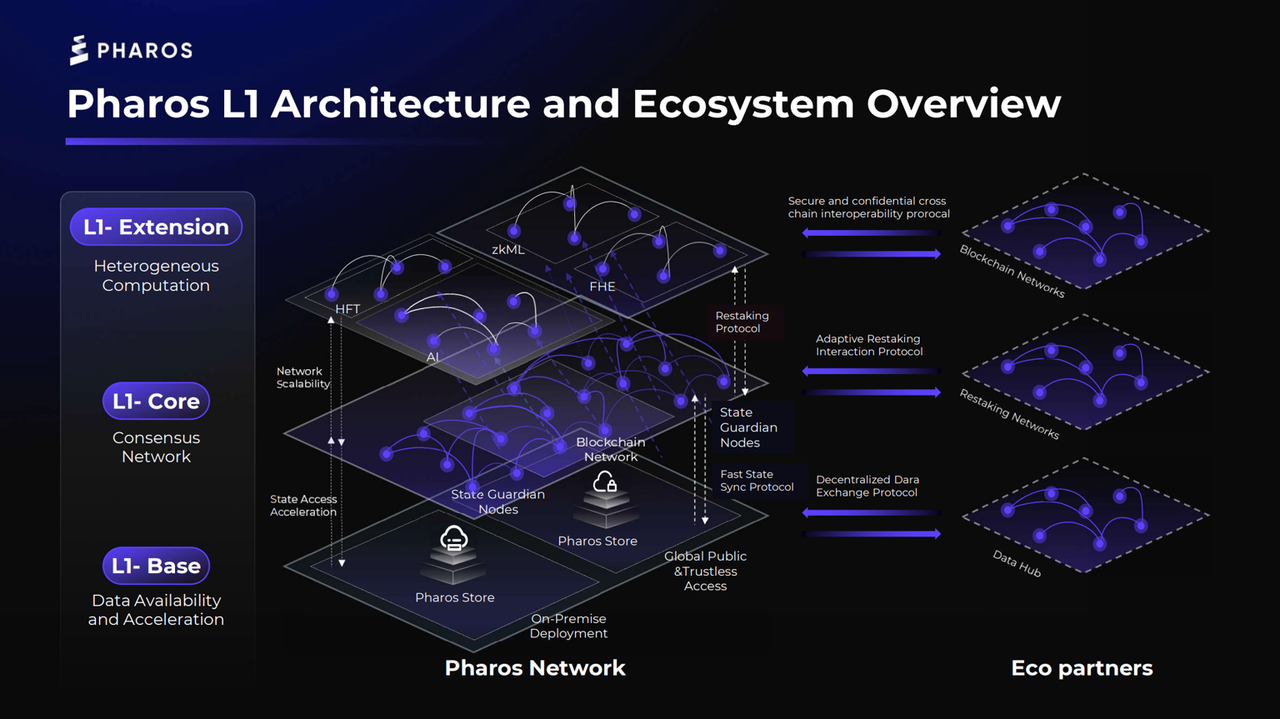
Pharos empowers RWA tokenization through its high-performance Layer1 architecture. Leveraging a parallel execution mechanism, Pharos can process multiple transactions simultaneously, dramatically increasing network throughput. This is critical for RWA, where real asset transactions involve significant capital flows and frequent settlements—network bottlenecks would directly impede liquidity.

How Does Pharos’s High-Performance Architecture Support RWA On-Chain? Pharos L1 architecture and ecosystem overview, source: Pharos

Pharos’s modular architecture also allows for flexible adaptation to diverse financial scenarios. Asset issuance, payment settlement, and liquidity management can be optimized independently through dedicated modules, without compromising network stability. This design enhances support for complex financial operations, providing a more reliable foundation for the issuance and circulation of real assets on-chain.

How Does RealFi Infrastructure Connect Traditional Assets with On-Chain Liquidity?

Pharos’s RealFi infrastructure is designed to provide a more efficient liquidity gateway for traditional financial assets by leveraging on-chain networks. Traditional financial assets often suffer from low liquidity and sluggish settlement, but blockchain enables faster, more efficient asset movement through digitization and on-chain trading. By building a network tailored for financial asset flows, Pharos makes it easier for traditional assets to access on-chain markets and benefit from broader liquidity.

This approach means Pharos is not just about “on-chaining” assets—it’s about enabling true asset liquidity. Once real assets are tokenized, all trading, clearing, and value transfer depend on the underlying network. Pharos’s high-performance architecture and long-term value model are specifically built for this purpose, connecting traditional assets with on-chain liquidity and advancing the RealFi ecosystem.

How Does PROS Capture Value in the RWA On-Chain Ecosystem?

In Pharos’s RealFi framework, PROS is the primary medium for network value transfer. When real assets are issued, traded, and settled on-chain, these activities generate trading fee demand, and PROS, as the native token, serves as the value capture mechanism. As more RWA projects join the network, increased on-chain activity will drive higher demand for PROS.

Additionally, PROS is integral to staking and ecosystem incentive mechanisms. Validator nodes secure the network through staking, while ecosystem participants are incentivized to onboard assets and applications. This structure ensures network growth feeds back into token demand, creating a value cycle driven by genuine financial activity—a key economic foundation for Pharos as it expands RWA tokenization.

What Makes Pharos Uniquely Positioned to Drive RWA On-Chain?

Pharos stands out by combining high-performance technology with a RealFi value model, delivering comprehensive infrastructure for RWA tokenization. Unlike platforms focused solely on asset issuance, Pharos prioritizes post-tokenization liquidity and sustained value. This strategic focus positions it as a “real financial asset on-chain operation network”—not just an asset mapping solution.

As the RWA market grows, the importance of robust, efficient, and sustainable infrastructure will rise. The platforms that can provide stable and scalable support for real assets will become key players in the RWA space. Pharos is building the foundation for RWAs to enter the on-chain financial market at scale.

Summary

Pharos (PROS) delivers foundational support for on-chaining Real World Assets (RWA) with a high-performance Layer1 architecture and financial scenario-driven infrastructure. Its parallel execution boosts transaction efficiency, modular design enhances adaptability, and the long-term value model of PROS enables a RealFi network that bridges traditional assets and on-chain liquidity.

As RWA emerges as a major growth driver for blockchain finance, the demand for financial-grade infrastructure will continue to rise. Pharos’s unique value lies in not only enabling asset tokenization but also supporting liquidity and value capture. With continued ecosystem expansion, Pharos is positioned to be a leading infrastructure for RealFi innovation.

FAQs

How Does Pharos Drive RWA On-Chain?

Pharos leverages high-performance Layer1 architecture and modular design to deliver efficient, foundational support for the issuance, trading, and settlement of real assets—enabling seamless integration of RWA into the on-chain financial ecosystem.

Why Do RWAs Require Specialized Infrastructure?

Tokenizing real assets involves complex trading and settlement needs, with heightened requirements for throughput, stability, and long-term value mechanisms—challenges that general-purpose blockchains cannot fully address.

What Is Pharos’s RealFi Infrastructure Logic?

Pharos’s core logic is to connect traditional financial assets with on-chain liquidity through a high-performance network, supporting the circulation and value exchange of real assets on-chain.

What Role Does PROS Play in RWA Tokenization?

PROS is used to pay trading fees, participate in staking, and drive ecosystem incentives, making it a critical component of Pharos’s value capture and network operation mechanisms.

Author: Jayne
Disclaimer
* The information is not intended to be and does not constitute financial advice or any other recommendation of any sort offered or endorsed by Gate.
* This article may not be reproduced, transmitted or copied without referencing Gate. Contravention is an infringement of Copyright Act and may be subject to legal action.

Related Articles

The Future of Cross-Chain Bridges: Full-Chain Interoperability Becomes Inevitable, Liquidity Bridges Will Decline
Beginner

The Future of Cross-Chain Bridges: Full-Chain Interoperability Becomes Inevitable, Liquidity Bridges Will Decline

This article explores the development trends, applications, and prospects of cross-chain bridges.
2026-04-08 17:11:27
Solana Need L2s And Appchains?
Advanced

Solana Need L2s And Appchains?

Solana faces both opportunities and challenges in its development. Recently, severe network congestion has led to a high transaction failure rate and increased fees. Consequently, some have suggested using Layer 2 and appchain technologies to address this issue. This article explores the feasibility of this strategy.
2026-04-06 23:31:03
Sui: How are users leveraging its speed, security, & scalability?
Intermediate

Sui: How are users leveraging its speed, security, & scalability?

Sui is a PoS L1 blockchain with a novel architecture whose object-centric model enables parallelization of transactions through verifier level scaling. In this research paper the unique features of the Sui blockchain will be introduced, the economic prospects of SUI tokens will be presented, and it will be explained how investors can learn about which dApps are driving the use of the chain through the Sui application campaign.
2026-04-07 01:11:45
Navigating the Zero Knowledge Landscape
Advanced

Navigating the Zero Knowledge Landscape

This article introduces the technical principles, framework, and applications of Zero-Knowledge (ZK) technology, covering aspects from privacy, identity (ID), decentralized exchanges (DEX), to oracles.
2026-04-08 15:08:18
What is Tronscan and How Can You Use it in 2025?
Beginner

What is Tronscan and How Can You Use it in 2025?

Tronscan is a blockchain explorer that goes beyond the basics, offering wallet management, token tracking, smart contract insights, and governance participation. By 2025, it has evolved with enhanced security features, expanded analytics, cross-chain integration, and improved mobile experience. The platform now includes advanced biometric authentication, real-time transaction monitoring, and a comprehensive DeFi dashboard. Developers benefit from AI-powered smart contract analysis and improved testing environments, while users enjoy a unified multi-chain portfolio view and gesture-based navigation on mobile devices.
2026-03-24 11:52:42
What Is Ethereum 2.0? Understanding The Merge
Intermediate

What Is Ethereum 2.0? Understanding The Merge

A change in one of the top cryptocurrencies that might impact the whole ecosystem
2026-04-09 09:17:06