Crypto as a financial asset refers to digital assets that regulators place in categories similar to investment instruments—subject to disclosure, fair trading, investor suitability, and access rules for funds and ETFs. An on-chain token does not carry an inherent “payment” or “investment” label. Legislatures and supervisors decide, based on use case, issuance design, and trading context, whether an asset falls under payment-services law, financial-instruments law, or securities law.
Digital assets often combine transfer/settlement functions with investment trading. A single “payment method” label no longer covers the full compliance surface. Japan’s FIEA adjustments, the U.S. SEC/CFTC split, and the EU’s MiCA multi-category framework all aim to bring digital assets into structures that can be supervised, disclosed, and—where rules allow—held inside funds.
From a blockchain perspective, reclassification does not change the ledger or self-custody model, but it does change exchange licensing, issuer disclosure duties, tax treatment, and whether ETF shares can be held in a securities account. Understanding crypto financial-asset classification is the starting point for checking cross-border compliance, product documents, and tax treatment.
Is Crypto a Financial Asset or a Payment Method?
Two common regulatory framings appear worldwide. Under a payment-method frame, digital assets are treated as virtual or crypto assets used for transfer and settlement; the focus is AML, KYC, and payment-service provider registration. Under a financial-product frame, digital assets are treated as investable and tradable assets that funds may hold; the focus is disclosure, insider-trading prohibitions, and investor protection.
Financial product vs payment method compares the two frames across law, tax, ETF eligibility, and typical use cases. The same bitcoin can support peer-to-peer transfers and exchange trading; a stablecoin may trigger both payment rules and reserve-asset oversight. When reviewing a product, check which regulatory line the activity falls under—not only the token name.
| Framing |
Regulatory goal |
Typical laws |
Typical use cases |
| Payment method |
Payment safety, AML |
Payment services / funds settlement acts |
Transfers, settlement, payment stablecoins |
| Financial product |
Market fairness, investor protection |
Financial instruments / securities laws |
Investment trading, fund holdings, public offers |
| Function split |
Rules by token type |
MiCA, securities case law |
Stablecoins, security tokens, utility tokens |
The table summarizes baseline framings and function-based splits. MiCA does not label every token a “financial asset”; it classifies ART, EMT, and other crypto-assets. U.S. practice often relies on tests such as Howey to identify security tokens.
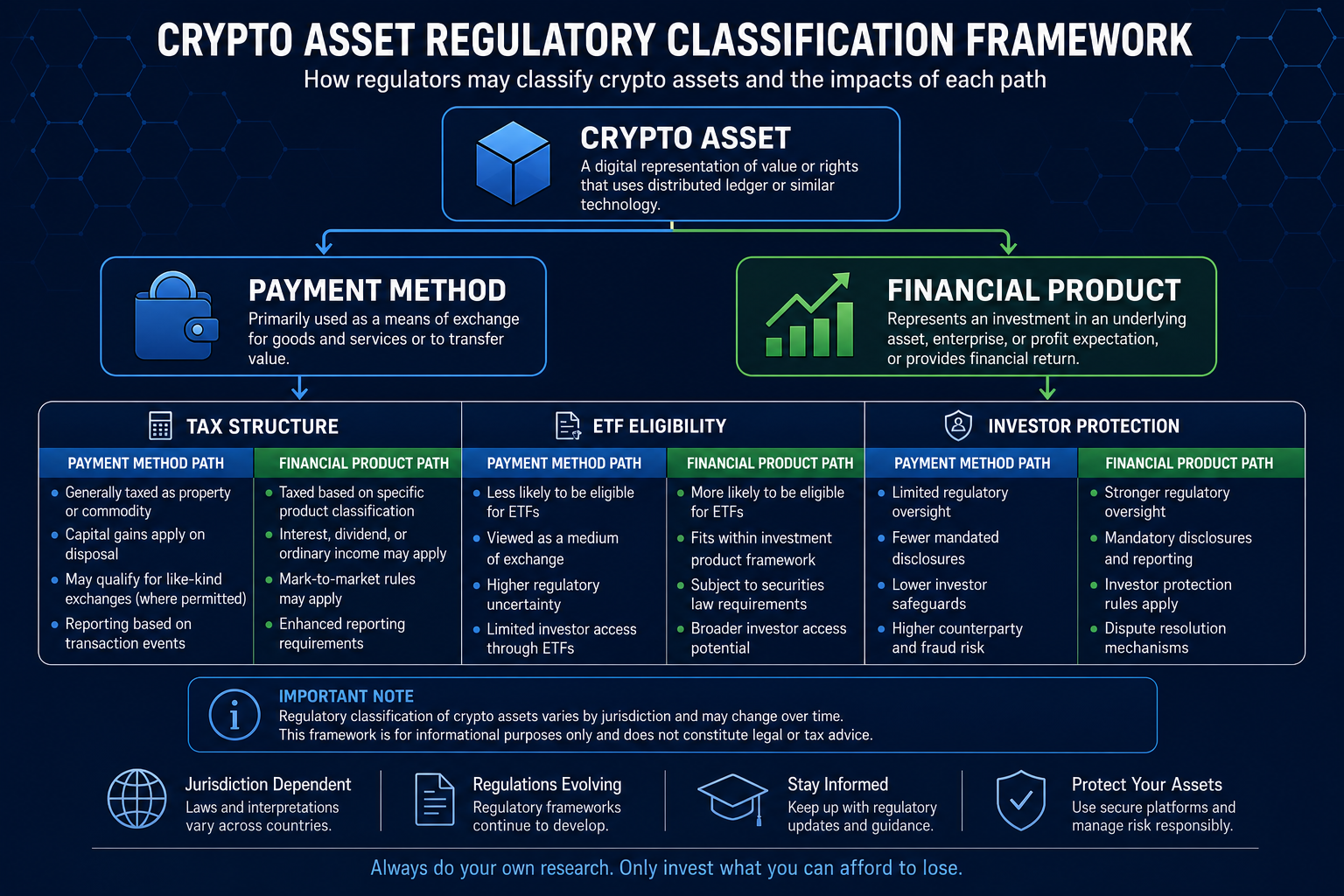 Figure 1. Classification framework for crypto under payment-method vs financial-product regulatory paths.
What Does Financial-Product Classification Mean?
When digital assets are classified as financial products or financial assets, trading, issuance, and intermediation usually carry capital-market style duties: higher disclosure for venues and issuers; possible application of market-abuse rules; suitability requirements for public sales; and—where conditions are met—permission for funds or ETFs to hold the asset as underlying exposure.
What it means when crypto becomes a financial asset unpacks how a classification label rewrites disclosure duties, intermediary obligations, and product boundaries—and why legal reclassification still is not the same as approving a named fund product.
Classification as a financial product is not the same as saying “every token is a security.” Securities analysis focuses on investment-contract elements; financial-instruments law is a broader category used in some jurisdictions. Specific duties always follow the enacted text.
Does Classification Change How Crypto Is Taxed?
Legal classification and tax treatment sit in related but separate systems. Under payment-method framing, some jurisdictions treat crypto transfer gains as ordinary or miscellaneous income with progressive rates. Under financial-product framing, lawmakers more often align crypto gains with capital gains on stocks and bonds—separate taxation or a unified capital-gains rate—and may allow loss carryforward.
Japan’s legislative direction is a clear example: shifting qualifying registered-exchange gains toward separate taxation near equity rates (~20%), while DeFi, staking, and offshore platforms may follow different rules. Japan reclassifies crypto as a financial asset explains what investors should verify under the FIEA path—registered venues, separate-tax scope, and ETF product boundaries that still need standalone review. Always verify published tax authority guidance in the investor’s residence jurisdiction.
Why Does the Financial-Product Frame Matter for Crypto ETFs?
An exchange-traded fund lists on a securities market; its underlying usually must belong to an asset class funds are legally allowed to hold. Payment-method rules answer whether conversion and transfer services can be offered; they do not automatically answer whether a fund may hold spot bitcoin. Placing digital assets under financial-instruments law is therefore often treated as a legal precondition for spot crypto ETFs.
Countries with approved crypto ETFs surveys markets such as the United States, Hong Kong, Australia, Canada, and Brazil, and contrasts spot vs futures products on tracking, roll costs, and regulatory path. Keep two layers distinct: legal reclassification decides whether the asset can be supervised as a financial product; product-level approval decides whether a named fund may issue and list. Japan may adjust FIEA classification while still requiring separate fund-law and exchange review for any ETF.
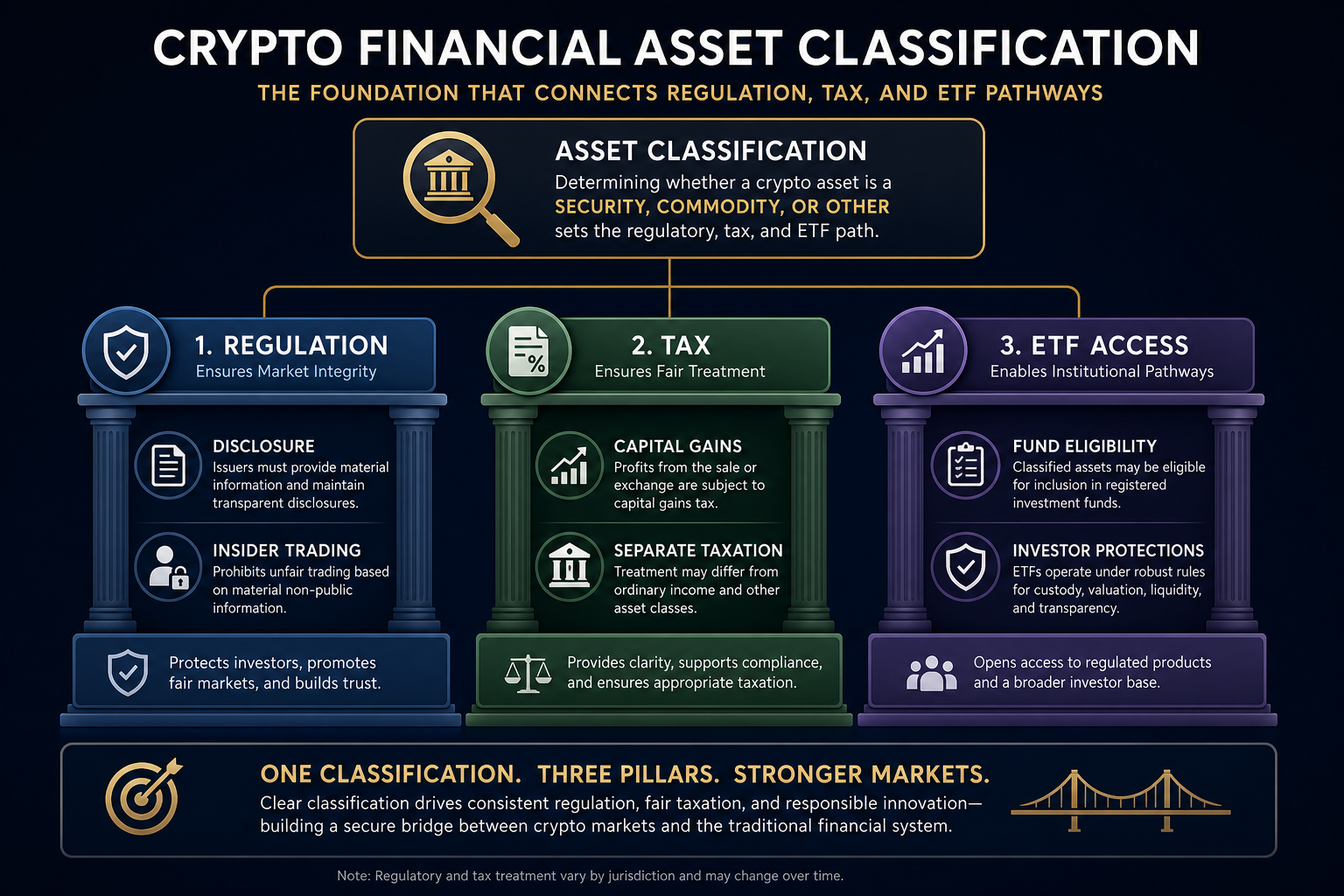 Figure 2. How crypto financial-asset classification links to regulatory duties, tax design, and ETF access.
Which Countries Treat Crypto as Financial Assets or Financial Products?
There is no single global crypto statute. Countries recognizing crypto as financial assets compares Japan, the United States, the EU, the United Kingdom, Singapore, and South Korea: Japan’s FIEA path; U.S. SEC/CFTC division plus securities case law; EU MiCA categories; and FCA/MAS approaches that separate payment tokens from capital-market products.
| Jurisdiction |
Main tools |
Classification feature |
| Japan |
FIEA + PSA |
Crypto under financial-instruments law |
| United States |
Securities / commodities laws |
SEC/CFTC split + case law |
| European Union |
MiCA + MiFID |
ART / EMT / other crypto-assets |
| Hong Kong |
SFC virtual-asset rules |
Licensed venues + spot ETFs |
| Singapore |
Payment Services Act + SFA |
Payment tokens vs capital-market products |
The table is a framework comparison only. Whether a specific token falls into a category depends on issuance, marketing, and holder rights. Cross-border activity may trigger both service-provider and investor-residence rules.
What Should Investors Check on Compliance and Tax Boundaries?
When classification rules change, investors can use a public-information checklist rather than social-media shorthand.
| Check item |
What to confirm |
| Regulatory class |
Payment law, financial-instruments law, or securities law |
| Venue |
Whether the exchange/custodian is licensed and under which supervisor |
| Product structure |
Spot, futures ETF, ETP, or self-custody on-chain |
| Disclosure |
Prospectus, risk factors, holdings reports |
| Tax treatment |
Ordinary income, capital gains, withholding |
| Rights |
Subscription/redemption, voting, or other contractual rights |
The checklist builds a verification habit; it does not rank regulatory models or imply that one classification is “better” for investors.
Advantages, Risks, and Limits of Classification
Advantages include clearer institutional transparency: regulated venues face stronger disclosure and asset-segregation expectations, and funds/ETFs gain a clearer approval pathway.
Risks and limits remain: classification does not remove price volatility, liquidity shocks, smart-contract bugs, or counterparty risk. Cross-border conflicts can persist; transition periods may run old and new rules in parallel. DeFi and self-custody may sit only partly inside the new frame.
Summary
Whether crypto is a financial asset depends on jurisdiction-level classification. Payment-method framing emphasizes transfer safety and AML; financial-product framing emphasizes disclosure, investor protection, and fund access. Labels affect tax design and the legal path for spot crypto ETFs, but “recognized as a financial asset” is not the same as “a specific ETF is approved.” Japan, the United States, the EU, Hong Kong, and Singapore use different tools. In cross-border settings, check service-provider rules, token type, and product documents—and separate on-chain mechanics from securities-account products across regulation, tax, and disclosure.
FAQ
Is crypto a financial asset?
It depends on jurisdiction and use case. Some markets place digital assets mainly under payment-services law; others under financial-instruments or securities law with capital-market duties. Payment use and investment trading of the same asset can trigger different rules.
What does it mean if crypto becomes a financial product?
Trading, issuance, and fund holdings may face higher disclosure, market-abuse controls, and suitability management, and may gain a legal category basis for crypto ETFs. That does not automatically make every token a security.
How does financial-product classification relate to crypto ETFs?
ETFs list on securities markets; underlyings usually must be assets funds may legally hold. The financial-product frame supplies a category precondition; listing still needs fund approval, custody, and exchange rules.
How is crypto taxed in Japan?
Japan’s legislative direction moves qualifying gains from registered-exchange trading toward separate taxation closer to equity treatment. Whether DeFi, staking, and offshore platforms share that treatment depends on Japanese tax law and implementing rules.
Which countries have approved spot bitcoin ETFs?
The U.S. SEC has approved multiple spot bitcoin ETFs; Hong Kong’s SFC has also approved spot bitcoin ETFs for local listing. Australia, Canada, and Brazil likewise host regulated spot bitcoin fund products. Structures and fees differ by market.
Do you need to pay tax for holding bitcoin?
Most jurisdictions tax transfers, exchanges, or certain acquisition events (such as mining or staking), but rates, taxable events, and filing rules vary. Follow published rules in the investor’s tax residence; there is no global uniform standard.