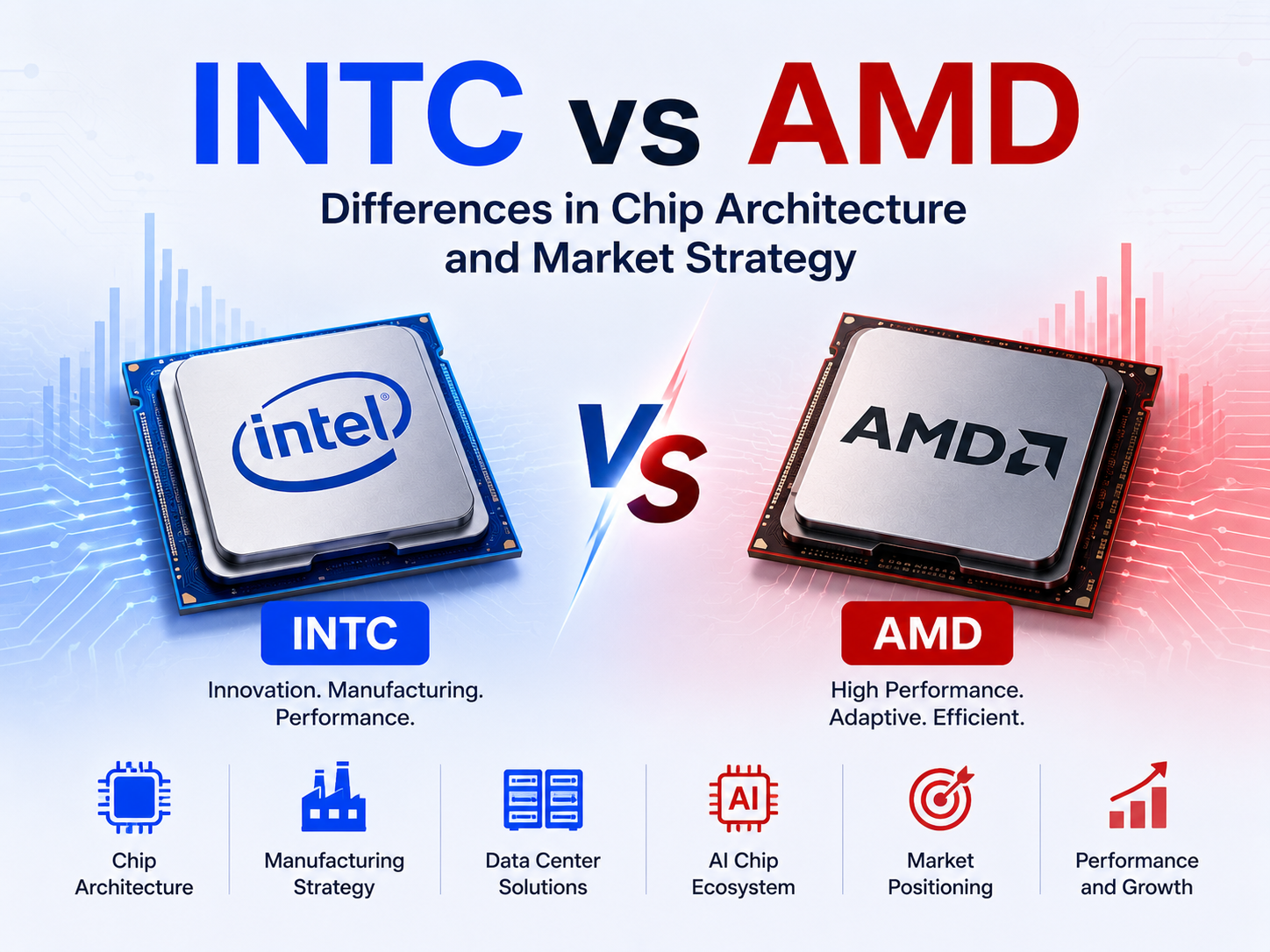
Intel has long followed an integrated model that combines chip design and manufacturing, while AMD leans more toward a structure built around chip design and external foundry partnerships. These different business models also affect how the two companies perform in terms of costs, product refresh cycles, and market competition.
When capital markets analyze INTC and AMD, they usually focus on data center operations, AI chip strategies, advanced process capabilities, and changes in market share. These factors also continue to shape the long-term valuation logic for both companies.
What Is INTC?
INTC is the stock ticker used by Intel Corporation on the Nasdaq exchange. Intel has long been one of the world’s major companies in the CPU and enterprise-level chip markets.
Intel’s core businesses include client computing, data center chips, AI chips, and wafer manufacturing. Personal computer CPUs and server chips have long formed important sources of revenue for Intel.
Intel’s market profile is defined by its ability to handle both chip design and manufacturing. Compared with some companies that are responsible only for chip design, Intel has long used an integrated IDM structure.
INTC’s market performance is usually affected by semiconductor cycles, changes in the AI industry, and demand from data centers.
What Is AMD?
AMD stands for Advanced Micro Devices and is also one of the world’s major semiconductor and CPU companies. AMD has long competed with Intel in the personal computer and server chip markets.
AMD’s core businesses include CPUs, GPUs, data center chips, and AI accelerators. High-performance computing and gaming graphics cards are also important business areas for AMD.
AMD leans more toward the model of a chip design company. Compared with Intel, AMD mainly relies on external wafer foundries for chip production.
AMD’s market growth logic is usually tied to data center expansion, high-performance computing, and changes in the AI chip market.
Differences Between INTC and AMD in Chip Architecture
INTC and AMD have long competed around CPU architecture and performance. Both companies use the x86 instruction set architecture, but their chip design approaches differ in certain ways.
Intel has long emphasized single-core performance and enterprise-level stability. Personal computers and enterprise servers are also important areas of strength for Intel.
AMD places greater emphasis on multi-core performance and cost efficiency. High core counts and performance for the price have long been important parts of AMD’s market competition strategy.
The two companies also differ in their product refresh cycles. The pace of advanced process adoption, chip packaging methods, and architecture upgrade paths all affect CPU performance.
| Comparison Dimension |
INTC |
AMD |
| Core Direction |
Single-core performance and stability |
Multi-core performance and value |
| Main Market |
Enterprise and consumer markets |
High-performance computing market |
| Architecture Focus |
Enterprise-level CPUs |
Multi-core CPUs |
| AI Direction |
Data centers and enterprise AI |
GPUs and AI acceleration |
Differences in chip architecture also affect how capital markets judge the long-term competitiveness of the two companies.
Differences Between Intel and AMD in Manufacturing Models
Intel has long used an integrated IDM model. Intel is responsible not only for chip design, but also has its own wafer manufacturing capabilities.
AMD mainly uses a fabless model. AMD focuses on chip design and relies on external wafer foundries for production.
Intel’s integrated manufacturing structure can strengthen supply chain control. Coordination among manufacturing, packaging, and design is also one of Intel’s important characteristics.
AMD’s model places more emphasis on flexibility. External foundry partnerships can help AMD adopt advanced process technologies more quickly and reduce some pressure from manufacturing capital expenditures.
Differences in manufacturing models also affect the two companies’ cost structures and profit margin performance.
Differences Between INTC and AMD in Data Center Strategy
The data center business has long been an important source of revenue for Intel. Enterprise server CPUs and the cloud computing chip market form core areas of competition for Intel.
AMD has continued expanding its share of the data center market in recent years. Growth in demand for high-performance server chips and cloud computing has also supported the expansion of AMD’s data center business.
Intel’s data center strengths mainly come from its long-standing enterprise customer base and stable ecosystem. Large cloud service platforms have used Intel server architectures for many years.
AMD, by contrast, places greater emphasis on high performance and energy efficiency. Some cloud computing companies and AI workload scenarios have also begun increasing their use of AMD chips.
Competition in the data center market will continue to affect the long-term market valuations of INTC and AMD.
Differences Between Intel and AMD in AI Chip Ecosystems
As demand for AI computing power has grown, both Intel and AMD have begun strengthening their AI chip strategies. Changes in the AI market will also continue to influence the valuation logic of the semiconductor industry.
Intel’s AI ecosystem leans more toward enterprise computing and data center coordination. Server CPUs, AI accelerators, and enterprise infrastructure are important directions for Intel.
AMD is also building out its presence in GPUs and AI accelerators. High-performance GPUs and the AI training market have become important growth directions for AMD as well.
The two companies have different positions within the AI chip ecosystem. Intel places more emphasis on enterprise computing systems, while AMD focuses more on high-performance GPUs and opportunities tied to computing power expansion.
Competition in the AI chip market also affects how capital markets judge the future growth potential of both companies.
Differences Between INTC and AMD in Market Positioning
INTC has long been viewed as a large, mature semiconductor company. Enterprise markets, server chips, and manufacturing capabilities are important foundations of Intel’s market position.
AMD’s market positioning leans more toward that of a growth-oriented semiconductor company. Data center expansion, high-performance chips, and AI market growth usually influence market expectations for AMD.
Intel’s valuation logic places greater emphasis on stable cash flow and long-term manufacturing capabilities. AMD’s valuation logic is more easily influenced by expectations for high-growth markets.
| Market Positioning |
INTC |
AMD |
| Company Profile |
Mature semiconductor company |
Growth-oriented chip company |
| Core Strengths |
Manufacturing and enterprise ecosystem |
High performance and growth speed |
| AI Market |
Enterprise AI infrastructure |
GPUs and AI computing power |
| Market Expectations |
Stability |
High growth |
Different market positioning also affects how institutional investors judge the risk preferences associated with the two companies.
Summary
INTC and AMD are both important companies in the global semiconductor industry, but they differ clearly in chip architecture, manufacturing models, data center strategy, and AI ecosystems.
Intel has long emphasized manufacturing capabilities, enterprise markets, and an integrated IDM structure, while AMD places more emphasis on high-performance chips, a flexible foundry model, and growth-oriented market opportunities.
Data center expansion, demand for AI computing power, and competition in advanced process technologies will continue to affect the long-term market performance of INTC and AMD.
FAQs
What Is the Biggest Difference Between INTC and AMD?
The biggest difference between INTC and AMD lies in their manufacturing models and market strategies. Intel has long used an integrated structure that combines chip design and manufacturing, while AMD leans more toward chip design and external foundry partnerships.
Why Does Intel Use the IDM Model?
Intel uses the IDM model mainly because it has both chip design and wafer manufacturing capabilities. This structure can strengthen supply chain control.
AMD has long built its market competition strategy around multi-core performance and performance for the price, so high-performance computing and data centers are important directions for AMD.
Why Does the AI Market Affect INTC and AMD?
As demand for AI computing power grows, the market for data center chips, GPUs, and AI accelerators continues to expand. As a result, changes in the AI industry affect the valuation logic of both companies.
Why Is the Data Center Business Important?
The data center business usually has relatively high profit margins. As demand grows from cloud computing platforms, enterprise servers, and AI infrastructure, data center revenue also affects the long-term growth capacity of chip companies.