The emergence of AI Agent is gradually moving on-chain finance from “manual operation” toward “automated execution.” In this process, AI systems need more than access to blockchain data. They also need to understand risk, identify abnormal behavior, and generate a basis for decision making.
Against this backdrop, on-chain data analytics is evolving from the traditional dashboard model into infrastructure for intelligent decision making. The way Wallitelli works is therefore closer to an “intelligent analytics system” than a simple data aggregation platform.
What Is the Core Operating Logic of Wallitelli?
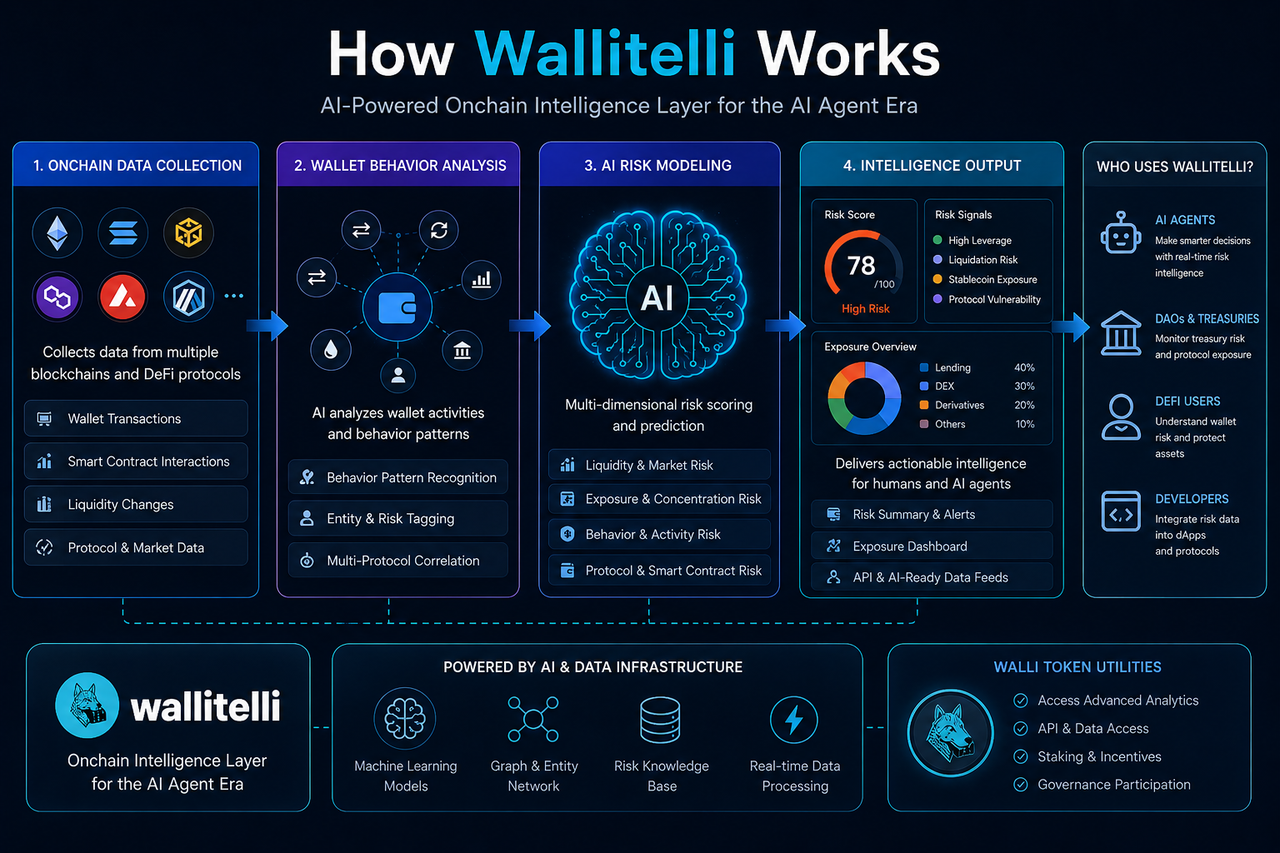
Wallitelli’s core operating logic mainly consists of four stages: on-chain data collection, wallet behavior analysis, AI risk modeling, and intelligence output. The goal of the entire system is not simply to display blockchain data, but to turn on-chain activity into structured risk information that both AI and humans can understand directly.
Traditional on-chain data platforms usually provide only transaction records and wallet information, while Wallitelli focuses more on the risk patterns, fund flow logic, and protocol exposure behind those behaviors. This model is closer to the “risk analysis layer” in a financial risk control system, except that the subjects being analyzed have expanded from traditional accounts to on-chain wallets and AI Agents.
How Does Wallitelli Collect On-Chain Data?
Wallitelli collects wallet activity, transaction records, liquidity changes, and protocol interaction data from different blockchain networks and DeFi protocols. Because blockchain data is highly fragmented and data structures vary across protocols, the system first needs to standardize the raw data.
For example, the same wallet may participate in lending protocols, liquidity mining, staking, and derivatives trading at the same time. Wallitelli integrates these scattered behaviors into a unified wallet profile, helping AI models understand wallet risk and behavioral patterns more accurately.
This unification process also forms an important foundation for subsequent AI risk analysis.
How Does Wallitelli Analyze Wallet Behavior?
After data collection is complete, the system moves into wallet behavior analysis. The core goal of this stage is to identify risk patterns and abnormal behavior within on-chain activity.
For example, if a wallet frequently uses high leverage strategies, transfers large amounts of assets across chains within a short period, or concentrates its activity in high risk protocols, the system may identify these behaviors as potential risk signals.
Compared with traditional on-chain browsers that only display transaction data, Wallitelli places greater emphasis on “behavioral understanding.” Its AI models analyze not only individual transactions, but also long term behavioral trends, protocol relationships, and asset flow patterns.
This approach makes the system better suited to AI Agent and automated finance scenarios.
How Does the AI Risk Model Work?
Wallitelli’s AI risk model is essentially an on-chain behavior recognition and risk inference system. The model analyzes liquidity risk, liquidation risk, stablecoin risk, wallet behavior risk, and protocol exposure in combination.
For example, even if a wallet holds a large amount of assets, the system may raise its overall risk level if those funds are heavily concentrated in highly volatile protocols. When several risk signals appear at the same time, the system can also dynamically adjust its risk assessment.
Unlike traditional single indicator analysis, Wallitelli emphasizes multi dimensional risk assessment. This approach is better suited to Autonomous Finance scenarios because AI Agents usually need a complete view of risk, rather than isolated data points.
How Does Wallitelli Generate Intelligence?
After completing risk analysis, Wallitelli converts the results into structured intelligence. These outputs may include wallet risk summaries, protocol exposure analysis, behavioral change alerts, liquidity risk warnings, and liquidation pressure monitoring.
Unlike traditional chart based systems, Wallitelli focuses more on “actionable information.” AI Agents do not necessarily need a full transaction history. What they need more is a direct understanding of whether current risk is rising, whether a protocol shows signs of abnormality, and whether asset allocation should be adjusted.
For that reason, Wallitelli’s intelligence system is essentially closer to an “on-chain risk decision layer” than a simple data display tool.
The biggest difference between Wallitelli and traditional on-chain analytics platforms is that its target users are not only humans, but also AI Agents and automated systems.
Traditional platforms usually focus on data display, wallet tracking, and address labels, while Wallitelli places greater emphasis on AI based risk understanding, behavioral pattern analysis, and automated decision support.
This difference means Wallitelli is closer to an “on-chain intelligent decision layer.” As on-chain ecosystems become increasingly complex, simple data display is becoming less able to meet the needs of AI automation, while intelligent information systems are becoming more important.
What Challenges Does Wallitelli Face?
On-Chain intelligence systems are still in an early stage, so they face several challenges.
First, on-chain data itself is highly complex, and data standards are not unified across different protocols. How AI models can build stable and reusable risk judgment mechanisms remains an important question.
Second, AI-based risk identification is not absolutely accurate. Some normal trading behaviors may be misclassified as risky, so the system needs to continuously improve both its models and data quality.
In addition, the broader market for AI Agents and Autonomous Finance is still developing. Industry demand and standards for on-chain intelligence layers are also still taking shape.
Conclusion
As an intelligence system that uses AI models to analyze on-chain behavior, wallet activity, and protocol risk, Wallitelli aims to provide users and AI Agents with structured, actionable on-chain risk information.
Compared with traditional blockchain analytics platforms, Wallitelli places greater emphasis on AI native Intelligence and Agent ready Intelligence, allowing AI systems to directly understand and use on-chain intelligence.
FAQs
How Does Wallitelli Analyze Wallet Risk?
Wallitelli analyzes wallet transaction behavior, protocol interactions, liquidity changes, and asset exposure, then uses AI models to generate a comprehensive risk score and behavioral profile.
What Does Wallitelli’s AI Risk Model Do?
The AI risk model is used to identify liquidation risk, stablecoin risk, abnormal transaction behavior, multi protocol exposure, and liquidity pressure, generating actionable risk intelligence.
Why Do AI Agents Need On-Chain Intelligence?
AI Agents need to understand on-chain risk and protocol status in real time. Traditional on-chain data is often difficult to use directly for automated decision making, so a structured intelligence system is needed.