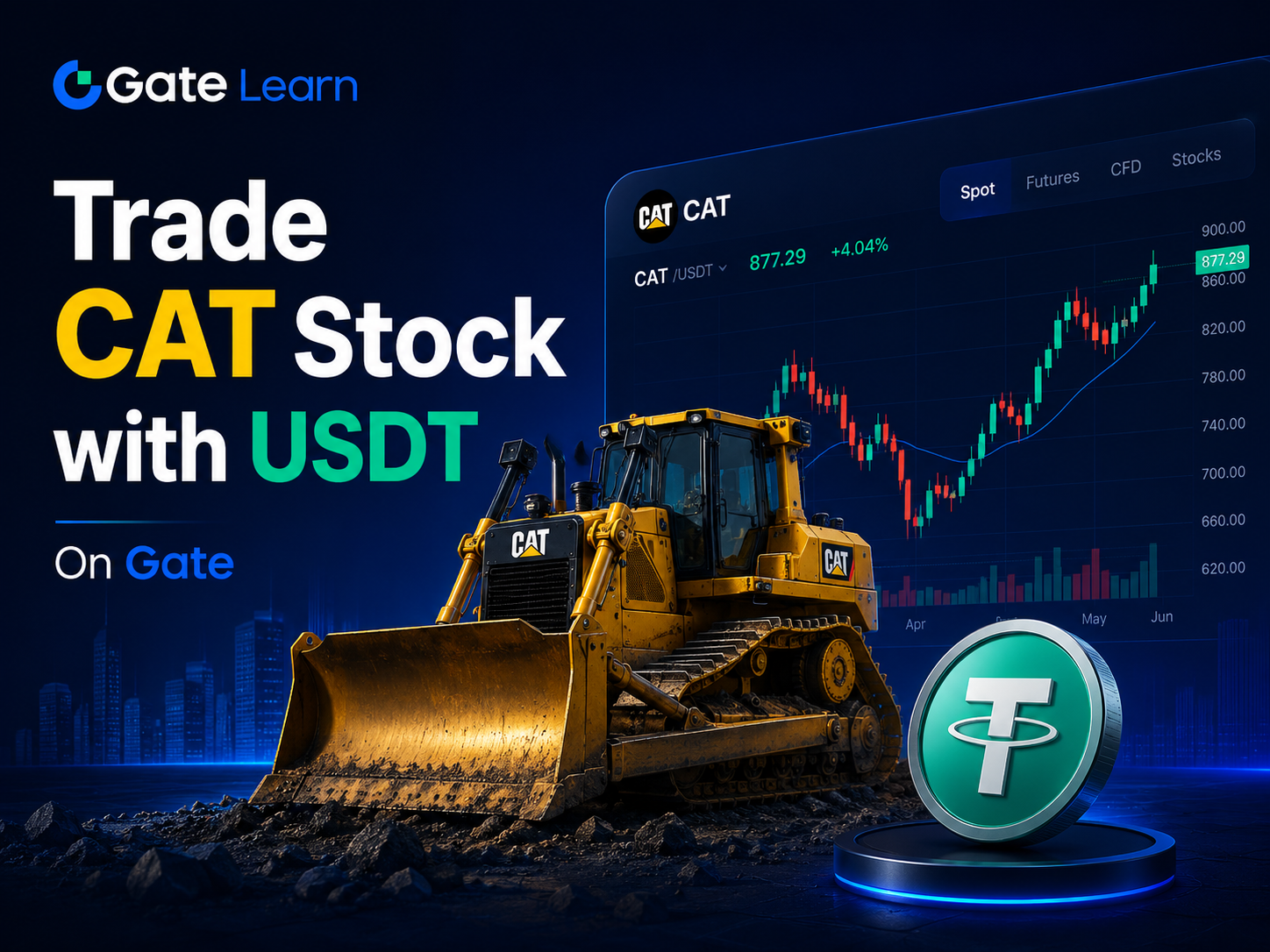
The Gate Stocks page provides users with CAT market prices, charts, and trading information. At the same time, Gate has introduced a CAT perpetual contract settled in USDT, supporting long, short, and leveraged trading. Before trading, users must confirm whether their chosen entry is for stocks, spot products, CFDs, or perpetual contracts.
For crypto users, USDT primarily serves to simplify funding, allowing digital assets in the account to directly connect with traditional stock prices. However, products priced or settled in USDT do not necessarily mean that all CAT products represent actual ownership of Caterpillar Inc. common stock.
What You Need to Know About CAT Product Types Before Trading on Gate
Before trading CAT on Gate, you must distinguish between stocks, CATG/USDT, CATUSDT perpetual contracts, and CFDs. While all search results are linked to Caterpillar Inc., each entry features distinct trading mechanisms, risk profiles, and rights.
According to the Gate interface, CAT-related products fall into the following categories:
| Product Entry |
Product Attribute |
Role of USDT |
Equivalent to Holding Common Stock |
Main Source of Risk |
| CAT Stock |
Stock trading product |
Funding or settlement channel, see page rules |
Depends on stock product rights disclosure |
Stock price volatility, liquidity, trading hours |
| CATG/USDT |
USDT trading pair |
Quotation and settlement unit |
Should not be judged by name alone |
Product structure, market price, liquidity |
| CATUSDT Perpetual Contract |
USDT-margined derivative |
Margin and PnL settlement |
No |
Leverage, funding rate, liquidation |
| CAT CFD |
Contract for difference |
Margin or settlement unit |
No |
Price spread, leverage, overnight costs |
Gate's official announcement clarifies that CATUSDT is a USDT-margined perpetual contract supporting both long and short positions with 1–20x leverage. This makes it a derivative tracking CAT price movements, not Caterpillar common stock.
Similar product names do not guarantee the same rights. Users should always review product type, settlement rules, trading hours, fees, and shareholder rights to avoid confusing perpetual contracts or CFDs with actual stocks.
How to Search for the CAT (Caterpillar) Stock Trading Page
When searching for CAT on Gate, using the company name "Caterpillar" is often more effective than just "CAT" to filter out similarly named crypto assets. Search results may include Spot, Futures, Stocks, and CFD categories—users should confirm the target entry by checking product labels.
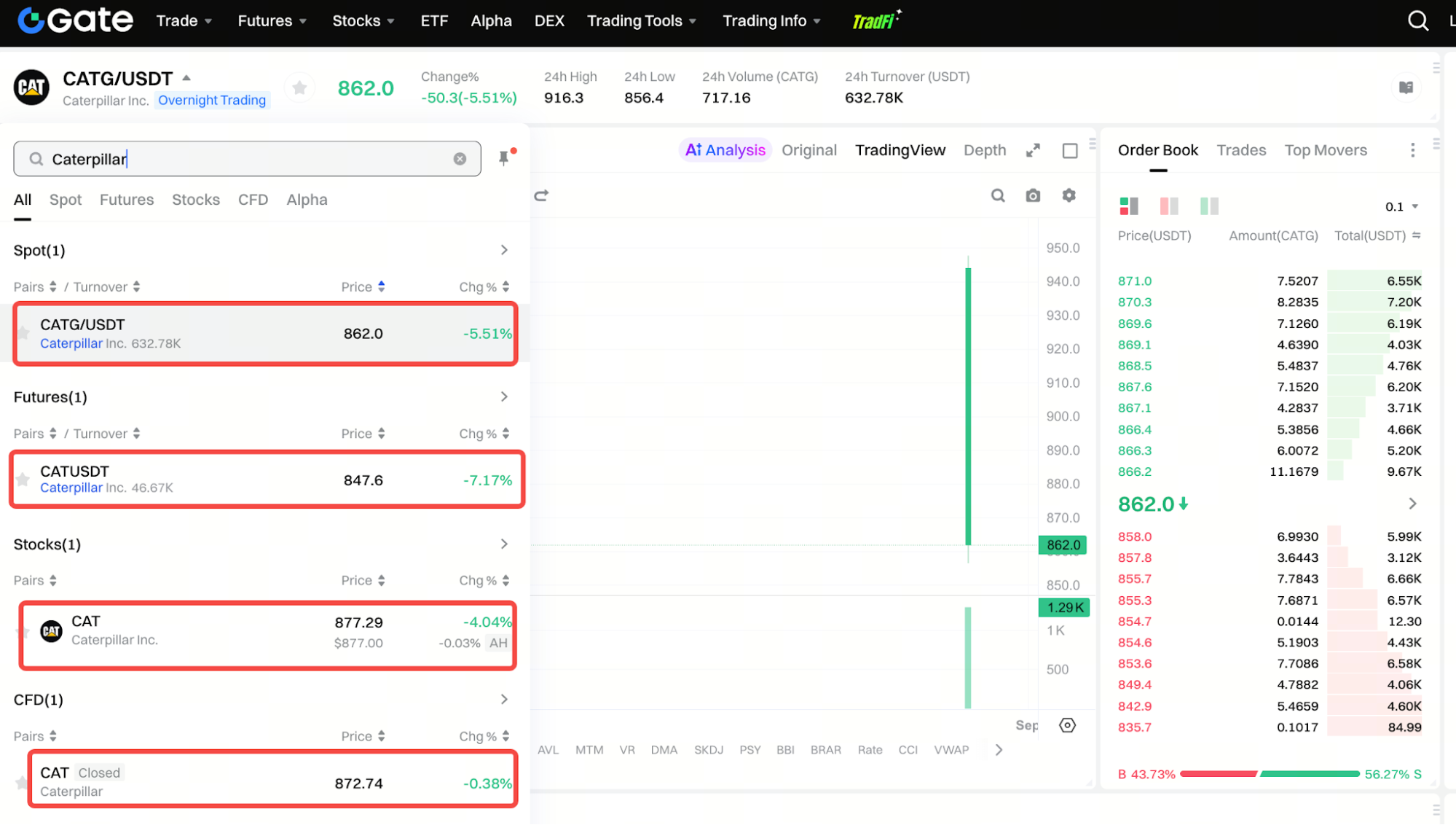
Current Gate search results for Caterpillar include CATG/USDT, CATUSDT, CAT Stock, and CAT CFD. If your goal is to access Caterpillar stock itself, prioritize CAT under the Stocks category; if you're interested in margin trading for price movements, check the CFD or Futures labels.
The Gate Stocks page provides CAT's real-time price, market charts, and performance data—key references for identifying the stock entry. Available products, trading hours, and regional access may change, so always rely on your account page for the most current information.
How to Buy CAT Stock with USDT
The core approach to trading CAT stock with USDT is to use USDT as your funding source and establish a CAT position according to Gate's stock product pricing and settlement rules. First, confirm that the trading page is labeled as Stocks, not Futures or CFD, and then determine tradable quantity and capital requirements per product rules.
Gate supports fractional share trading, so you don't have to buy a whole share at once. You can open smaller positions based on available funds and the platform's minimum trade size. Stock prices still track the underlying market and are affected by U.S. trading hours, liquidity, order execution, and exchange rate or settlement mechanisms.
Keep in mind: displaying prices in USDT does not alter CAT's underlying stock nature or market drivers. Caterpillar's financials, demand for construction equipment, mining capital expenditures, and U.S. equity market volatility continue to influence CAT's price.
How to Choose CAT Stock Order Types
Order type directly impacts execution speed, price, and the risk of non-fulfillment. Market orders prioritize speed, with final prices subject to order book changes; limit orders let you set a price, but may not execute if the market doesn't reach your target.
In fast-moving or less liquid markets, market orders may fill at prices different from those quoted at order placement. Limit orders cap your buy or sell price but don't guarantee execution, so you must weigh price control against execution certainty.
Order mechanisms can vary by product. Stocks, CFDs, and perpetual contracts may all support market and limit orders, but contracts add parameters like leverage, margin, TP/SL, and liquidation—ordinary stock logic does not apply.
How to View CAT Stock Positions and Order Records
CAT stock position records typically show position size, average cost, current market value, and unrealized PnL. Order records help distinguish filled, partially filled, unfilled, and canceled orders, clarifying whether asset changes stem from price movement or new trades.
Always view position information by product. CAT stock positions reflect the quantity and value of stock holdings; CATUSDT perpetual contracts display direction, leverage, margin, entry price, and liquidation price; CAT CFD may also show overnight fees or margin usage.
Do not simply combine PnL across different entries. For example, holding both CAT stock and a CATUSDT short contract creates opposite exposures—always check position direction, notional value, and risk mechanics separately.
How to Sell CAT Stock and Settle in USDT
The outcome of selling CAT stock depends on the quantity sold, execution price, and platform fees. Once the order fills, the corresponding asset value is credited to your account per Gate's settlement rules and can be managed as USDT or other supported funds.
Selling stocks and closing contract positions are fundamentally different. Selling stocks reduces your equity position; closing a perpetual contract ends a long or short position, with PnL based on entry price, closing price, leverage, funding rate, and fees.
USDT settlement simplifies moving funds between crypto and securities accounts, but does not eliminate price differences, fees, or settlement times. Always refer to trade details, fees, and product rules for your net proceeds.
How Does Gate CAT Stock Trading Differ from Traditional Brokers?
The main differences between trading CAT on Gate and with traditional brokers are in funding, product range, settlement units, and account structure. Traditional brokers use fiat to buy exchange-listed stocks; Gate combines stocks, USDT pairs, CFDs, and perpetual contracts within a single digital asset account.
| Comparison |
Gate CAT Trading |
Traditional Broker CAT Stock |
| Funding |
USDT or platform-supported funds |
USD or other fiat currencies |
| Product Range |
Stocks, trading pairs, CFDs, perpetual contracts |
Common stock, options, other securities |
| Stock Ownership |
Depends on product |
Actual equity for common stock |
| Long/Short Mechanism |
CFDs and perpetual contracts support both |
Stocks are typically long-only |
| Leverage |
Derivatives may support leverage |
Depends on margin account rules |
| Trading Hours |
Varies by product |
Set by securities exchanges |
| Settlement |
USDT available |
Typically fiat currency |
| Dividends/Voting |
Depends on product rights |
Usually available to shareholders |
Gate offers a more direct link between crypto accounts and traditional asset prices, but users must identify product types. When multiple CAT entries appear, first determine if you're trading stocks or derivatives, then assess leverage, margin, and shareholder rights.
Traditional brokers offer clearer product boundaries but may require separate securities accounts, fiat conversion, and compliance with local regulations. The account structures are not identical—similar prices do not make them the same trade.
Summary
When trading CAT with USDT on Gate, distinguish between CAT stock, CATG/USDT, CATUSDT perpetual contracts, and CAT CFD. While all are tied to Caterpillar's price, they differ in asset ownership, settlement, direction, and risk.
The Gate stock entry most closely resembles traditional stock trading, with USDT as the funding source. CATUSDT perpetual contracts and CAT CFD are derivatives and do not represent direct ownership of Caterpillar common stock. Order type affects execution price and probability; position management must be done separately for each product.
FAQ
Are CATG/USDT and CAT Stock the Same Product on Gate?
No. CATG/USDT and CAT stock are not the same product, even though they relate to the same company. They may differ in trading category, settlement, and asset rights—always refer to each product’s details.
Why Do CAT Product Prices Differ on Gate?
CAT product prices can vary due to trading hours, liquidity, order book depth, funding rates, and pricing mechanisms. Stocks, CFDs, and perpetual contracts may show price discrepancies.
Do CATUSDT Perpetual Contracts Grant Caterpillar Dividends?
No. Holding CATUSDT perpetual contracts does not equate to owning Caterpillar common stock, so you generally do not receive dividends or voting rights. Any cash adjustments are subject to contract terms.
Can You Trade CAT Stock When U.S. Markets Are Closed?
Trading availability for CAT stock during U.S. market closure depends on Gate's supported trading hours. Overnight trading, CFDs, and perpetual contracts may have different schedules.
Does Trading CAT with USDT Incur Exchange Rate Risk?
USDT settlement reduces the need for direct USD conversion, but users must still consider USDT-USD price deviations, underlying stock price movements, and product settlement risks.
Why Monitor the Funding Rate for Perpetual Contracts?
Perpetual contracts have no fixed expiration, and the funding rate balances long and short positions. Over time, periodic funding payments or receipts directly affect your final PnL.