Over the past decade, Proof-of-Work, or PoW, has been one of the most established consensus mechanisms in the blockchain industry. Bitcoin miners use ASIC devices to perform hash calculations as they compete for new block rewards. However, the biggest problem with traditional PoW is that large amounts of computing power are spent on hash calculations that have no real-world use.
With the development of Zero-Knowledge Proofs, or ZK, and AI infrastructure, the industry has begun exploring a new direction known as “Useful Proof of Work.” Nockchain emerged in this context. It attempts to upgrade traditional PoW hash competition into verifiable proof generation.
How Does Nockchain Mining Work?
In traditional PoW networks, a miner’s main job is to keep trying random hashes until they find a result that meets the network’s difficulty requirement.
In Nockchain, however, miners perform proving tasks.
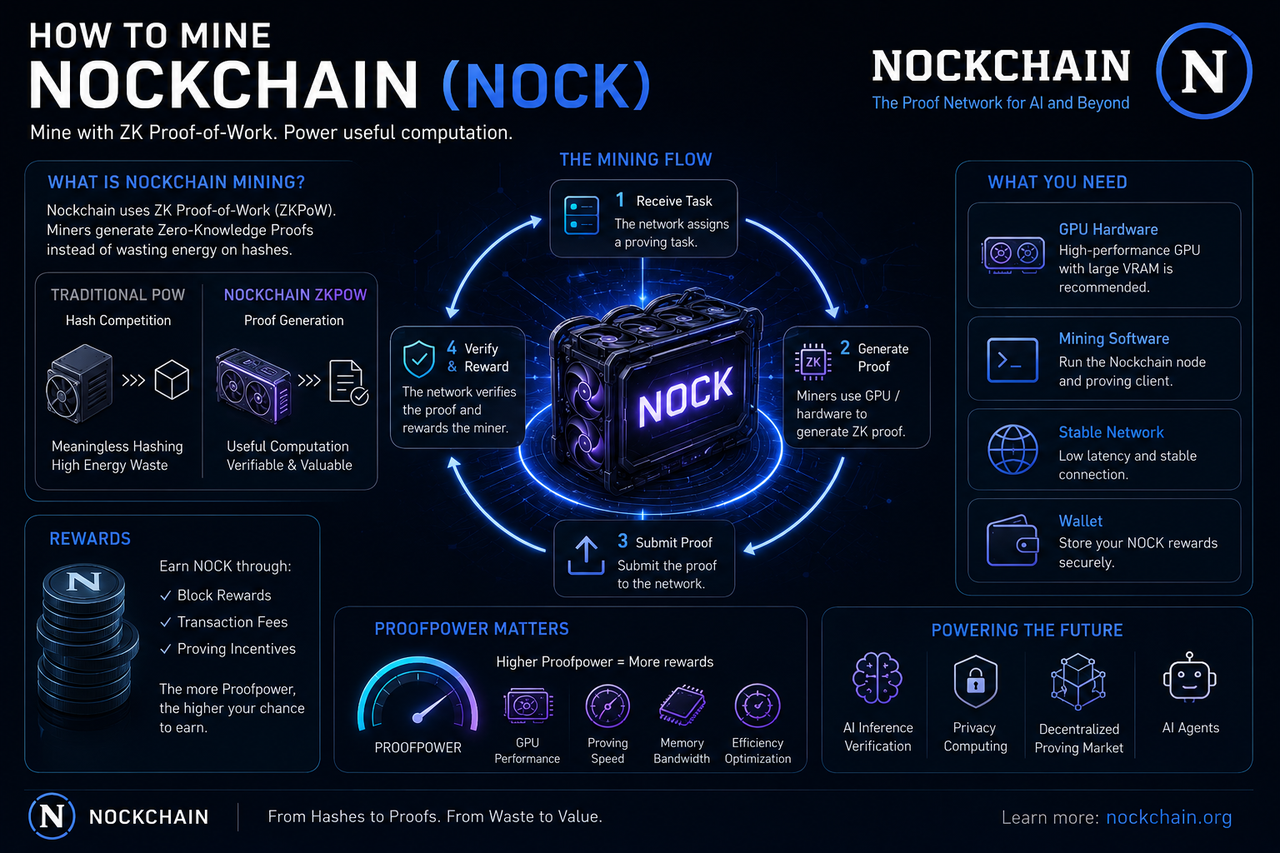
The network assigns miners proving computations that need to be completed. Miners then use GPUs or proving hardware to generate the corresponding Zero-Knowledge Proofs. Once a proof is verified by the network, the miner can receive block rewards and related earnings.
Therefore, the core of Nockchain mining is no longer hashpower, but proof generation capability.
Simply put:
This design means miners’ computational resources can genuinely serve real-world computational needs, rather than being used only for network security.
What Is Proofpower?
In the Nockchain ecosystem, Proofpower is an important measure of a miner’s capability.
It is similar to hashpower in the Bitcoin network, but it does not mean the same thing.
Proofpower refers to a miner’s ability to generate valid Zero-Knowledge Proofs.
A miner’s Proofpower is usually affected by the following factors:
-
GPU performance
-
proving speed
-
proving efficiency
-
hardware optimization
-
memory bandwidth
Because Zero-Knowledge Proof generation places high demands on hardware performance, GPU acceleration and proving hardware may become important parts of the Nockchain mining ecosystem in the future.
What Do You Need to Participate in Nockchain Mining?
Participating in Nockchain Mining usually requires several core components.
The first is GPU hardware. Since ZK proving has a high demand for parallel computation, high-performance GPUs can often provide higher Proofpower.
The second is proving software. Miners need to run the corresponding Nockchain node and proving client to receive proving tasks, generate proofs, and submit them to the network.
A stable network environment and the ability to run a node are also required. Miners need to stay synchronized with the Nockchain network and submit proofs in a timely manner.
Compared with traditional ASIC mining, Nockchain Mining is closer to a “high-performance computing, or HPC, plus ZK proving” model.
Where Do Nockchain Mining Rewards Come From?
NOCK Mining rewards mainly come from block rewards and network transaction fees.
When a miner successfully generates a valid proof and that proof is verified by the network, the miner may receive block rewards, transaction fees, and proving incentives. Since Nockchain’s consensus mechanism is built on proof generation, miners are effectively providing proving services to the entire network.
As AI inference verification, privacy computation, and decentralized proving markets develop in the future, demand for proofs may also continue to grow.
How Is Nockchain Mining Different from Bitcoin Mining?
Although both belong to the PoW model, their operating logic is completely different.
Bitcoin Mining aims to secure the network through hash competition, while Nockchain Mining seeks to use computing power for verifiable computation.
In the Bitcoin network, miners continuously perform SHA-256 hash calculations. In the Nockchain network, miners generate Zero-Knowledge Proofs.
Their hardware logic also differs:
As a result, Nockchain is seen as an important attempt to evolve the PoW model toward “Useful Proof of Work.”
What Are the Risks of Nockchain Mining?
Although Nockchain’s technical direction is innovative, its mining model is still at a relatively early stage.
First, Zero-Knowledge Proof generation places high demands on GPUs and proving hardware, so miners may face significant hardware costs.
Second, the overall proving economy is still in its early stages, and real market demand has not yet fully matured.
In addition, the Nockchain ecosystem is still expanding. Its developer ecosystem, proving market, AI application demand, and node network scale all still need further growth.
For miners, NOCK Mining is therefore better suited to participants with a long-term technical perspective.
Conclusion
Through ZK Proof-of-Work, or ZKPoW, Nockchain upgrades traditional meaningless hash competition into Zero-Knowledge Proof generation with real-world utility. Miners no longer merely consume energy. Instead, they directly participate in building verifiable computation and proving infrastructure.
FAQs
How Is NOCK Mining Different from Bitcoin Mining?
Bitcoin Mining relies on hash competition, while NOCK Mining relies on Zero-Knowledge Proof generation.
What Is Proofpower?
Proofpower is a miner’s ability to generate valid Zero-Knowledge Proofs. It is the equivalent of hashpower in traditional PoW networks.
Does Nockchain Mining Require a GPU?
Usually, yes. Since Zero-Knowledge Proof generation requires substantial parallel computation, high-performance GPUs are better suited to Nockchain Mining.
Nockchain focuses on verifiable computation and proving infrastructure, which can be used for AI inference verification and AI Agent execution proofs.







