As blockchain evolves from a simple transaction network into a platform for programmable finance and decentralized applications, zero knowledge proofs, or ZK proofs, are becoming a core technology in Web3 infrastructure. In areas such as Rollup scaling, cross chain communication, and verifiable AI computation, developers increasingly need infrastructure that can generate proofs at low cost and at large scale.
Traditional ZK systems usually rely on centralized Prover services. The Prover Network from Succinct aims to organize global computing power through a decentralized market mechanism, making proof generation available on demand, much like cloud computing resources.
What Is the Succinct Prover Network?
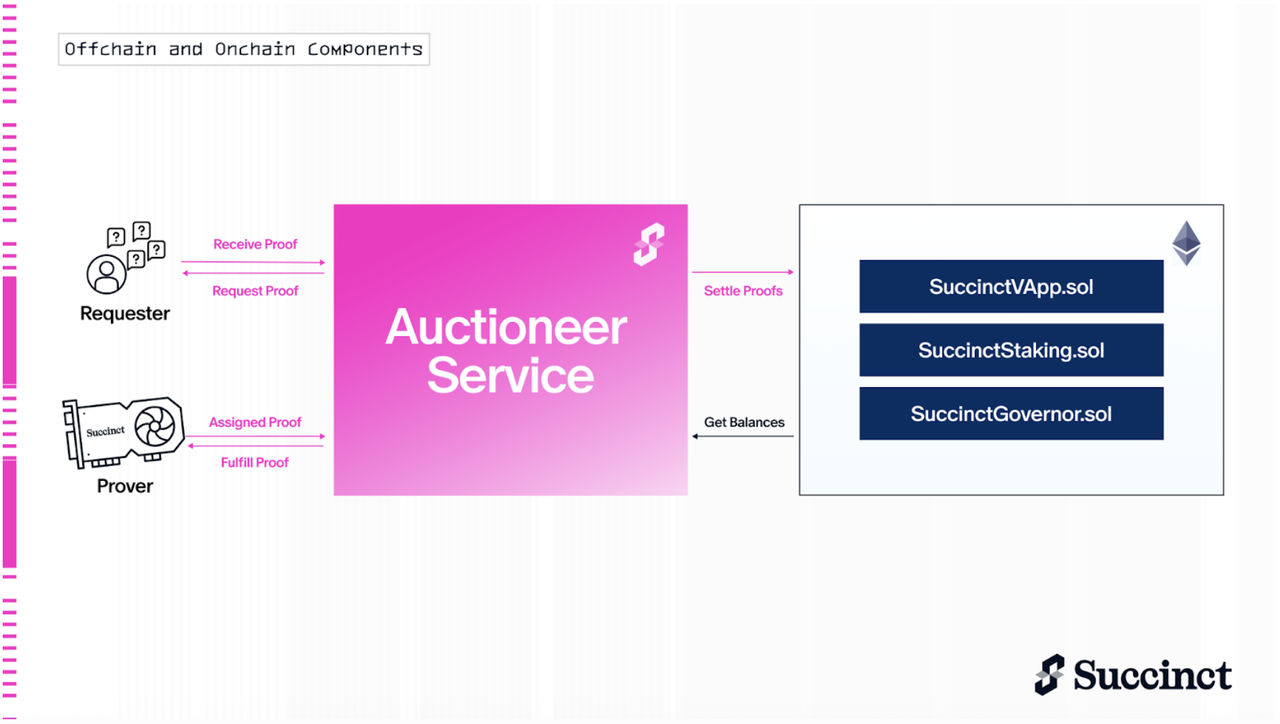
Succinct Prover Network is, at its core, an open decentralized Proof Marketplace. It connects two main types of participants: developers and protocols that need proofs, and Prover nodes that provide computing resources.
In traditional architecture, a Rollup or cross chain protocol often needs to maintain its own Prover cluster. In the Succinct network, however, project teams only need to submit tasks, and the system automatically handles proof generation, verification, and settlement.
This model is similar to a cloud computing platform. Ethereum provides decentralized settlement, AWS provides computing resources, and Succinct provides decentralized proof generation capability. In this sense, Succinct is more like “Proof as a Service” infrastructure.
Why Is a Decentralized Proof Network Needed?
One of the defining features of zero knowledge proofs is that proof generation is highly complex, while verification is relatively simple.
Verifying a SNARK proof on-chain usually requires relatively little gas, but generating a complex proof often requires substantial GPU computing power and processing time.
If every project builds its own Prover infrastructure, project costs rise significantly and system scalability becomes limited. At the same time, centralized Provers can introduce censorship risks and single points of failure.
Succinct aims to integrate idle computing resources around the world through an open market, making proof generation lower cost, more efficient, and more resistant to censorship. This is the core value of the Prover Network.
How Does a ZK Proof Request Work?
A complete ZK proof request usually goes through five stages: request submission, task assignment, proof generation, on-chain verification, and reward settlement.
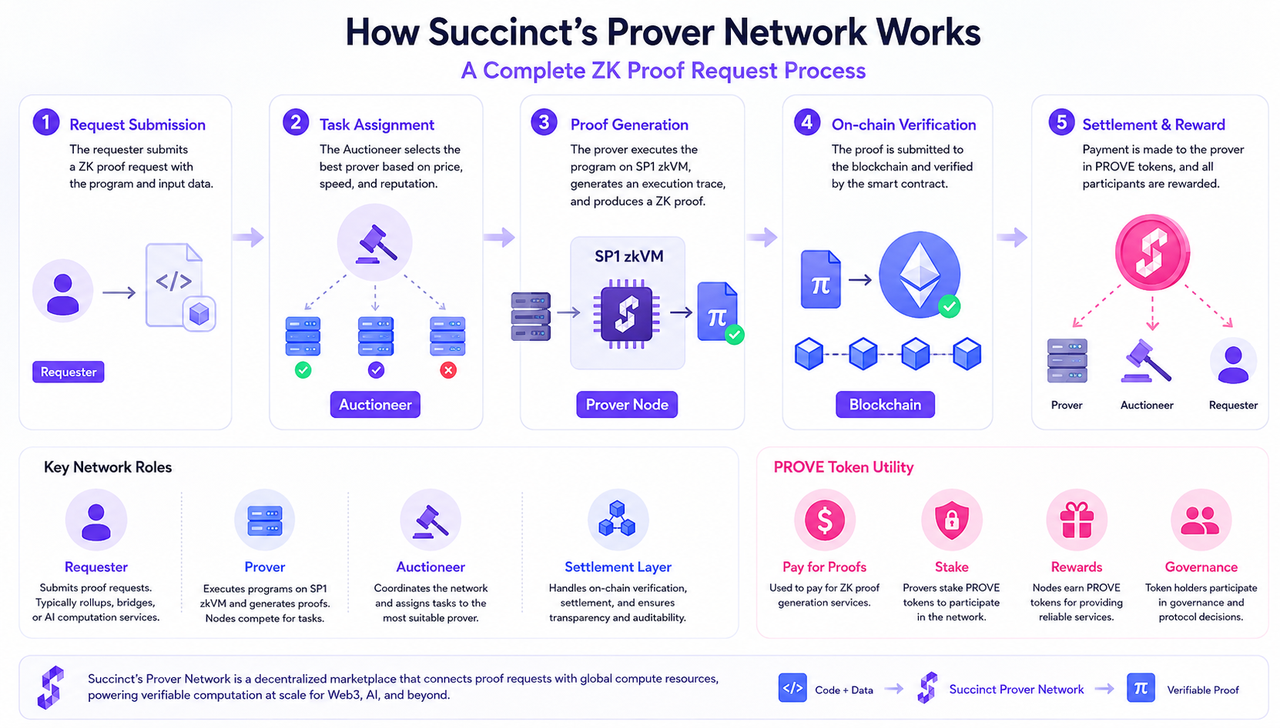
Request Submission
Developers first need to submit a proof request to the network.
The request usually includes program code, input data, verification parameters, and budget information. These programs usually run on SP1 zkVM, so developers do not need to hand write complex ZK circuits. Instead, they can write business logic directly in Rust.
For example:
A Rollup can submit a state transition task; an AI protocol can submit a model inference result; an Oracle can submit an off chain data computation; and a cross chain bridge can submit a state synchronization request.
After the task is submitted, the system automatically moves to the next stage.
Task Assignment
The Auctioneer in the Succinct network is responsible for task scheduling.
Its role is similar to a coordination layer in the proof market. It automatically selects the most suitable Prover node based on the state of the network.
When assigning tasks, the system usually considers several factors, including node reputation, proof cost, response speed, and hardware capability.
If a node has a stable track record, generates proofs faster, has stronger GPU performance, or offers lower costs, it is usually more likely to receive tasks.
This market-based mechanism means proof generation no longer depends on a single institution. Instead, it becomes an open and competitive computing power network.
Proof Generation
After the task assignment is completed, the Prover node begins executing the program and generating the proof.
This stage mainly relies on SP1 zkVM.
SP1 zkVM is a general purpose zero knowledge virtual machine provided by Succinct. Developers can write programs directly in Rust, after which the system automatically compiles them into RISC-V instructions and executes them inside the zkVM.
The overall process is roughly as follows:
Rust Program → RISC-V → Execution Trace → STARK Proof → SNARK Compression
Compared with traditional ZK development, the biggest feature of SP1 zkVM is that:
Developers do not need to learn complex ZK DSLs or hand write cryptographic circuits.
This gradually shifts zero knowledge proof development from “cryptographic engineering” toward “ordinary software development.”
What Is an Execution Trace?
When a zkVM executes a program, the system records the full execution process.
This process is called an execution trace.
It records every state change during program execution, including:
The system then converts these traces into mathematical constraints and ultimately generates a ZK proof.
Therefore, the essence of a proof is not simply proving that a certain result exists. It proves that “the program was correctly executed according to the rules.”
On-Chain Verification
After the proof is generated, it is submitted on-chain for verification.
On-Chain verification usually has several characteristics:
After verification succeeds, the relevant protocol can safely update its state.
For example:
A Rollup can update its Layer 2 state; a cross chain bridge can synchronize data across different chains; an AI application can verify model outputs; and an Oracle can confirm the authenticity of off chain data.
This is also one of the key reasons why ZK technology is so highly valued in Web3.
Why Is Verification Cheaper Than Generation?
This is one of the core features of zero knowledge proofs.
The proof generation stage requires:
-
Executing the complete program
-
Building mathematical constraints
-
Computing complex polynomials
This process is computationally intensive.
The verification stage, however, only needs to check whether the final proof satisfies cryptographic rules, so the cost is much lower.
This structure, “heavy computation off chain, lightweight verification on-chain,” is also an important foundation for scaling Rollups and verifiable computation.
Settlement and Rewards
Once proof verification is complete, the system enters the settlement stage.
The PROVE token is mainly used to pay proof service fees, support node staking, distribute rewards, and participate in network governance.
Nodes that consistently provide high quality proofs over time will receive more rewards and tasks. Conversely, malicious behavior may lead to lower reputation or even staking penalties.
Therefore, PROVE is not only a payment tool, but also an important part of the network’s security mechanism.
Core Roles in the Succinct Network
The entire network is mainly made up of four types of roles.
Requester
Requesters usually include Rollups, AI protocols, Oracles, cross chain bridges, and various Web3 applications. They are responsible for submitting programs and data that need to be verified.
Prover
Provers are the computing power providers in the network. Their role is to execute programs, generate proofs, submit results, and receive rewards.
The stronger a node’s performance, the more likely it is to receive complex tasks.
Auctioneer
The Auctioneer is responsible for scheduling tasks, matching nodes, and optimizing network resource allocation.
It functions like the network’s “proof scheduling system.”
Settlement Layer
The Settlement Layer is responsible for on-chain verification, state recording, and reward settlement.
This layer is usually deployed on high security blockchains such as Ethereum.
Challenges Facing Succinct
Despite its broad potential, Succinct still faces several practical challenges.
First, generating complex proofs remains costly and requires substantial GPU and hardware resources.
Second, a general purpose zkVM needs to balance performance, security, and generality at the same time, making it far more technically complex than specialized ZK circuits.
In addition, competition in the zkVM and ZK infrastructure space is currently intense. Projects such as RISC Zero, zkSync, Starknet, and Polygon zkEVM are all competing for developers and ecosystem resources.
At the same time, the market for large scale verifiable computation is still in its early stages, and truly large scale demand has not yet fully emerged.
Conclusion
Succinct’s Prover Network is trying to turn ZK proofs from a complex cryptographic tool into a standardized infrastructure service.
Through SP1 zkVM, a decentralized Prover market, the Auctioneer scheduling mechanism, and the PROVE incentive system, Succinct builds an open Proof Economy that allows developers to access verifiable computation much like calling a cloud service.
FAQs
What Steps Are Required for a ZK Proof Request?
A request usually includes request submission, task assignment, proof generation, on-chain verification, and reward settlement.
What Role Does SP1 zkVM Play in the Network?
SP1 zkVM executes programs and automatically generates ZK proofs, allowing developers to avoid hand writing complex ZK circuits.
Why Is a Decentralized Prover Network Needed?
Because proof generation is expensive. A decentralized network can integrate global computing resources, reduce costs, and improve scalability.