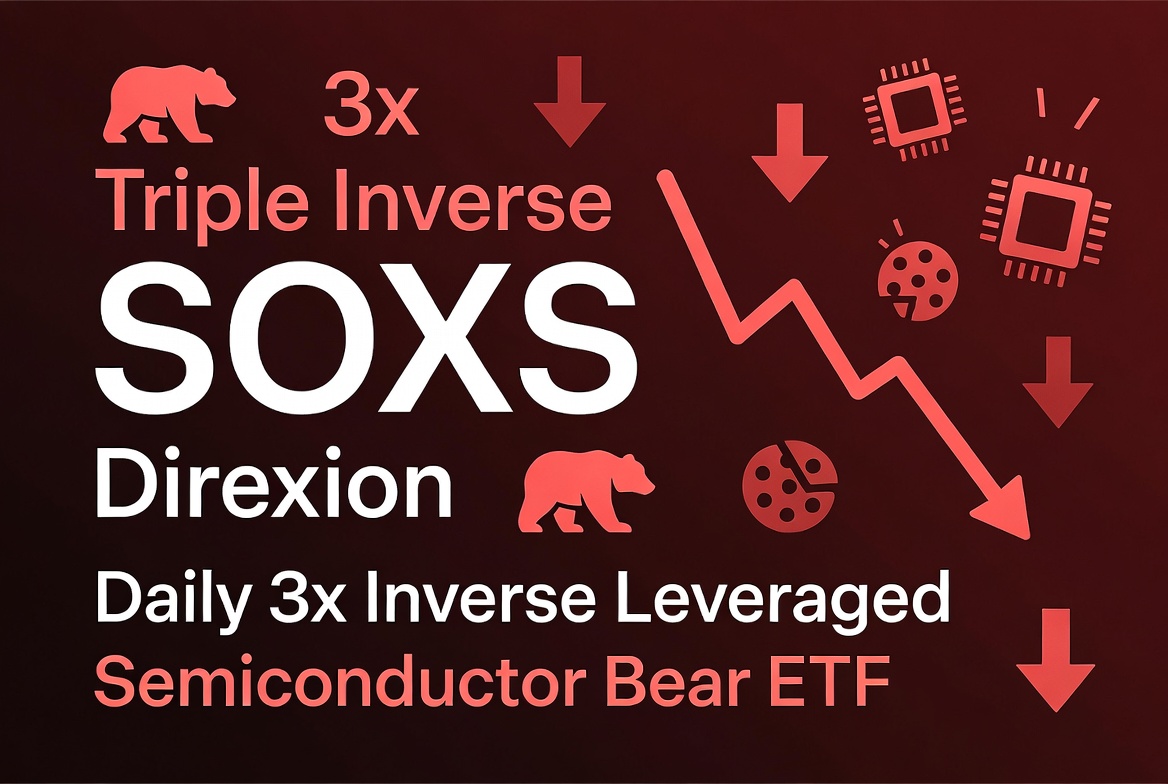
The semiconductor industry has long been highly volatile. As a result, changes in AI chips, GPUs, servers, and wafer manufacturing often have a direct impact on SOXS’s price performance. When market risk appetite declines, SOXS trading volume also tends to rise noticeably.
SOXS is not a traditional long term investment ETF. Because the product includes daily rebalancing and a 3x leverage mechanism, SOXS is better understood as a short term risk trading tool rather than a long term asset allocation vehicle.

The main purpose of SOXS is to provide amplified inverse returns when the semiconductor sector falls. Structurally, SOXS does not directly short any single chip company. Instead, it uses financial derivatives to create short exposure to the broader semiconductor index. The deeper the decline in the chip sector, the greater the theoretical upside for SOXS tends to be.
SOXS is closer to a short term market risk management tool. Some traders use SOXS to hedge semiconductor stock risk, or to trade pullbacks in the technology sector.
SOXS’s core return objective is to deliver three times the inverse daily return of a semiconductor index. In other words, the product is focused on “daily volatility,” not long term cumulative returns. This structure means SOXS usually carries higher risk and volatility than ordinary ETFs.
SOXS moves inversely to the semiconductor index because the ETF itself is built around a short index structure.
Semiconductor indexes usually include companies involved in GPUs, CPUs, AI chips, wafer manufacturing, and semiconductor equipment. As a result, changes in the chip industry directly affect index performance.
First, when the semiconductor sector pulls back, SOXS’s inverse return structure generates gains accordingly.
Next, the fund uses swaps, futures, and other derivatives to maintain short exposure to the index. The more pronounced the market volatility, the more frequently positions usually need to be adjusted.
Then, risk off sentiment may push more capital into the inverse ETF market. During sharp declines in the technology sector, SOXS trading volume typically rises significantly.
Ultimately, SOXS tends to form a clear negative correlation with the semiconductor index.
This structure makes SOXS a typical trading tool for downturns in the semiconductor market.
SOXS’s 3x leverage structure is essentially built on the amplification mechanism of financial derivatives.
First, the fund uses derivatives to create market exposure greater than its net asset value. This leverage structure allows the ETF to magnify index movements.
Next, when the semiconductor index falls, SOXS’s returns are amplified accordingly. The larger the index decline, the greater the theoretical gain in SOXS tends to be.
The table below shows SOXS’s theoretical return structure:
| Daily Change in Semiconductor Index | Theoretical Change in SOXS |
|---|---|
| -1% | 0.03 |
| -2% | 0.06 |
| 0.01 | -3% |
| 0.02 | -6% |
This structure means both returns and risks are magnified at the same time.
From a trading logic perspective, SOXS is better suited to high volatility, short term markets than to long term holding strategies.
SOXS’s daily rebalancing mechanism continuously affects the ETF’s net asset value structure and long term performance.
First, SOXS aims to track three times the inverse return on a “single day.” For that reason, the fund needs to recalculate its leverage ratio every day.
After the market closes, the fund adjusts its derivative positions based on changes in net asset value. The greater the index volatility, the larger the rebalancing adjustment usually becomes.
In addition, a continuously choppy market may lead to compounding drift. Even if the semiconductor index changes only slightly over the long run, SOXS’s net asset value may gradually decline.
This phenomenon is often called volatility decay. In markets with frequent rises and falls, the long term net asset value of leveraged ETFs often wears down over time.
Therefore, SOXS is more focused on short term trading than on long term investment logic.
SOXS’s volatility amplification mechanism means its price changes are usually much larger than those of ordinary ETFs.
The semiconductor industry itself is a highly volatile sector. The AI boom, changes in chip inventories, and technology industry cycles all affect market sentiment.
First, 3x leverage directly amplifies market volatility. Even a small decline in the semiconductor index may push SOXS sharply higher.
Next, market panic can further increase short term capital flows. During rapid pullbacks in technology stocks, SOXS volatility usually rises significantly.
Then, the daily rebalancing mechanism reinforces short term price changes. The fund needs to keep adjusting leveraged positions to maintain its target return structure.
Ultimately, SOXS may fluctuate far more than ordinary semiconductor ETFs.
This structure means SOXS is better suited to trading scenarios where investors have a high tolerance for risk.
The key difference between SOXS and traditional short selling lies in the trading structure and risk model.
Traditional short selling usually requires borrowing shares, selling them, and then waiting for the price to fall before buying them back. Ordinary short selling also typically involves stock borrowing costs and margin requirements.
SOXS, by contrast, creates inverse returns directly through an ETF structure. Users do not need to borrow shares directly or manage a separate short position.
The table below shows the main differences between the two approaches:
| Type | Traditional Short Selling | SOXS |
|---|---|---|
| Requires Borrowing Shares | Yes | No |
| Trading Method | Short Sale | ETF Trading |
| Leverage Structure | Optional | Fixed 3x |
| Risk Structure | Theoretically Unlimited | High Volatility |
SOXS usually has a lower trading threshold than traditional short selling, but its volatility risk remains high.
Therefore, SOXS is closer to a standardized leveraged inverse trading tool.
SOXS is mainly used during chip sector pullbacks, high volatility markets, and periods of technology risk hedging.
Some traders use SOXS to hedge AI chip or semiconductor stock positions. When chip companies experience sharp pullbacks, SOXS can theoretically generate inverse returns.
Short term volatility trading is another important use case for SOXS. In highly volatile technology markets, SOXS’s price sensitivity is usually much higher than that of ordinary ETFs.
Some institutional capital also uses SOXS to manage market risk exposure. When the semiconductor industry enters a correction cycle, SOXS trading volume typically rises quickly.
At the same time, some multi asset trading platforms have begun offering CFD products related to U.S. stock ETFs. Products such as Gate CFD, launched by Gate, are gradually expanding the coverage of digital asset platforms into overseas ETFs and global market assets.
However, it is important to note that SOXS is already a highly volatile leveraged ETF. If it is further combined with CFDs or additional leverage structures, overall risk usually increases even more.
SOXS is a leveraged ETF that seeks to deliver three times the inverse daily return of a semiconductor index. It is mainly used for trading chip sector pullbacks, hedging market risk, and managing short term volatility.
The core structure of SOXS is built on inverse returns, leverage amplification, and daily rebalancing, which means its risk is usually significantly higher than that of ordinary ETFs.
Because the semiconductor industry itself is highly volatile, SOXS is better suited to short term trading scenarios than to long term asset allocation.
SOXS is a 3x leveraged inverse semiconductor ETF that aims to deliver three times the inverse daily return of a semiconductor index.
SOXS uses financial derivatives to create short index exposure, so when the semiconductor index falls, SOXS can theoretically rise.
3x leverage means that when the semiconductor index falls by 1% in a single day, SOXS could theoretically rise by about 3%.
SOXS is affected by semiconductor industry volatility, leverage structure, and daily rebalancing, so its price movements are usually much larger than those of ordinary ETFs.
Ordinary semiconductor ETFs usually track the long term growth of the industry, while SOXS is more of a short term inverse leveraged trading instrument.