As consumer demand evolves rapidly, raw material prices fluctuate, and the global supply chain environment becomes increasingly complex, the supply chain has become a vital foundation for competition among consumer goods companies. PepsiCo is shaping future operating models for the global consumer goods sector through data-driven supply chain optimization and technological innovation.
How PepsiCo’s Supply Chain System Works
PepsiCo stands as a global leader in food and beverages, boasting renowned brands such as Pepsi, Lay’s, Gatorade, and Quaker, with business operations spanning more than 200 countries and territories. As a consumer goods powerhouse with both beverage and food divisions, PepsiCo’s supply chain must handle highly complex processes across production, procurement, inventory, logistics, and market demand management.
PepsiCo’s supply chain model goes beyond mere manufacturing—it’s a comprehensive global network covering raw material sourcing, product development, manufacturing, warehousing, distribution, and consumer engagement. From agricultural inputs to final product sales, every stage relies on supply chain collaboration to maximize efficiency.
Upstream, PepsiCo procures vast quantities of agricultural raw materials, including potatoes, corn, grains, water, sugar, and packaging materials. These inputs are subject to seasonal shifts, climate factors, and international market price fluctuations, prompting the company to forge long-term procurement partnerships and use supply chain forecasting to mitigate supply risks.
In manufacturing, PepsiCo deploys a global production footprint, building plants in diverse regions to bring products closer to key consumer markets. Regional production not only cuts transportation costs but also accelerates supply responsiveness.
Downstream, PepsiCo leverages its warehousing network, transportation infrastructure, and retail channels to swiftly deliver products to supermarkets, convenience stores, foodservice outlets, and online retail platforms. For fast-moving consumer goods companies, supply chain speed directly affects product freshness, inventory levels, and consumer experience.
PepsiCo’s supply chain advantage is rooted not in a single technology, but in the seamless coordination among procurement, manufacturing, logistics, and data systems.
Why Supply Chain Is a Strategic Advantage for Consumer Goods
| Comparison Dimension |
Traditional Supply Chain |
Digital Supply Chain |
| Demand Forecasting |
Relies on historical data and manual expertise |
AI models anticipate market shifts |
| Production Model |
Fixed production schedules |
Dynamic production adjustments |
| Inventory Management |
Reactive restocking |
Intelligent inventory optimization |
| Logistics Management |
Static transportation routes |
Data-driven route optimization |
| Risk Management |
Reactive response |
Proactive risk prediction |
Supply chains are evolving from basic cost management tools into core competitive assets for consumer goods companies.
Historically, competition centered on brand marketing, channel coverage, and product innovation. As global markets shift and consumer demand diversifies, companies must deliver faster, offer broader product portfolios, and operate more efficiently—making supply chain strength a decisive factor.
First, supply chain impacts cost structure. Food and beverage margins are shaped by raw material, energy, labor, and transportation costs. Optimizing procurement, increasing automation, and minimizing inventory waste elevate overall profitability.
Second, supply chain determines market responsiveness. Consumer trends—like health foods, low-sugar drinks, and functional beverages—are emerging rapidly. Without supply chain flexibility, companies struggle to adapt production plans in real time.
Additionally, global supply chain uncertainty has heightened the importance of robust supply chain management. Events like pandemics, geopolitical tensions, energy price swings, and extreme weather have all disrupted food and beverage supply stability.
For multinationals like PepsiCo, supply chains serve both production and risk management functions. Building smarter, more agile supply chain systems enhances resilience to market volatility.
How PepsiCo Drives Smart Manufacturing
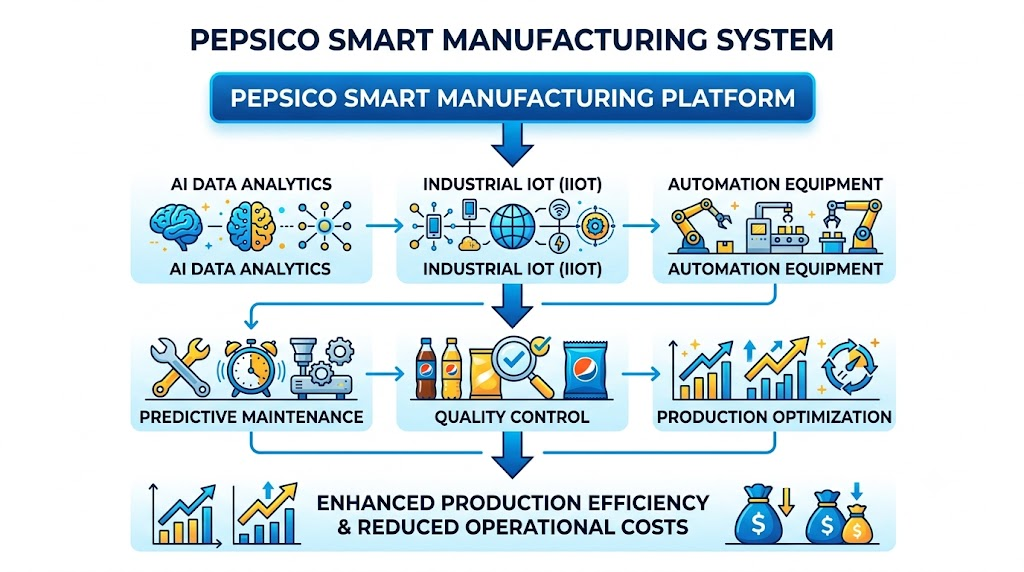
Smart manufacturing is a key pillar for PepsiCo’s supply chain efficiency. With advances in artificial intelligence (AI), industrial IoT (IIoT), automation, and data analytics, traditional food manufacturing is transitioning to digital factory models.
PepsiCo is digitizing manufacturing processes across its global sites, harnessing data collection and intelligent analytics to optimize production. For example, sensors on production lines monitor equipment status, throughput, and product quality in real time.
Compared to traditional methods, smart manufacturing enables early detection of production anomalies. Predictive maintenance analyzes equipment data to forecast potential failures, allowing proactive maintenance and reducing downtime.
In food and beverage, quality control is a critical application of smart manufacturing. Production involves parameters like temperature, humidity, formulation ratios, and packaging standards; digital systems boost detection accuracy and minimize human error.
Smart manufacturing also empowers PepsiCo to execute flexible, small-batch production. As consumer demand becomes more segmented, the company must launch more regional and personalized products, and smart production lines improve adjustment efficiency.
Looking ahead, as AI matures, smart manufacturing may evolve from automated production to autonomous optimization—continuously adjusting production parameters via algorithms for superior operational efficiency.
How Automation and Digitization Enhance Production Efficiency
Automation and digitization are essential to PepsiCo’s supply chain transformation, moving production from experience-driven to data-driven systems.
Automation—through robotics, automated packaging, and intelligent warehousing—reduces repetitive manual labor, boosts production speed, and improves stability. Automated equipment in packaging and logistics operates continuously, raising production line efficiency.
Automated warehouses optimize inventory placement and turnover via intelligent systems. For consumer goods companies managing vast SKUs, efficient inventory management reduces overstock and prevents shortages.
Digitization connects every supply chain segment. Enterprise resource planning (ERP), supply chain management (SCM), and data analytics platforms enable PepsiCo to integrate procurement, production, sales, and logistics data.
For instance, when regional demand spikes, data systems help adjust production plans and coordinate raw material supply and logistics. This real-time collaboration shifts supply chains from reactive to proactive.
AI and machine learning unlock new forecasting possibilities. Leveraging historical sales, market trends, weather, and consumer behavior data, companies can refine demand forecasts.
For PepsiCo, a digital supply chain means not just higher efficiency, but a more transparent, controllable global operation.
How PepsiCo Achieves Global Procurement and Logistics Synchronization
PepsiCo’s global supply chain management must address production efficiency and coordinate procurement, transportation, and market demand across regions. The synergy of global procurement and logistics is fundamental to sustaining competitive advantage.
PepsiCo sources raw materials from multiple countries and regions. Snack production requires large volumes of agricultural inputs, while beverage operations rely on water, sugars, and packaging materials. Regional differences in agriculture, climate, and supply capacity demand a diversified procurement system to mitigate single-source risks.
Global procurement is not simply about lowest-cost suppliers—it’s about balancing cost, quality, stability, and sustainability. In food, raw material quality directly affects product safety and brand reputation, making long-term supplier partnerships and management essential.
PepsiCo strengthens upstream supply chain management through supplier collaboration. In agriculture, the company promotes standardized cultivation to stabilize quality and reduce environmental impact.
For logistics, PepsiCo manages a complex global transportation network. Food and beverage products are high-frequency, low-unit price, and require large-scale distribution, so logistics efficiency directly impacts operating costs.
To optimize logistics, PepsiCo continuously refines its transportation network: route optimization, increased vehicle utilization, and data-driven inventory layout. Targeted logistics planning reduces distances and accelerates supply.
Regional supply chain layouts are a strategic focus. Building local production and distribution in key markets reduces logistics costs and enhances responsiveness compared to long-distance transport.
For example, when demand surges in a region, local production can quickly adjust supply without relying on cross-regional transport—a crucial model for global consumer goods companies.
How PepsiCo Advances Sustainable Supply Chain Initiatives
Sustainability has become a central pillar of supply chain strategy for global consumer goods companies. For PepsiCo, sustainable supply chains involve environmental stewardship, long-term cost control, and competitive strength.
Consumer goods supply chains are deeply linked to agriculture, energy, water, and packaging, requiring companies to reduce environmental impact at every stage.
In agriculture, PepsiCo promotes sustainable farming practices. Optimizing agricultural technology, improving land use, and minimizing resource waste secure stable long-term raw material supply.
Agricultural supply is highly sensitive to climate change. Extreme weather can reduce crop yields and drive up production costs, making supply chain resilience a key strategic goal.
In packaging, PepsiCo pursues eco-friendly solutions. Traditional plastics offer low cost and convenience but create environmental strain. The company is innovating packaging materials and increasing recyclable content.
Energy management is vital for sustainable supply chains. Enhancing energy efficiency, adopting renewables, and cutting carbon emissions in manufacturing reduce long-term operational costs.
Supplier management is also integral. Large consumer goods companies must ensure supply chain partners meet environmental and social responsibility standards.
In the long run, sustainable supply chains are not merely an added expense—they help companies build stable, efficient, and future-ready operations.
Opportunities and Challenges for Consumer Goods Supply Chains
As global economic conditions shift, consumer goods supply chains are entering a new era. Digitization, AI, and automation offer fresh opportunities, but also introduce complexity.
-
AI is a key tool for supply chain optimization—enabling demand forecasting, inventory management, logistics planning, and production enhancement. Traditionally, supply plans relied on historical sales and manual expertise; AI incorporates variables like consumer trends, weather, and market data for improved accuracy.
-
Automation is transforming food manufacturing. Robotics, unmanned warehousing, and automated transport further lower labor costs and enhance production stability. Yet, global supply chains face persistent challenges.
-
Raw material price volatility is a lasting concern. The food sector depends on agriculture, which is vulnerable to climate, energy prices, and trade conditions.
-
Consumer demand is changing faster than ever. Younger consumers prioritize health, sustainability, and personalization, requiring flexible supply chain capabilities.
-
Global supply chains increase operational complexity. Varying regulations, trade policies, and market environments demand agile supply chain management.
For global companies like PepsiCo, future competition will hinge on supply chain efficiency, digital capabilities, and risk management—not just brand strength.
PepsiCo Supply Chain: Future Directions
PepsiCo’s supply chain strategy will likely continue to emphasize intelligence, agility, and sustainability.
-
AI will further transform supply chain management—from demand forecasting and production scheduling to logistics optimization, AI will become central to decision-making. Future systems may not only analyze data but also proactively recommend optimizations, such as automatic production schedule adjustments or inventory-based route optimization.
-
Digital Twin technology will see broader adoption. Digital Twins create virtual models to simulate real-world production and logistics, helping companies forecast strategic impacts. For global consumer goods companies, Digital Twins streamline complex supply networks and boost decision efficiency.
-
Supply chain localization will intensify. Global companies once relied on centralized production, but increasingly focus on regional supply capabilities to reduce global supply risks.
-
Sustainability will remain a key upgrade focus. With stricter regulations and rising consumer environmental awareness, companies must continually optimize energy, packaging, and agricultural supply systems.
Over time, supply chain competition in consumer goods will shift from “scale advantage” to “intelligent operational advantage.” Companies with robust data, advanced automation, and resilient supply chains will best adapt to future market changes.
Summary
PepsiCo’s supply chain system exemplifies the shift from traditional manufacturing to intelligent operations in global consumer goods. Through global procurement, smart manufacturing, automation, digital management, and sustainable supply chain development, PepsiCo continually enhances operational efficiency and strengthens its agility in responding to market shifts.
As competition intensifies in consumer goods, the supply chain has evolved from a backend support function into a strategic asset for value creation. Changing consumer demand, global uncertainty, and technological innovation are prompting companies to redefine supply chain management.
Looking forward, as AI, automation, and data technologies advance, supply chains will become smarter and more transparent. For global enterprises like PepsiCo, ongoing supply chain optimization is not only a means to reduce costs—it’s a critical foundation for sustained long-term competitiveness.