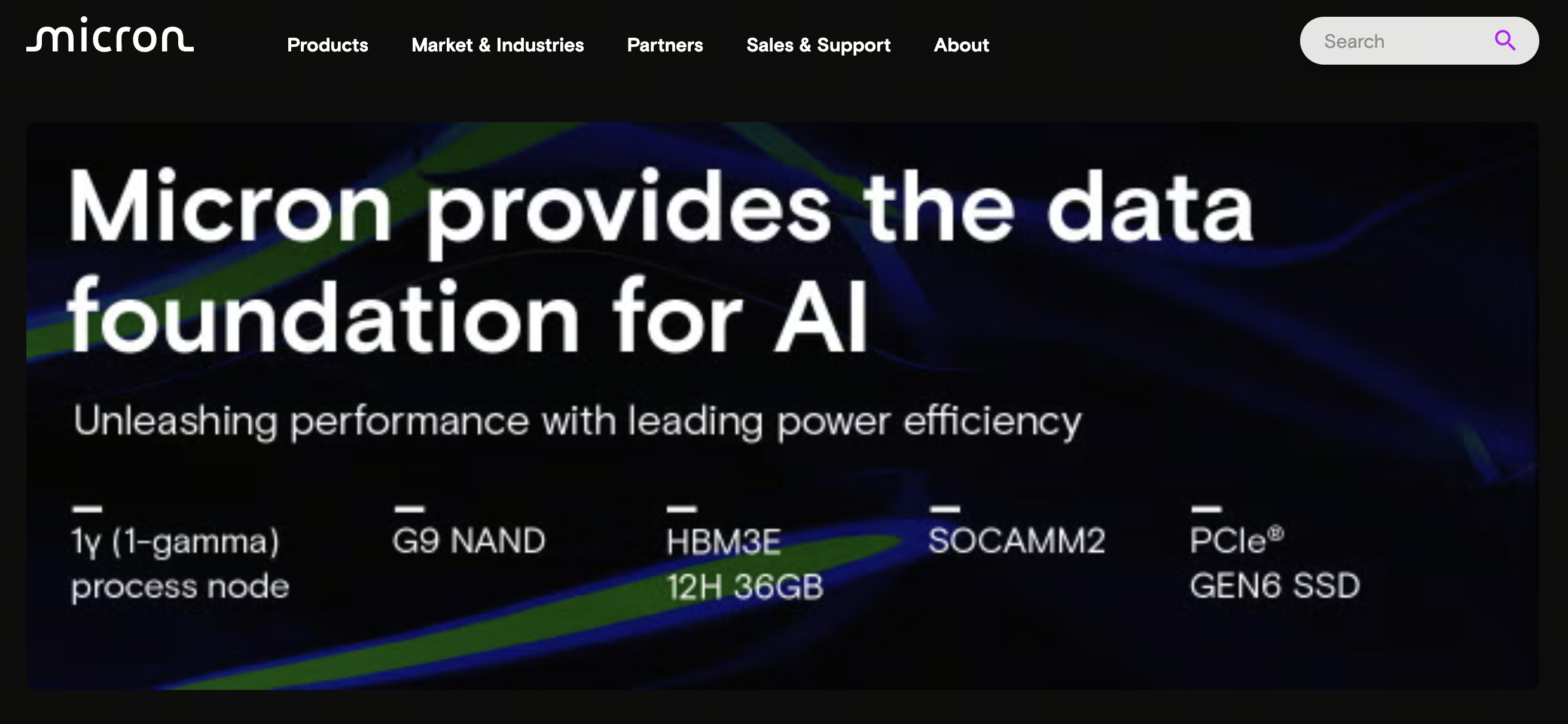
AI large model training requires not only GPU computing power but also massive high-speed data exchange capabilities. If GPUs cannot continuously access training data, overall AI system efficiency drops sharply. That is why high-performance memory has become essential infrastructure in the AI supply chain.
As AI data centers continue to scale, demand for HBM, server DRAM, and enterprise-grade SSDs is surging. Micron is therefore more than just a traditional memory chip company — it is a key player in AI infrastructure.

Source: micron.com
Micron's core mission in the AI ecosystem is to enable high-speed data transfer and storage for AI systems. While AI GPUs handle computation, DRAM, HBM, and enterprise SSDs manage data caching, retrieval, and long-term retention. The entire AI system depends on a seamless interplay between compute and storage.
From an industry perspective, AI infrastructure typically comprises GPUs, CPUs, networking, servers, and storage. Companies like NVIDIA focus on GPU compute, while Micron specializes in high-performance memory and data flow efficiency.
During training, GPUs constantly access vast volumes of parameters and data. If data retrieval is too slow, even the most powerful GPUs cannot sustain high throughput. This is why the AI market is seeing explosive demand for HBM and server DRAM.
In essence, AI infrastructure expansion drives growth not only for GPUs but also for high-performance storage.
AI model training demands enormous data throughput, making traditional storage systems inadequate for large-scale workloads. In particular, large language model (LLM) training requires GPUs to simultaneously read huge quantities of parameters, weights, and training data.
While conventional DRAM offers fast caching, AI GPUs require far higher bandwidth than typical compute tasks. When GPUs cannot fetch data quickly enough, compute resources idle and training efficiency drops.
HBM is purpose-built to bridge this gap, delivering superior bandwidth and lower latency compared to standard DRAM. This makes HBM ideal for AI data centers and high-performance computing (HPC) systems.
The takeaway: the AI era demands not only better GPUs but also faster data transfer fabrics. High-performance memory has therefore become a cornerstone of modern AI infrastructure.
HBM works in tight coordination with AI GPUs. Unlike traditional memory modules installed separately, HBM emphasizes close integration and high-speed data links.
The process works as follows: First, the GPU handles AI compute tasks. HBM then rapidly supplies training data and parameter cache. A high-speed interconnect ensures low-latency data exchange between the GPU and HBM. This enables the AI system to sustain efficient large-scale model training.
Structurally, HBM is typically co-packaged with GPUs using advanced packaging technologies. This minimizes data travel distance, reducing both latency and power consumption.
The table below shows the collaboration between AI GPUs and HBM:
| Module | Primary Function |
|---|---|
| GPU | AI Compute |
| HBM | High-Speed Data Exchange |
| DRAM | System Cache |
| SSD | Long-Term Data Storage |
This architecture means AI chip performance depends not only on the GPU but also on HBM bandwidth.
Micron supports AI GPUs and data centers through HBM, server DRAM, and enterprise SSDs. Compared to consumer electronics, AI data centers demand higher stability, bandwidth, and continuous uptime.
During AI server operation, GPUs constantly access large volumes of training data. Data is first cached in DRAM, then HBM enables high-speed GPU data exchange. Finally, enterprise SSDs handle long-term storage and database management.
This means AI data centers require a multi-tier storage architecture. Without high-speed memory, even the best GPUs will see significantly lower training efficiency.
As AI models grow, the demand for HBM and server DRAM per data center continues to climb.
AI servers need high-performance storage primarily because they process massive datasets. Compared to traditional enterprise servers, AI systems must handle far more parameters, model weights, and training data.
The workflow is straightforward: AI model training continuously reads massive data. GPUs handle computation, while DRAM and HBM provide high-speed caching and data transfer. If storage cannot keep pace with GPU speed, training efficiency suffers.
Moreover, large model training often runs continuously for extended periods. Storage systems must therefore offer not only speed but also stability and sustained load capacity.
In short, AI infrastructure competition is not just about GPUs — it is equally about high-performance memory and storage systems.
The expansion of AI infrastructure is fueling rapid growth in Micron's high-performance memory business. In particular, AI data center demand is becoming a key driver for HBM and server DRAM markets.
Traditional consumer electronics markets are cyclical, tied to smartphones and PCs. In contrast, AI data centers focus on long-term compute expansion and enterprise server builds, creating a fundamentally different demand profile.
As AI GPU shipments increase, HBM demand rises in lockstep. GPUs need large amounts of high-bandwidth memory, and AI chip performance is tightly linked to HBM data exchange efficiency.
At the same time, cloud providers and big tech firms are continuously building out AI data centers, further boosting demand for server DRAM and enterprise SSDs.
Micron's AI storage products are primarily deployed in AI data centers, cloud computing, high-performance servers, and large-scale model training. As AI systems scale, high-performance memory has become a critical component of modern AI infrastructure.
AI data centers are the primary use case for HBM and server DRAM. During training, GPUs constantly read massive data, so memory speed directly affects training efficiency.
Cloud platforms also rely heavily on enterprise SSDs and server storage. Large AI platforms need not only model training but also long-term data retention and online inference support.
Additionally, markets like autonomous driving, edge AI, and HPC are increasing their demand for high-performance storage. Modern AI systems' requirements for data bandwidth and storage capacity are only rising.
Micron's (MU) core role in the AI ecosystem is to provide high-performance memory and storage for GPUs, data centers, and AI servers. HBM, DRAM, and enterprise SSDs have thus become essential AI infrastructure.
AI large model training depends not only on GPU compute but also on high-speed data transfer. HBM helps GPUs improve data throughput, driving rapid growth in the AI market's demand for high-performance memory.
As AI data centers continue to expand, memory chip makers like Micron are becoming increasingly vital to AI infrastructure.
HBM is a high-performance memory technology designed for AI GPUs and HPC systems, offering higher bandwidth and lower latency than conventional memory.
Micron supplies DRAM, HBM, and enterprise SSDs, making it a key storage provider for AI data centers and GPU systems.
AI GPUs must read large amounts of data continuously during training. HBM boosts data exchange speed, improving training efficiency.
NVIDIA provides AI GPU compute power, while Micron supplies HBM and server memory. Together they form a critical part of AI infrastructure.
AI data centers process massive model parameters and training data, requiring fast DRAM, HBM, and enterprise SSDs for efficient data exchange and long-term storage.