As DeFi, NFTs, and on-chain applications continue to grow, the way Web3 users interact with blockchain networks is gradually shifting from centralized account systems to self-custody wallets. In this process, wallets are no longer just simple tools for storing assets. They have become a key gateway connecting users, smart contracts, and blockchain networks.
MetaMask, one of the most common wallets in the Ethereum ecosystem, is now widely used for token transfers, on-chain trading, NFT interactions, DApp logins, and many other scenarios. For most users, an on-chain action usually begins with connecting an account and signing a transaction through MetaMask.
As a self-custody wallet, MetaMask’s core functions include account management, private key signing, on-chain transactions, and DApp connections. Unlike centralized exchanges, MetaMask does not custody user assets. Instead, it helps users control blockchain accounts through private keys.
When a user creates a MetaMask wallet, the system generates a set of seed phrases. These seed phrases can then be used to derive the private key, public key, and wallet address. The private key is used to sign transactions, while the wallet address is used to receive and send digital assets. MetaMask itself does not store assets. A user’s tokens and NFTs are actually recorded on the blockchain, while the wallet simply serves as the interface for accessing and interacting with those assets.
What Happens After a User Initiates a Transaction?
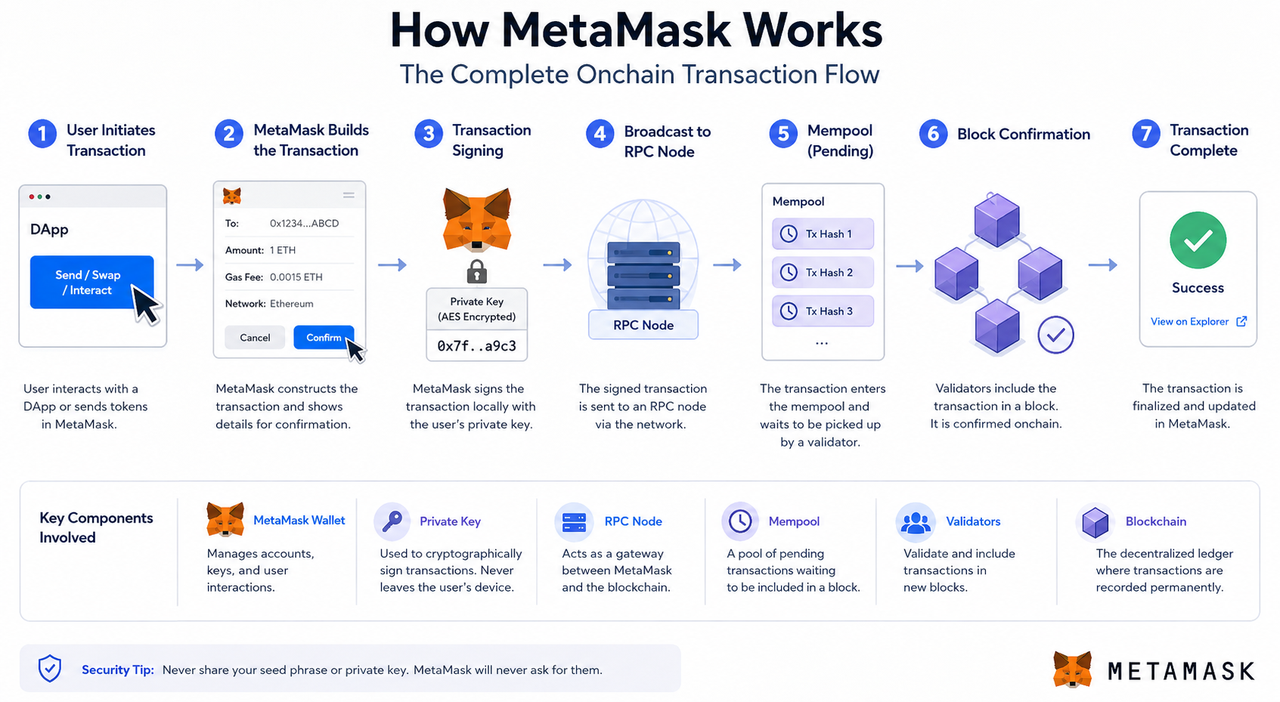
When a user clicks “Send” in MetaMask or confirms a transaction in a DApp, the wallet begins constructing an on-chain transaction. A transaction usually includes information such as the sender address, recipient address, amount, Gas Fee, Nonce, and smart contract call data.
Before the user confirms, MetaMask displays a transaction window showing the estimated fee, network status, and approval details. If the transaction involves a smart contract, the wallet also shows the relevant contract call permissions. Only after the user confirms does the transaction move into the formal signing stage.
How Does the Private Key Sign a Transaction?
Transaction signing is one of MetaMask’s most important functions.
After the user confirms a transaction, MetaMask calls the locally stored private key to create a digital signature for the transaction data. During this process, the private key is never exposed. Instead, it generates an encrypted signature that blockchain nodes can verify.
By verifying the signature, the blockchain network can confirm that the transaction was authorized by the corresponding account. This means blockchains do not need to rely on traditional account password systems. Identity verification is handled through cryptography. This is why the security of seed phrases and private keys is always so important. Once they are leaked, an attacker may be able to directly control the assets in the wallet.
What Role Does the Gas Fee Play in a Transaction?
The Gas Fee is the transaction fee users pay to the blockchain network. It is used to incentivize nodes to verify and execute transactions.
On Ethereum and most EVM networks, every on-chain action consumes computing resources, so each transaction must pay the corresponding amount of Gas. MetaMask automatically estimates the fee based on current network conditions and allows users to adjust transaction speed and Gas settings.
When the network becomes congested, Gas costs usually rise. Many Layer2 networks, such as Linea, Arbitrum, and Optimism, are designed in part to reduce on-chain Gas costs for users, improving transaction efficiency and the overall user experience.
How Is a Transaction Broadcast to the Blockchain Network?
After the transaction is signed, MetaMask sends it to the blockchain network through an RPC node. An RPC node acts as a communication interface between the wallet and the blockchain, helping synchronize on-chain data and broadcast transactions.
Once broadcast, the transaction first enters the blockchain’s mempool, where it waits to be packaged by validators. After the transaction is included in a new block, its status changes from Pending to Confirmed.
If the user sets the Gas too low, the transaction may remain Pending for a long time, or even fail eventually. For this reason, Gas settings directly affect how quickly a transaction is confirmed.
How Does the DApp Approval Mechanism Work?
MetaMask’s interaction with DApps is not limited to ordinary transfers. It also involves smart contract approvals.
For example, when a user uses a certain token in a DeFi protocol for the first time, they usually need to execute an Approval transaction first. This process means the user allows the smart contract to access the relevant asset within a specified limit.
After approval is granted, the protocol can proceed with actions such as swaps, lending, borrowing, or staking. However, long standing unlimited approvals can also create risk. If a malicious contract gains broad permissions, user assets may be transferred away. For this reason, regularly checking and revoking approvals has become an important security habit for Web3 users.
MetaMask is a self-custody wallet, while centralized exchanges use a platform custody model.
In an exchange system, the platform is responsible for storing user assets and account information. In MetaMask, users manage their own private keys and seed phrases. This means users have full control over their assets, but they also bear the responsibility for their own security.
MetaMask is better suited for connecting to DApps, participating in on-chain protocols, and managing on-chain identity, while exchange accounts are more focused on centralized trading and asset custody. The two play different roles in the Web3 ecosystem.
MetaMask’s popularity is closely tied to the development of the Ethereum ecosystem.
Because it provided a standardized browser extension interface early on, many DApps began supporting MetaMask by default. As the DeFi and NFT markets expanded, MetaMask gradually developed a strong network effect.
In addition, MetaMask has continued to expand its multichain support, Layer2 access, Swap, Bridge, and Snaps plugin ecosystem. As a result, it has evolved from a single wallet tool into a broader piece of Web3 infrastructure. For many users, the first step into Web3 is installing MetaMask and connecting to an on-chain application.
Summary
MetaMask’s core role is to help users manage on-chain accounts, sign transactions, and connect to Web3 applications. From initiation to confirmation, an on-chain transaction usually goes through several steps, including transaction construction, private key signing, Gas calculation, RPC broadcasting, and block confirmation.
FAQs
MetaMask stores users’ private keys locally in encrypted form, but it does not upload them to a centralized server. Seed phrases and private keys are still managed by the users themselves.
Why Do on-chain Transactions Require a Gas Fee?
The Gas Fee pays for the computing and verification costs of the blockchain network, incentivizing nodes to process transactions and keep the network running.
What Does Pending Mean?
Pending means the transaction has been broadcast but has not yet been formally confirmed by the blockchain. This is usually related to network congestion or a low Gas setting.
If the transaction has not yet been confirmed, the user can try to replace it by increasing the Gas or sending a substitute transaction, but cancellation does not succeed in every case.