For Meta, advertising isn’t just a revenue stream—it’s the backbone of its entire social ecosystem. Free services attract users, user behavior data fine‑tunes ad targeting, and revenue funds platform growth and tech investment. This flywheel forms the core of Meta’s business model.
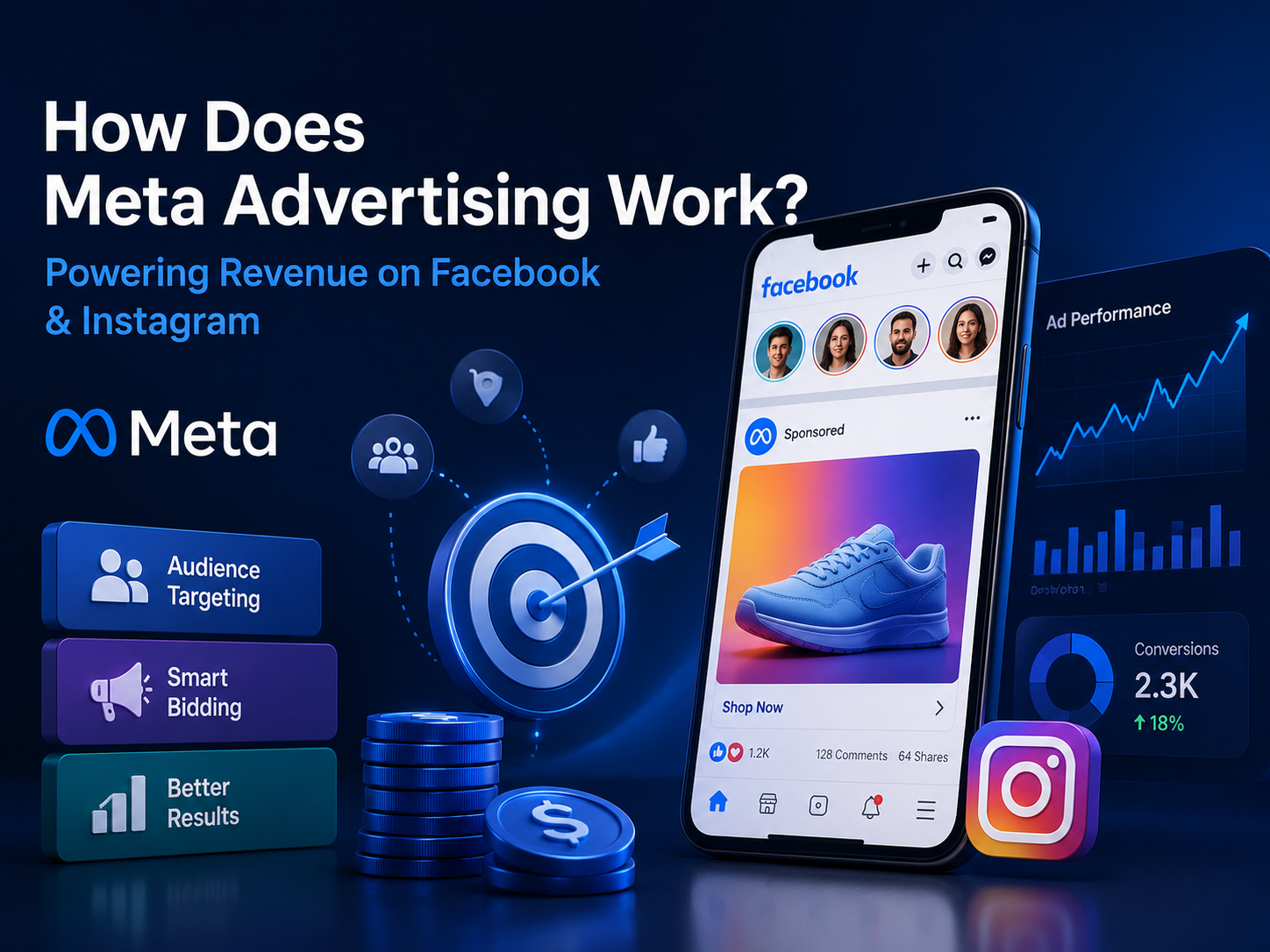
Meta’s ad business is a digital advertising ecosystem built across Facebook, Instagram, Messenger, and select third‑party channels. Advertisers create campaigns via Meta Ads Manager and target audiences based on marketing goals, budget, and desired demographics.
Unlike traditional TV or outdoor ads, Meta ads excel at precision targeting. Advertisers can choose users by age, location, interests, behavior, and purchase intent to improve delivery efficiency.
Today, Meta ads support brand marketing, e‑commerce, app installs, content distribution, and local business promotion. With billions of active users and mature analytics, Meta is a dominant force in global digital advertising.
How the Ad Auction System Works
Meta doesn’t sell ad space at fixed prices—it uses real‑time bidding. When multiple advertisers target similar audiences, the system automatically runs an auction.
Meta’s auction isn’t just about who bids highest; it evaluates several factors:
| Factor |
Role |
| Bid |
Amount the advertiser is willing to pay |
| Estimated action rate |
Likelihood of user interaction or conversion |
| Ad quality |
Content quality and user experience score |
| Ad relevance |
How well the ad matches the target audience |
The system calculates a combined value rather than picking the highest bid alone. This balances user experience, ad performance, and platform revenue, creating a healthier ad ecosystem.
For advertisers, high‑quality content can outperform larger budgets, as the auction rewards relevance and engagement.
How User Data Boosts Ad Precision
Meta’s ad system gains a major edge from user data. Years of interactions on Facebook and Instagram have generated rich behavioral signals—browsing, likes, comments, shares, follows, and watch time—that the system uses to refine interest and intent predictions.
These signals feed machine learning models that anticipate which content and products users are most likely to engage with.
Importantly, Meta does not sell raw user data to advertisers. Advertisers only select target audience attributes; the system handles ad delivery. Advertisers see aggregated statistics and conversion data, not identifiable user information.
This approach lets Meta improve ad performance while maintaining data security and privacy safeguards.
How Facebook and Instagram Generate Ad Revenue
Although both platforms sit under Meta’s umbrella, their ad scenarios differ.
Facebook ads rely on communities, interest groups, feed content, and business pages—ideal for brand building, local promotions, and long‑term campaigns. Instagram emphasizes visual content, making it a natural fit for fashion, beauty, consumer brands, and creator marketing.
Key ad formats include:
| Ad Format |
Primary Platform |
| Feed ads |
Facebook, Instagram |
| Reels ads |
Instagram, Facebook |
| Stories ads |
Instagram, Facebook |
| Video ads |
Facebook, Instagram |
| Explore ads |
Instagram |
| Shop ads |
Facebook, Instagram |
Revenue comes from impressions, clicks, and conversions. With short‑video surging, Reels ads have become a major growth driver within Meta’s ad system.
Advertisers stick with Meta because of its massive reach and mature ad infrastructure. They care about ROI, and Meta’s system—powered by analytics and automated optimization—helps boost conversion rates and marketing efficiency.
Meta’s advantages include:
- Global active user reach
- Flexible campaign objective settings
- Granular audience targeting
- Advanced analytics tools
- Automated ad optimization
These capabilities make Meta a cornerstone of digital marketing for businesses of all sizes, from global brands to local shops.
Meta’s biggest advantages are network effects and data scale. Facebook, Instagram, and WhatsApp form a vast user network. Constant content creation and interaction feed algorithm improvements and ad optimization—an advantage hard to replicate quickly.
Meta also offers a complete ad tool chain: creation, creative testing, analytics, conversion tracking—all within one platform.
Compared to traditional ad platforms, Meta leverages strong social relationships. Users don’t just consume content; they interact with friends, brands, and creators, amplifying ad reach.
With AI advances, Meta is using machine learning to automate creative optimization, audience matching, and budget allocation, further sharpening its edge.
Despite being Meta’s core revenue engine, the ad model faces several headwinds.
First, global privacy regulations are tightening. Laws limiting data collection and use can weaken targeting precision.
Second, competition is fierce. Short‑video platforms, search giants, and new content platforms all vie for ad dollars, intensifying market pressure.
Third, AI is reshaping the industry. Future ad systems will need not only better targeting but also content generation, automated optimization, and intelligent analysis. Meta must keep innovating to stay ahead.
So while Meta’s ad business is mature and scalable, it must continuously adapt to regulation, technology shifts, and competitive dynamics.
Summary
Meta’s ad business is built on a massive social ecosystem, linking advertisers and users through auctions, data analytics, and precision targeting. Facebook and Instagram provide diverse ad environments, and ad revenue remains Meta’s primary commercial engine.
User scale, data accumulation, and ad technology form Meta’s competitive moat. As AI evolves, Meta is further strengthening its ecosystem with smart recommendations and automated optimization, securing its position in digital advertising.
FAQ
What is Meta’s main source of revenue?
Meta’s main revenue source is digital advertising. Facebook and Instagram generate revenue by selling ad placements to advertisers.
How does Meta’s ad auction work?
Meta’s ad auction evaluates bid price, ad quality, conversion likelihood, and relevance to determine which ad is shown—not just the highest bidder.
What’s the difference between Facebook and Instagram ads?
Facebook ads are better for community engagement and brand building, while Instagram ads emphasize visual content and are popular with fashion, consumer goods, and creator marketing.
Does Meta sell personal user data?
No. Meta does not sell personal data to advertisers. Advertisers only select target audience traits; the system handles ad delivery.
Why do advertisers choose Meta?
Advertisers choose Meta for its massive user base, sophisticated targeting, analytics tools, and automated optimization—all of which improve marketing ROI.
How will AI affect Meta’s ad business?
AI is enhancing ad recommendations, creative generation, budget optimization, and audience matching, making Meta’s ad system more efficient and effective.