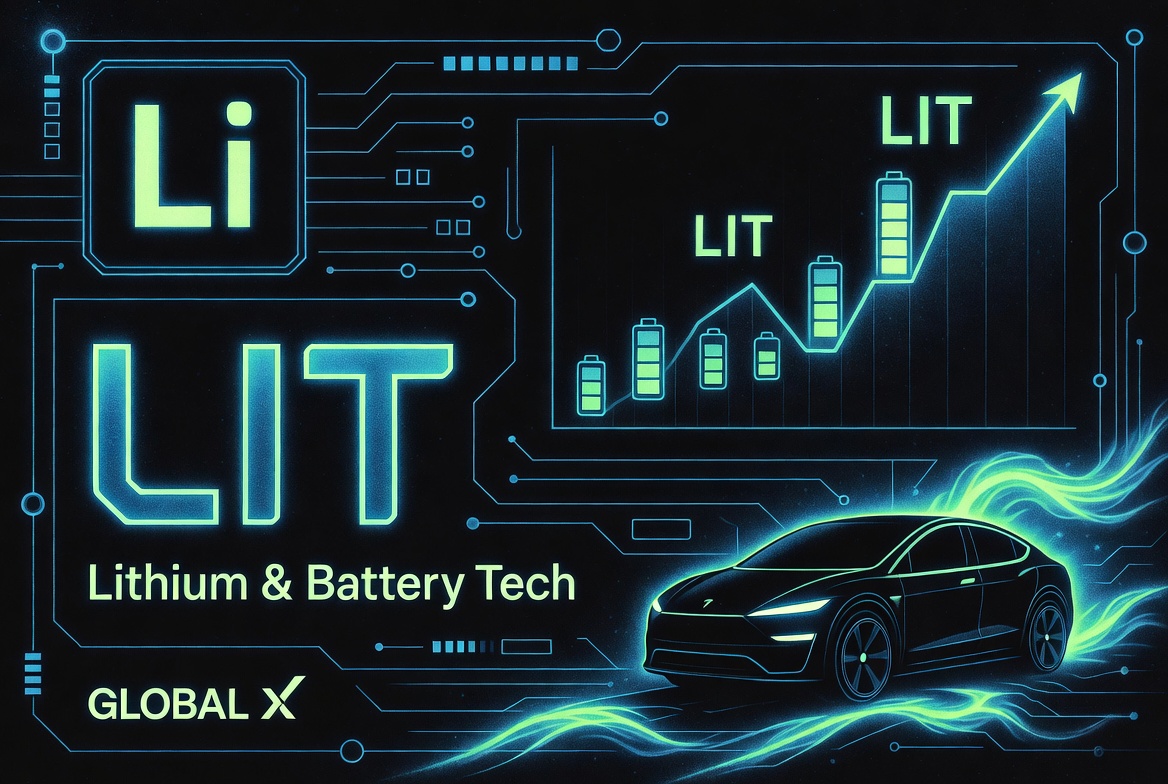
Since LIT covers the entire lithium battery supply chain, its price movements reflect shifts in global new energy supply and demand rather than the performance of any single company. As such, LIT is widely regarded as a comprehensive barometer of the new energy and lithium resource markets.
As electric vehicles become more widespread and energy storage systems expand, the lithium battery supply chain has grown increasingly volatile. This has made LIT highly correlated with cyclical market trends.

At its core, LIT's connection to the new energy market stems from lithium batteries being the critical infrastructure of the new energy ecosystem. New energy vehicles, energy storage systems, and grid upgrades all rely on lithium batteries for energy conversion and storage.
Structurally, expansion of the new energy market directly drives battery demand, which in turn feeds back into the lithium mining and materials supply chain. This cascading effect allows LIT to capture the entire new energy industry cycle.
During bullish new energy market phases, expectations for lithium resource and battery company profitability typically rise in tandem, pushing LIT higher.
Thus, LIT's trajectory hinges not on individual companies but on the coordinated dynamics of the entire new energy supply chain.
Lithium price increases have a pronounced impact on LIT because lithium is the core raw material for power batteries. Changes in lithium prices directly influence battery manufacturing costs and mining company profit structures.
When lithium prices rise, lithium mining companies usually see improved profitability, lifting their constituent stocks. At the same time, the market anticipates stronger new energy demand, driving up valuations across the supply chain.
However, excessively rapid lithium price appreciation can also compress battery makers' margins, creating structural divergence within the supply chain.
This bidirectional impact makes lithium prices a key variable in LIT's volatility.
New energy vehicle (NEV) sales are a critical demand-side variable for LIT. NEV production is heavily dependent on power batteries, which in turn rely on lithium resources and materials.
When NEV sales rise, battery orders increase, prompting capacity expansion among battery manufacturers and boosting lithium mining demand. This demand expansion typically lifts the entire LIT supply chain.
Conversely, when NEV sales slow, market expectations for battery demand decline, putting pressure on valuations for lithium resource and battery companies.
Therefore, the NEV market serves as a vital transmission channel linking LIT to end-user demand.
Battery companies carry significant weight in LIT, and their profitability directly influences ETF performance. Their revenue primarily comes from power battery sales and energy storage system orders.
When NEV demand is strong, battery orders rise, capacity utilization improves, and profitability strengthens. These developments are usually reflected in LIT price increases.
Additionally, the growth of the energy storage market enhances the stability of long-term battery orders, making industry valuations more resilient.
Thus, battery companies are not just a midstream manufacturing link but also a primary driver of LIT volatility.
The global energy transition is fundamentally reshaping the energy mix, shifting from fossil fuels to electrification and storage systems. This shift directly elevates the importance of lithium batteries.
As countries pursue carbon neutrality goals, demand for NEVs and energy storage systems continues to climb, driving expansion of the lithium resource and battery supply chain.
This structural change transforms LIT from a purely cyclical asset into one with long-term growth characteristics.
The faster the energy transition accelerates, the greater the growth elasticity of the lithium battery supply chain, reinforcing LIT's long-term trend potential.
Lithium resource supply-demand dynamics are a major factor shaping LIT's risk profile. When lithium supply tightens, prices can spike rapidly, pushing up costs across the supply chain.
In such conditions, lithium mining companies may benefit, but battery manufacturers face cost pressures, creating divergence within the supply chain.
Conversely, when lithium supply is abundant, prices may fall, squeezing mining company profits while lowering battery manufacturing costs — which can benefit downstream demand.
These supply-demand swings give LIT's risk profile a pronounced cyclical character, closely tied to commodity markets.
Market participants frequently use LIT to gauge the overall trajectory of the new energy supply chain. Some rely on LIT to assess lithium price cycles and NEV market sentiment.
On the trading side, LIT is often employed to build diversified new energy asset portfolios, mitigating single-stock risk.
It also serves as a proxy for the global energy transition, making it a go-to indicator for new energy exposure in macro trading strategies.
Given its volatility structure, LIT is well suited for medium- to long-term trend-following and cyclical allocation approaches.
LIT's performance within new energy market cycles is primarily driven by lithium prices, NEV sales, and battery company profitability. As an ETF tracking the lithium battery supply chain, its price movements encapsulate shifts in global new energy supply and demand.
As the energy transition continues, LIT's correlation with lithium resources and the battery supply chain will only strengthen, making its market behavior increasingly defined by both cyclical and growth dynamics.
New energy vehicles require large quantities of power batteries, and those batteries depend on lithium resources. So changes in NEV sales affect demand across the entire supply chain.
Not necessarily. While rising lithium prices benefit mining companies, they can also increase costs for battery makers, resulting in a structurally divided impact.
LIT functions more like an industry index, reflecting the overall performance of the lithium battery supply chain rather than the movement of any single company.
Battery companies sit at the midpoint of the supply chain, linking lithium resources to NEV demand. Their weight significantly influences the ETF's performance.
LIT exhibits pronounced cyclical and growth characteristics. It is better suited for tracking new energy industry trends than for making directional bets on a single outcome.