As generative AI shifts from technological exploration to commercial deployment, Anthropic is actively working to convert its foundational model capabilities into sustainable revenue streams. For investors and AI industry analysts, understanding how Anthropic generates profit is essential for evaluating the future commercialization prospects of AI companies.
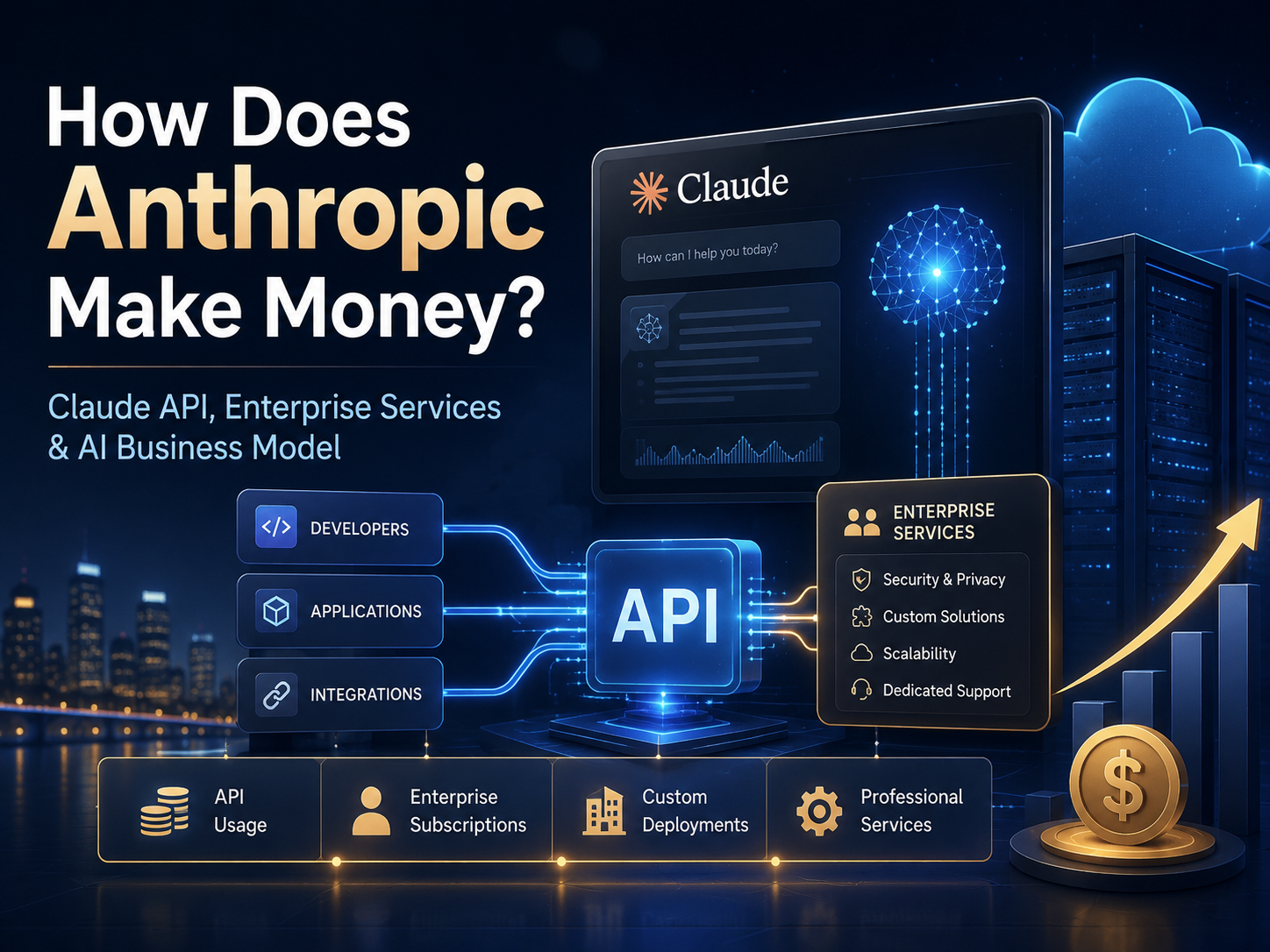
Anthropic’s revenue model is multi-layered, built on model services, a developer ecosystem, and enterprise solutions rather than a single product. The Claude API serves as a major gateway for developers and businesses to leverage Anthropic’s technology, making it a critical pillar of the company’s monetization strategy.
What Are Anthropic’s Main Revenue Streams
Anthropic’s primary revenue sources include Claude product services, API usage fees, and enterprise-grade AI solutions. As a private AI company, Anthropic does not disclose comprehensive financial data like publicly traded firms. Consequently, insights into its business model are drawn from official product disclosures, partnerships, and public market data.
At the heart of Anthropic’s commercial ecosystem is Claude. Individual users access AI assistant features through Claude products, while developers and enterprises integrate AI functionality into their applications and workflows via API calls.
Currently, AI model providers typically generate revenue from the following channels:
| Revenue Source |
Business Model |
| Claude Products |
AI assistant services for individuals and teams |
| API Services |
Usage-based or volume-based billing for model calls |
| Enterprise Services |
AI deployment and management solutions for organizations |
| Cloud Platform Partnerships |
Extending model services via cloud infrastructure |
Unlike traditional software firms, Anthropic’s business model is highly dependent on the scale of model usage. User call volume, enterprise deployment, and model efficiency all directly impact revenue growth.
How the Claude API Drives Commercialization
The Claude API is Anthropic’s primary channel for delivering model capabilities to developers and enterprises, serving as the critical bridge between AI technology and real-world business applications.
With the Claude API, developers can embed advanced capabilities—such as text generation, code assistance, knowledge analysis, and intelligent Q&A—into their products without building large language models themselves. This approach mirrors the software infrastructure-as-a-service paradigm of the cloud era, making sophisticated AI accessible to a broad range of enterprises through APIs.
Key enterprise use cases for the Claude API include:
- Intelligent customer support and user interaction systems
- Enterprise knowledge base search and document analysis
- Software development assistance
- Content generation and office automation
- Data analysis and information processing
For Anthropic, the API model’s primary value lies in expanding the reach of its models. As more developers and businesses build on Claude, model services can become a recurring revenue stream.
However, the API business model presents challenges. High computational demands, pricing competition, and infrastructure efficiency all impact profitability.
How Enterprise Clients Use Anthropic AI Services
Enterprises leverage Anthropic AI services to embed large language model capabilities into their existing business processes, boosting information processing efficiency and automation.
Compared to individual users, enterprises prioritize model stability, security, data handling, and long-term service reliability. As a result, Anthropic emphasizes Claude’s dependability and AI safety principles in its enterprise offerings.
Common enterprise application scenarios include:
| Application Scenario |
Usage Method |
| Customer Service |
Building intelligent customer support and automated response systems |
| Knowledge Management |
Analyzing internal documents and information |
| Software Development |
Assisting with code generation and debugging |
| Business Analysis |
Processing large volumes of text and business data |
For large organizations, selecting an AI model provider depends not only on model performance, but also on compliance, data security, and system integration capabilities.
This makes the enterprise market a potentially critical long-term growth avenue for Anthropic. Compared to consumer-facing AI products, enterprise solutions typically command higher willingness to pay and more stable demand.
The Impact of Cloud Computing Partners on Anthropic’s Growth
Cloud computing partnerships are central to Anthropic’s go-to-market strategy. Training and operating large language models require immense computational resources, making robust infrastructure support essential.
Anthropic’s collaborations with leading cloud platforms enable enterprise clients to access Claude models through established cloud infrastructure. This lowers the technical barriers for enterprise AI adoption and helps Anthropic scale its model reach.
Cloud partnerships benefit Anthropic in several key ways:
| Impact Area |
Contribution |
| Computing Resource Support |
Infrastructure for training and inference |
| Enterprise Channel Expansion |
Broader access to enterprise customers |
| Technical Integration |
Easier AI integration with existing enterprise systems |
| Business Scale Expansion |
Increased model service utilization |
For AI model companies, cloud partnerships are both infrastructure solutions and vital commercial distribution channels. While traditional software companies monetize through license sales, AI firms must address model training, deployment, and delivery simultaneously.
Thus, cloud partners directly affect Anthropic’s revenue growth, enterprise acquisition, and long-term market positioning.
How AI Model Companies Differ from Traditional Software Companies
AI model companies operate under fundamentally different business models compared to traditional software vendors. While software firms develop a product once and generate revenue through licensing or subscriptions, AI companies face a more complex cost structure—requiring continuous investment in model training, computational resources, data processing, and optimization.
| Dimension |
Traditional Software Company |
AI Model Company |
| Core Assets |
Software products and code |
Foundational models and AI capabilities |
| Major Costs |
R&D, server maintenance |
Model training, inference, computational resources |
| Revenue Model |
Subscription, licensing |
API calls, subscription, enterprise services |
| Scale Effects |
Marginal costs fall with user growth |
Model scale increases capability but raises computational demands |
| Competition Drivers |
Features, ecosystem |
Model performance, data, computational power, security |
Anthropic’s model is best described as “AI infrastructure-as-a-service.” Claude is not merely an application, but a suite of intelligent capabilities accessible by developers and enterprises on demand.
This requires AI companies to balance three critical factors:
- Model performance
- Service cost
- User scale
If model capabilities are strong but operating costs are high, commercialization is constrained; if price competition is fierce, long-term profitability may suffer.
Challenges Facing Anthropic’s Commercialization
Despite strong market attention, Anthropic’s path to commercialization is not without challenges.
First, AI model development and operations are costly. Training advanced models demands significant computational resources, and ongoing inference consumes substantial GPU and data center capacity. Improving efficiency and reducing per-unit service cost are vital for long-term viability.
Second, competition in the foundational AI model space is intense. Companies like OpenAI, Google DeepMind, and Meta are making significant investments, giving enterprises a growing array of model options.
Moreover, AI commercialization is still rapidly evolving. While enterprises are eager to explore AI, the real-world value, willingness to pay, and long-term adoption patterns across use cases are still being validated.
| Challenge |
Impact |
| High computational costs |
Pressure on profitability |
| Fierce industry competition |
Market share risk |
| Business models still evolving |
Uncertain revenue growth |
| Growing regulatory requirements |
Impacts deployment strategies |
For Anthropic, future growth will hinge not only on Claude’s technical edge, but also on building a stable enterprise client base and a sustainable revenue model.
Summary
Anthropic’s monetization strategy centers on Claude AI services, spanning API usage, enterprise solutions, and cloud partnerships.
Compared to traditional software firms, AI model companies are more reliant on technical prowess, computational resources, and user scale. Model performance drives product competitiveness, while commercialization capacity determines long-term value.
Anthropic’s ability to scale revenue will depend on Claude’s enterprise adoption, its efficiency in managing AI service costs, and its long-term positioning in the competitive landscape of large AI models.
FAQ
What Is Anthropic’s Main Source of Revenue?
Anthropic primarily earns revenue through Claude products, API services, and enterprise-grade AI solutions.
How Is the Claude API Priced?
Claude API pricing is typically based on model call volume and usage, with developers and enterprises billed according to actual consumption.
Why Do Enterprises Choose Claude from Anthropic?
Enterprises select Claude for its advanced model capabilities, security, reliability, and effectiveness in knowledge management and business automation.
How Does Anthropic’s Business Model Differ from OpenAI’s?
Anthropic focuses more on enterprise AI services and model safety, while OpenAI builds a broader ecosystem through ChatGPT, APIs, and enterprise offerings.
Why Do AI Model Companies Need Cloud Partners?
AI model training and deployment require vast computational resources. Cloud partners provide essential infrastructure and help expand enterprise reach.
What Risks Does Anthropic Face in Commercialization?
Anthropic faces risks including high computational costs, intense AI sector competition, the need to validate its profit model, and evolving regulatory requirements.