Canton is a blockchain network designed for institutional finance. Through the Global Synchronizer, Daml smart contracts, and a shared synchronization mechanism, it enables data interoperability and atomic settlement between different financial systems. Unlike traditional cross chain bridges, Canton places greater emphasis on state synchronization and coordinated validation, helping reduce trust and security risks in cross system asset transfers.
In traditional finance, different institutions often run on separate databases and clearing systems, which leads to inefficient asset transfers and prevents data from being synchronized in real time. The “Synchronized Finance” architecture proposed by Canton allows multiple applications and subnetworks to share a unified state while continuing to operate independently, enabling institutional grade collaboration.
As RWA, digital securities, and on-chain payment networks continue to develop, institutional markets are seeing growing demand for cross chain interoperability. Canton’s privacy mechanism and coordination layer design also make it one of the important directions for institutional blockchain infrastructure.
How Does Canton Enable Institutional Blockchain Interoperability?
Canton’s interoperability does not simply mean “cross chain transfers.” Instead, it uses a unified synchronization mechanism to enable real time state sharing and atomic collaboration between different financial systems. Its core goal is to allow multiple institutions, applications, and networks to complete asset transfers, settlement, and contract execution together without exposing sensitive data.
What Is Blockchain Interoperability?
Blockchain interoperability refers to the ability of different blockchain networks or distributed systems to share data, transfer assets, and coordinate state.
In the early blockchain ecosystem, most networks operated independently from one another. When users wanted to move assets from one network to another, they usually had to rely on cross chain bridges, custody services, or third party validation mechanisms. While this model can support basic asset transfers, it also introduces security risks, liquidity fragmentation, and data inconsistency.
For institutional finance, interoperability is not only about whether assets can be transferred. It also involves:
Whether state can be synchronized across multiple systems
Whether transactions can be completed simultaneously
Whether data can be shared according to permissions
Whether compliance rules can be enforced consistently
For this reason, institutional grade interoperability is usually more complex than cross chain communication between ordinary public blockchains.
Why Does Institutional Finance Need Interoperability?
Traditional financial markets have long struggled with system silos. Banks, securities firms, payment networks, and clearing systems often run on different technical architectures. Even when they are involved in the same asset transaction, large numbers of intermediaries are still needed for confirmation and synchronization.
For example, a cross border securities transaction may require multiple rounds of reconciliation among custodians, payment networks, settlement centers, and banking systems. Because these systems lack a unified state synchronization mechanism, final settlement can often take hours or even days.
As RWA, digital bonds, and on-chain payments continue to grow, institutions are increasingly looking to blockchain for faster cross system clearing, lower reconciliation costs, stronger data consistency, and more secure asset synchronization.
How Does Canton’s Global Synchronizer Work?
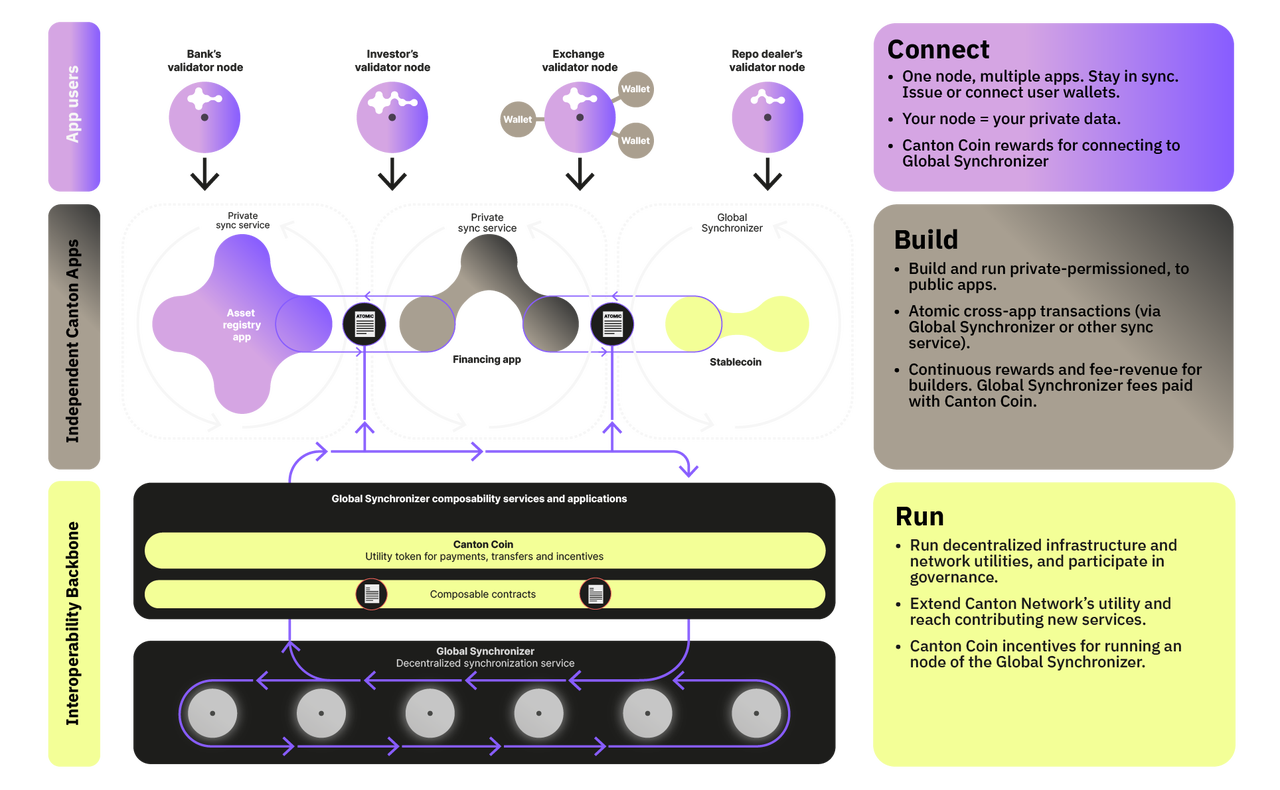
The Global Synchronizer is one of Canton’s core coordination layers for enabling interoperability. Its main role is to provide a unified time order and state synchronization mechanism for multiple applications and subnetworks.
In a traditional cross chain bridge structure, assets are usually transferred between different chains through locking and message passing. Canton, by contrast, places greater emphasis on a shared synchronized state, where multiple participating systems jointly confirm whether a transaction has been completed successfully.
When a transaction takes place:
The Participant Node submits the transaction request
The Sequencer orders the messages
The Mediator coordinates transaction validation
The Global Synchronizer synchronizes the final state
This structure helps ensure that all participants see a consistent result, preventing double spending, state conflicts, or partial transaction failures.
Because the Global Synchronizer focuses more on state coordination than simple asset movement, it is better suited to complex financial agreements and institutional clearing scenarios.
How Do Daml Smart Contracts Support Cross Network Collaboration?
Daml is the smart contract language used by Canton, and one of its main design priorities is multiparty collaboration and permission control.
On traditional public blockchains, smart contracts usually execute publicly by default, and all nodes can view transaction data. Daml allows developers to define:
Which participants can view data
Which institutions can perform specific actions
Which assets can be synchronized across systems
Daml can also describe complex financial workflows, such as digital bond issuance, multiparty payment settlement, custody and clearing processes, and on-chain asset lifecycle management.
By combining Daml with the Global Synchronizer, Canton can enable more granular collaboration across multiple independent networks.
How Is Canton Different From Traditional Cross Chain Bridges?
Although Canton and traditional cross chain bridges both involve “cross network interaction,” their underlying logic is clearly different.
Traditional cross chain bridges usually rely on:
Locking mechanisms
Relay validation
Third party signatures
Wrapped Assets
This model can support asset transfers, but it can also become a target for security attacks. In recent years, several major DeFi security incidents have been linked to cross chain bridge vulnerabilities.
By comparison, Canton places more emphasis on shared synchronized state, atomic settlement, multiparty consistency validation, and permissioned data sharing. Canton’s goal is therefore not to become a general purpose cross chain bridge, but to build a synchronized collaboration network suited to institutional finance.
Why Is Canton’s Interoperability Suitable for RWA?
RWA, or real world assets, usually involve collaboration among multiple institutions, such as issuers, custodians, banks, and regulators.
In traditional systems, these institutions often operate on separate databases, making it difficult to synchronize asset states in real time.
Canton’s interoperability architecture can:
Unify asset states
Support permissioned data sharing
Enable real time synchronized settlement
Reduce cross institution reconciliation costs
As a result, Canton is widely regarded as one of the important directions for institutional grade RWA infrastructure.
Conclusion
Canton’s interoperability is not simply “cross chain communication” in the traditional sense. It is a synchronized collaboration architecture built for institutional finance.
Through the Global Synchronizer, Daml smart contracts, and atomic settlement mechanisms, Canton can enable data synchronization, asset coordination, and consistency validation across different financial systems. As institutional finance gradually moves on-chain and becomes more programmable, interoperability may become one of the core capabilities in the future competition around financial infrastructure.
FAQs
How Is Canton’s Interoperability Different From Traditional Cross Chain Bridges?
Traditional cross chain bridges mainly focus on asset transfers, while Canton places greater emphasis on state synchronization, atomic settlement, and multiparty consistency validation.
Why Is Canton Suitable for Institutional Finance?
Because it provides privacy controls, permission management, synchronized settlement, and cross system collaboration, making it better aligned with the compliance needs of institutional finance.
How Does Daml Support Interoperability?
Daml can define data access permissions and asset logic for different participants, enabling multiple institutions to jointly execute financial agreements.
Does Canton Support RWA?
Yes. Canton is widely used in digital bonds, on-chain funds, payment clearing, and other RWA scenarios.
Is Canton Fully Public and Transparent?
No. Canton uses Sub Transaction Privacy, which shares transaction data only with the relevant participants.
Author: Jayne
Translator: Jared
Disclaimer
* The information is not intended to be and does not constitute financial advice or any other recommendation of any sort offered or endorsed by Gate.
* This article may not be reproduced, transmitted or copied without referencing Gate. Contravention is an infringement of Copyright Act and may be subject to legal action.
Solana faces both opportunities and challenges in its development. Recently, severe network congestion has led to a high transaction failure rate and increased fees. Consequently, some have suggested using Layer 2 and appchain technologies to address this issue. This article explores the feasibility of this strategy.
Sui is a PoS L1 blockchain with a novel architecture whose object-centric model enables parallelization of transactions through verifier level scaling. In this research paper the unique features of the Sui blockchain will be introduced, the economic prospects of SUI tokens will be presented, and it will be explained how investors can learn about which dApps are driving the use of the chain through the Sui application campaign.
This article introduces the technical principles, framework, and applications of Zero-Knowledge (ZK) technology, covering aspects from privacy, identity (ID), decentralized exchanges (DEX), to oracles.
Tronscan is a blockchain explorer that goes beyond the basics, offering wallet management, token tracking, smart contract insights, and governance participation. By 2025, it has evolved with enhanced security features, expanded analytics, cross-chain integration, and improved mobile experience. The platform now includes advanced biometric authentication, real-time transaction monitoring, and a comprehensive DeFi dashboard. Developers benefit from AI-powered smart contract analysis and improved testing environments, while users enjoy a unified multi-chain portfolio view and gesture-based navigation on mobile devices.