What Are the Application Scenarios for AMD Chips? An Analysis from Gaming PCs to AI Data Centers

Beginner
TradFiTradFi
Last Updated 2026-05-28 08:23:40
Reading Time: 3m
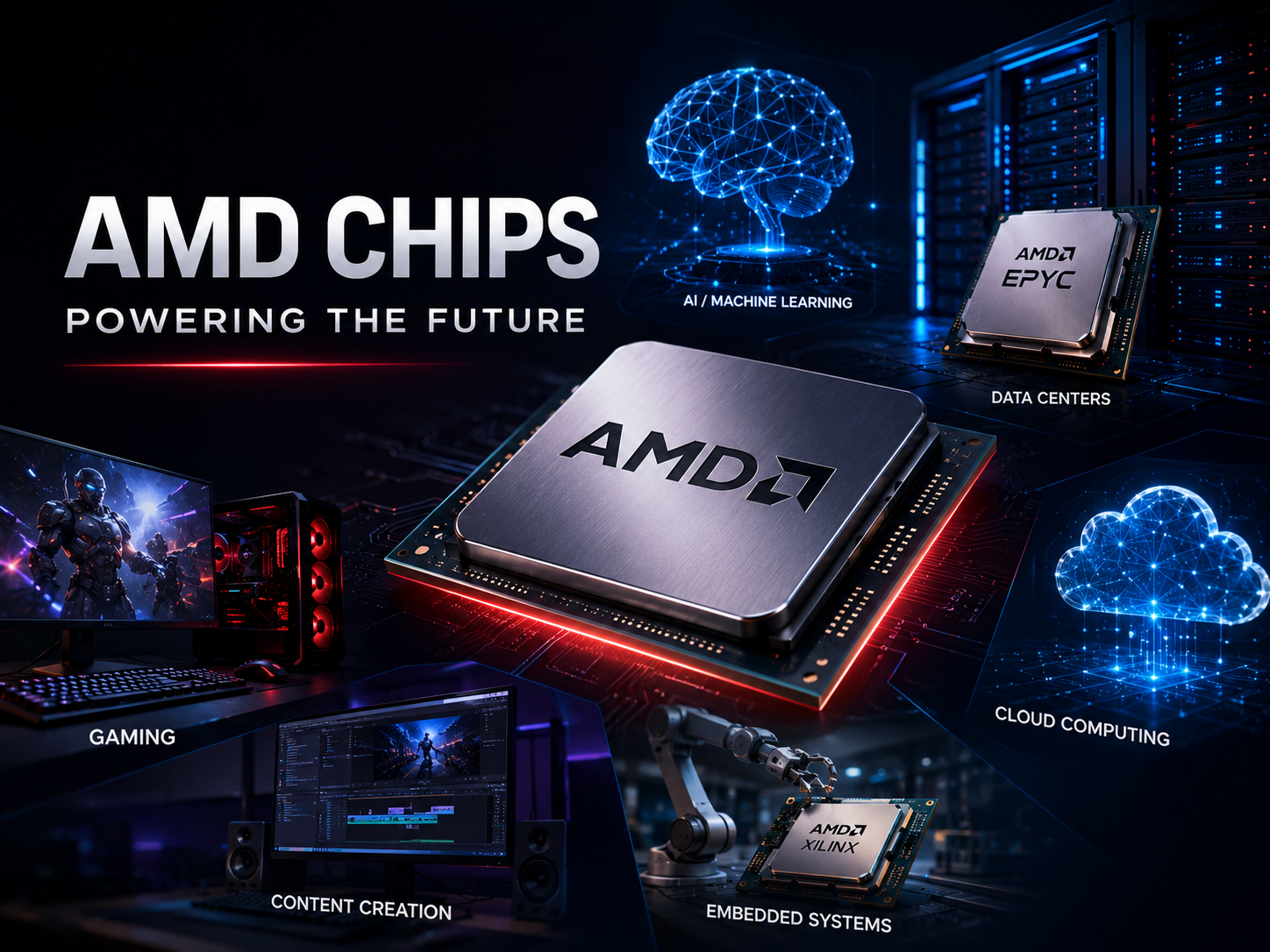
AMD chips are now widely deployed across gaming PCs, AI data centers, cloud computing platforms, and enterprise server markets. The Ryzen, Radeon, EPYC, and Instinct product lines from AMD address consumer computing, high-performance graphics, and AI training workloads, respectively.

AMD The core reason behind AMD's ever-expanding application landscape lies in its mastery of both CPU and GPU technologies. AMD doesn't just supply processors for personal computers; it also delivers high-performance computing power to AI data centers and cloud platforms.

AMD’s positioning varies between the consumer and enterprise markets. Ryzen and Radeon are geared toward individual users, while the EPYC and Instinct series primarily target cloud computing, AI infrastructure, and large-scale enterprise environments.

What Are the Application Scenarios for AMD Chips? An Analysis from Gaming PCs to AI Data Centers

What Are AMD's Core Products?

AMD’s product portfolio is built around CPUs, GPUs, AI accelerators, and embedded chips. Each product line is designed for distinct computing needs.

AMD’s current core offerings include:

Product Line Primary Use Case
Ryzen Consumer CPUs
Radeon Gaming & Graphics GPUs
EPYC Data Center CPUs
Instinct AI Accelerators
Xilinx FPGA Embedded & Edge Computing

The Ryzen series is primarily found in personal computers and creator workstations. Radeon GPUs are designed for game rendering, visual computing, and graphics processing.

The strategic importance of EPYC and Instinct products is on the rise. As demand for AI model training and cloud computing grows, the data center business has become a major strategic focus for AMD.

AMD CPU Applications in the Consumer Market

AMD Ryzen processors have become a dominant force in the consumer PC market. The Ryzen series covers gaming PCs, office computers, creator workstations, and high-performance laptops.

A key advantage of AMD Ryzen is its strong multi-core performance. Multi-threading capabilities directly affect the efficiency of video rendering, content creation, and demanding software applications.

AMD Ryzen is primarily used in:

  • Gaming PCs
  • Content Creation
  • Video Editing
  • High-Performance Laptops

In the gaming market, AMD Ryzen's main competitor is the Intel Core series. AMD typically highlights multi-core performance and price-to-performance ratio, while Intel focuses on higher single-core clock speeds in certain scenarios.

The significance of AMD CPUs in the consumer market extends beyond hardware specs to a complete platform ecosystem. AMD has built an integrated product lineup of motherboards, graphics cards, and processors that work together seamlessly.

AMD GPU Applications in Gaming

AMD Radeon GPUs are primarily used for game graphics rendering and visual computing. GPU chips can process massive graphical workloads simultaneously, making them ideal for AAA games and high-resolution rendering.

AMD Radeon GPUs are utilized in:

  • Gaming PCs
  • Game Consoles
  • Graphics Workstations
  • Video Rendering Systems

One key advantage of AMD GPUs in gaming is their strong graphics compute power and open ecosystem. AMD has also been a long-time supporter of graphics API standards like DirectX and Vulkan.

AMD Radeon GPUs are also featured in several major game console platforms, where both the graphics chip and CPU are supplied by AMD.

The competition between AMD and NVIDIA GPUs centers on graphics performance, ray tracing, and AI-driven graphics acceleration.

How AMD Chips Support AI and Machine Learning

AI and machine learning demand massive parallel computing power, making GPUs and AI accelerators essential for AI infrastructure.

The AMD Instinct series is primarily used for:

AI Application Area Primary Scenario
AI Training Large Language Model Training
AI Inference Real-Time AI Computing
HPC High-Performance Computing
Data Analysis Large-Scale Data Processing

AMD Instinct GPUs can train large language models and machine learning systems. AI training typically requires extensive parallel GPU compute resources, making the data center market a key focus for AMD.

AMD is also actively expanding the ROCm software ecosystem. ROCm is AMD’s open-source GPU computing platform, designed to support AI and high-performance computing tasks.

AMD’s main challenge in the AI market comes from NVIDIA’s CUDA ecosystem. CUDA has a well-established developer community, while AMD is still working to grow its own AI software ecosystem.

AMD in Cloud Computing and Servers

AMD EPYC server chips have entered the cloud computing and enterprise server markets. EPYC products emphasize multi-core performance, energy efficiency, and enterprise-grade scalability.

AMD EPYC chips are used in:

  • Cloud Computing Platforms
  • Enterprise Servers
  • AI Data Centers
  • Supercomputers

The importance of AMD’s data center business is steadily increasing. With rising demand for AI model training and cloud computing, the server market has become a major competitive battleground in the global chip industry.

AMD EPYC’s advantage in certain scenarios stems from its high core count and strong parallel processing capabilities. Large data centers prioritize power efficiency and compute density, making AMD’s multi-core architecture highly competitive.

AMD has long competed with the Intel Xeon series in the server market. However, the shift in AI infrastructure demands has created new opportunities for AMD in the enterprise.

AMD's Role in Edge Computing

Edge computing prioritizes low latency, localized processing, and real-time data handling. AMD chips have entered the industrial equipment, communications systems, and embedded computing markets.

A key component of AMD’s edge computing strategy comes from the Xilinx FPGA product line. FPGAs can be reconfigured to meet different computing needs, making them ideal for industrial and communications applications.

Key uses for AMD chips in edge computing include:

  • Industrial Automation
  • Smart Devices
  • Communication Base Stations
  • Automotive Electronics

The edge computing market is growing in importance. As AI models move into endpoint devices, the demand for local compute power is also rising.

AMD’s competitive focus in edge computing centers on high-performance, low-power compute and flexible hardware architectures.

Strengths and Limitations of the AMD Ecosystem

One of AMD’s core strengths is having both CPU and GPU technology. This allows AMD to serve multiple markets, from consumer PCs to AI data centers and enterprise servers.

The main advantages of the AMD ecosystem include:

Advantage Area Key Feature
Multi-Product Coverage CPU + GPU + AI
Multi-Core Performance Strong Parallel Compute
Open Ecosystem Open-Source Platform support
Data Center Presence Growing Enterprise Market

AMD also has some limitations. It lags behind NVIDIA in AI software ecosystems, particularly regarding developer tools and AI framework support.

AMD’s enterprise ecosystem has also had less time to mature than Intel’s. Many large enterprises still rely on the server ecosystem Intel has built over decades.

AMD’s competitiveness in the AI market will continue to depend on the strength of its software ecosystem and its ability to partner with data center operators.

Is AMD Expanding Its Enterprise Application Market?

AMD is actively expanding its footprint in the enterprise market. Data centers, AI infrastructure, and cloud computing platforms are now core parts of AMD’s business strategy.

AMD’s enterprise market growth is focused on three main areas:

  • Data Center CPUs
  • AI Accelerators
  • Edge Computing Platforms

AMD Instinct AI GPUs have entered some large-scale AI clusters and supercomputer markets. As demand for training large AI models grows, the enterprise GPU market is expanding rapidly.

AMD is also entering the industrial and communications markets through its FPGA and embedded solutions. The acquisition of Xilinx has further broadened AMD’s product portfolio in enterprise computing.

AMD’s goal is no longer just the consumer chip market. The company is building a complete ecosystem that spans AI, data centers, and enterprise computing.

Summary

AMD chips now power everything from consumer PCs and game graphics to AI training, cloud computing, and edge devices. The Ryzen, Radeon, EPYC, and Instinct series form the foundation of AMD’s current product lineup.

Growth in AI and data center demand is also pushing AMD to strengthen its enterprise market position. AMD is no longer just a traditional PC chipmaker; it is evolving into a key player in high-performance computing and AI infrastructure.

The ongoing competition between AMD, Intel, and NVIDIA is driving the global chip industry into a new computing era.

FAQ

What are the main application scenarios for AMD chips?

AMD chips are primarily used in gaming PCs, AI data centers, cloud computing platforms, enterprise servers, edge computing devices, and high-performance workstations.

Who is the AMD Ryzen processor for?

AMD Ryzen processors are designed for gamers, content creators, office users, and anyone who needs high-performance computing with strong multi-threaded capabilities.

Can AMD GPUs be used for AI training?

Yes, AMD Instinct GPUs are built for AI model training and high-performance computing tasks, and they support the ROCm open-source AI compute platform.

Why is AMD entering the data center market?

Data centers and AI training require massive high-performance compute resources. AMD is expanding its enterprise market presence through the EPYC and Instinct series to meet this demand.

What role does AMD play in edge computing?

AMD’s edge computing business focuses on industrial equipment, communication systems, and embedded platforms, with key areas including FPGAs and low-latency local compute.

What are the key differences between AMD and NVIDIA in the AI market?

AMD emphasizes an open ecosystem and the ROCm platform, while NVIDIA relies on its CUDA software ecosystem and a more mature AI development toolchain.

Author: Carlton
Disclaimer
* The information is not intended to be and does not constitute financial advice or any other recommendation of any sort offered or endorsed by Gate.
* This article may not be reproduced, transmitted or copied without referencing Gate. Contravention is an infringement of Copyright Act and may be subject to legal action.

Related Articles

How Does PAXG Work? In-Depth Overview of the Physical Gold Tokenization Mechanism
Beginner

How Does PAXG Work? In-Depth Overview of the Physical Gold Tokenization Mechanism

PAXG (Pax Gold) is a tokenized asset backed by physical gold, issued by the fintech company Paxos and traded on the Ethereum blockchain as an ERC-20 token. The core concept is to tokenize physical gold on-chain, with each PAXG token representing ownership of a certain amount of gold. This structure enables investors to hold and trade gold in the form of a digital asset.
2026-03-24 19:12:51
How is the price of PAXG determined? Pegging mechanism, trading depth, and influencing factors
Beginner

How is the price of PAXG determined? Pegging mechanism, trading depth, and influencing factors

PAXG (Pax Gold) is a tokenized asset backed by physical gold reserves, launched by fintech firm Paxos and issued as an ERC-20 token on the Ethereum blockchain. The core concept is to digitally represent real-world gold assets, allowing investors to hold and trade gold via the blockchain network. Because each PAXG token corresponds to a specific quantity of physical gold, its price is theoretically expected to closely track the global gold market.
2026-03-24 19:11:40
What Are the Risks of TSLA? Understanding Tesla’s Competitive Landscape and Investment Challenges
Intermediate

What Are the Risks of TSLA? Understanding Tesla’s Competitive Landscape and Investment Challenges

The main investment risks of TSLA come from intensifying industry competition, pricing pressure, swings in profitability, and changes in market valuation. As one of the global leaders in the new energy vehicle industry, Tesla has strong brand and technology advantages, but it still faces mounting competition from both traditional automakers and emerging EV brands. When evaluating TSLA, investors should pay close attention to Tesla’s market share, margin trends, technological progress, and the broader market environment in order to form a more complete view of its long-term investment value and risk.
2026-04-21 06:59:56
GoldFinger Use Cases in DeFi: How Gold Assets Enter the On-chain Financial System
Beginner

GoldFinger Use Cases in DeFi: How Gold Assets Enter the On-chain Financial System

Through asset tokenization and a Proof of Reserve mechanism, GoldFinger brings gold into the DeFi ecosystem, allowing it to take part in on-chain financial activity as collateral, a liquidity tool, and a component of yield strategies. Once tokenized, gold assets such as ART can function as collateral, liquidity instruments, and building blocks in yield strategies across lending markets, decentralized exchanges, and structured returns, turning a traditional store of value into composable on-chain financial infrastructure.
2026-04-15 03:47:31
How Does GoldFinger Work? Gold Asset Tokenization, Proof of Reserve, and on-chain Circulation Explained
Beginner

How Does GoldFinger Work? Gold Asset Tokenization, Proof of Reserve, and on-chain Circulation Explained

GoldFinger operates through a process that includes asset custody, Proof of Reserve, token minting, and on-chain circulation. By placing physical gold within a compliant custody framework and mapping it on-chain through ART tokens, GoldFinger turns gold into a digital, programmable asset. At the same time, its Proof of Reserve mechanism ensures that on-chain tokens correspond to the underlying assets, supporting trading, collateralization, and redemption in DeFi scenarios.
2026-04-15 03:01:54
What Is Tesla’s Business Model? How Tesla Drives Growth Through EVs, Energy, and Software
Intermediate

What Is Tesla’s Business Model? How Tesla Drives Growth Through EVs, Energy, and Software

Tesla’s business model is built on three main pillars: electric vehicle sales, energy solutions, and software services, supported by vertical integration to reduce costs and improve efficiency. Unlike traditional automakers, Tesla not only sells vehicles but also develops an ecosystem around energy storage, autonomous driving software, and charging infrastructure. This combination of manufacturing and technology-driven growth has made Tesla a highly watched company in capital markets, though its model also faces challenges such as intensifying competition and pressure on profitability.
2026-04-21 07:02:30