Tires are one of the few critical car components that require periodic replacement. Even when new car sales fluctuate, the massive global fleet of existing vehicles still needs regular maintenance and tire changes. As a result, the tire industry benefits from both automotive manufacturing growth and the aftermarket as a long-term revenue driver.
In recent years, with the rise of connected vehicles, electric cars, and digital fleet management, tire makers have expanded beyond manufacturing into data services and mobility solutions. Goodyear stands out as a key player in this industry transformation.
What Are the Key Facts About GT Stock?
GT is the ticker symbol for Goodyear Tire & Rubber Company, headquartered in Akron, Ohio. It is one of the world’s oldest tire manufacturers.
Founded in 1898, Goodyear has evolved into a global tire brand with products spanning passenger cars, SUVs, light trucks, commercial vehicles, off-the-road equipment, and aviation tires. Its long-standing brand equity and manufacturing expertise make it a vital supplier in the global automotive supply chain.
Unlike competitors that focus on premium or niche markets, Goodyear pursues a diversified go-to-market strategy, serving automakers, fleet operators, and end consumers simultaneously. This approach ensures its revenue is not reliant on a single customer segment but draws from multiple market segments.
Where Does Goodyear Get Its Revenue?
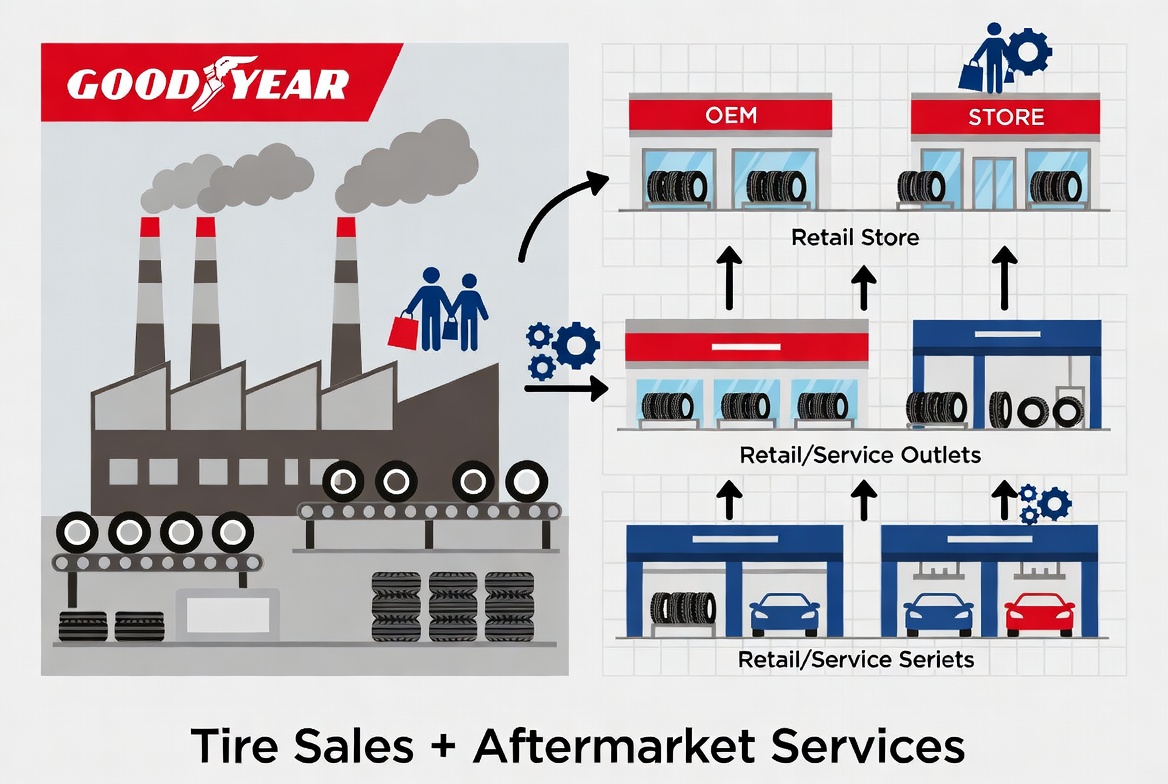
Goodyear’s revenue is primarily generated from tire sales and related services, with tire products remaining the core income source. From a business model perspective, Goodyear participates in two critical parts of the automotive supply chain: the original equipment (OEM) market and the replacement tire market.
The OEM business supplies tires directly to automakers. When manufacturers build new vehicles, they need tires that meet specific requirements as original equipment, so large tire companies maintain long-term relationships with automotive brands.
On the flip side, the replacement market serves vehicle owners directly. As tires wear down with mileage, consumers and fleet operators must replace them periodically. Compared to OEM, the replacement market typically offers higher margins and more stable demand.
Additionally, commercial vehicle services, fleet management solutions, and digital services are emerging as new revenue streams, helping Goodyear shift from a product-sales model toward a service-oriented income model.
| Revenue Segment |
Main Business |
| OEM Business |
Original equipment tires for new vehicles |
| Replacement Market |
Tire replacement and retail sales |
| Commercial Vehicle Business |
Logistics fleets and transportation services |
| Specialty Tires |
Off-the-road and aviation tires |
| Digital Services |
Fleet management and data solutions |
How Does the OEM Tire Business Generate Revenue?
The original equipment market is a key entry point for tire companies into the automotive supply chain.
When automakers launch new models, they conduct rigorous testing on tire performance, safety, durability, and energy efficiency. Only tire companies with strong technical capabilities make it into the supply chain. Goodyear has long supplied OEM tires to multiple global automotive brands, directly generating revenue while boosting brand visibility.
For tire makers, the real value of OEM business lies not just in sales volume but in brand exposure. The tire brand a consumer first encounters in a new car often influences their replacement choices later. Thus, the OEM market acts as a channel for capturing long-term customers.
However, OEM business faces intense price competition because automakers hold strong bargaining power. Consequently, tire companies rely on the replacement market to improve overall profitability.
How Does the Replacement Tire Market Drive Long-Term Growth?
The replacement tire market is widely regarded as the tire industry’s most important profit pool.
Unlike new car sales cycles, replacement demand is driven by the global vehicle population. Even if sales growth slows, vehicles already on the road still need periodic tire replacements based on usage, creating relatively stable demand.
This business model gives the tire industry consumer-like characteristics. When buying replacement tires, consumers prioritize brand reputation, safety, and user experience, allowing established brands to capture higher market share.
For Goodyear, its global sales network and after-sales service system enable sustained competition in the replacement market. As the global vehicle fleet continues to grow, this market remains a key pillar of the company’s revenue.
How Do Commercial Vehicle and Fleet Businesses Boost Profitability?
Beyond consumer markets, the commercial transportation segment is a critical business area for Goodyear.
Logistics firms, passenger transport operators, construction companies, and large fleets run many vehicles, requiring tires with high durability, low operating costs, and efficient maintenance. Compared to individual consumers, these clients buy in bulk and form long-term partnerships.
Commercial vehicle tires carry higher unit prices and often come with maintenance, monitoring, and management services. This allows tire companies to enhance overall profitability through service revenue beyond product sales.
For large fleets, tire wear directly affects fuel costs and operational efficiency, prompting more companies to adopt digital tire management systems. This opens new opportunities for Goodyear to expand its service business.
How Do Tire Services and Digital Solutions Expand Revenue?
With the rise of smart mobility and connected vehicle technology, tire companies are transforming from traditional manufacturers into comprehensive mobility service providers.
Goodyear has been investing in digital solutions, including tire monitoring systems, fleet management platforms, and predictive maintenance services. These technologies let business clients monitor tire status in real time, reducing downtime and improving efficiency.
Unlike one-time tire sales, digital services typically use subscription or ongoing service models, creating more predictable recurring revenue. For capital markets, recurring revenue often signals higher revenue predictability.
Looking ahead, autonomous driving, smart logistics, and connected vehicles will likely boost the importance of data services in the tire industry. For Goodyear, this means its business model is gradually shifting from manufacturing-led to service-led.
How to Buy GT (Goodyear Tire & Rubber) Stock
GT is listed on the Nasdaq Stock Market, making it a notable publicly traded company in the global tire and automotive supply chain.
Investors can buy GT stock through a brokerage account that supports U.S. equities, gaining exposure to the tire industry, automotive supply chain, and global transportation market performance and risks.
As digital assets and traditional finance converge, more trading instruments linked to stock price movements have emerged. For instance, some platforms offer CFD products tied to stock prices, allowing users to trade based on price changes without owning the underlying stock.
Using Gate TradFi as an example, users can access traditional financial assets like stocks, ETFs, indices, and commodities alongside digital asset markets. Some markets also feature Gate CFD products, letting users trade price movements of related assets through their digital asset accounts.
Regardless of the method, investors should fully understand the product structure, trading rules, liquidity, and regulatory requirements in their jurisdiction.
Summary
Goodyear’s business model rests on tire manufacturing, aftermarket services, and long-term customer relationships. The OEM business provides entry into the automotive supply chain, the replacement market delivers stable cash flow, and commercial vehicle services along with digital solutions open new growth paths. As the auto industry shifts toward electrification and intelligence, tire companies are evolving from traditional parts suppliers into comprehensive mobility service providers.
FAQ
What is Goodyear’s main source of revenue?
Goodyear earns revenue primarily from OEM tire sales, the replacement tire market, commercial vehicle operations, and tire-related services.
Why is the replacement tire market important for Goodyear?
The replacement market depends on the global vehicle population rather than new car sales alone, so it typically provides more stable and consistent revenue.
What does OEM business mean?
OEM (Original Equipment Manufacturer) refers to supplying original equipment tires to automakers. It is a key gateway for tire companies into the automotive supply chain.
How does the commercial vehicle business improve profitability?
Commercial clients purchase in bulk and require ongoing maintenance and management, generating higher value-added revenue for tire companies.
Is Goodyear investing in digital business?
Yes. Goodyear is rolling out digital solutions like tire monitoring, fleet management, and predictive maintenance to diversify revenue beyond traditional tire sales.
Will electric vehicles affect Goodyear’s business model?
Yes. EVs demand higher tire wear resistance, lower rolling resistance, and quieter performance, while also driving demand for smart tires and data services.