Gate TradFi Panorama: Connecting Global Traditional Financial Markets on a Single Platform

Last Updated 2026-03-25 08:10:33
Reading Time: 3m
Gate TradFi provides a unified account for multi-asset trading, supporting CFDs on gold, forex, indices, stocks, and commodities. This seamless connection between crypto assets and traditional financial markets boosts cross-market trading efficiency and offers greater flexibility in asset allocation.

Why Are Trading Platforms Expanding into TradFi?

Global financial markets are becoming increasingly integrated. More investors are seeking exposure to traditional financial markets beyond crypto assets to diversify risk and capture opportunities across different market cycles.

However, persistent challenges—such as fragmented accounts and complex fund transfers—have long separated traditional and crypto markets. To address these hurdles, trading platforms are pursuing multi-asset integration, making the TradFi module a strategic area of development.

Gate TradFi: Overall Positioning
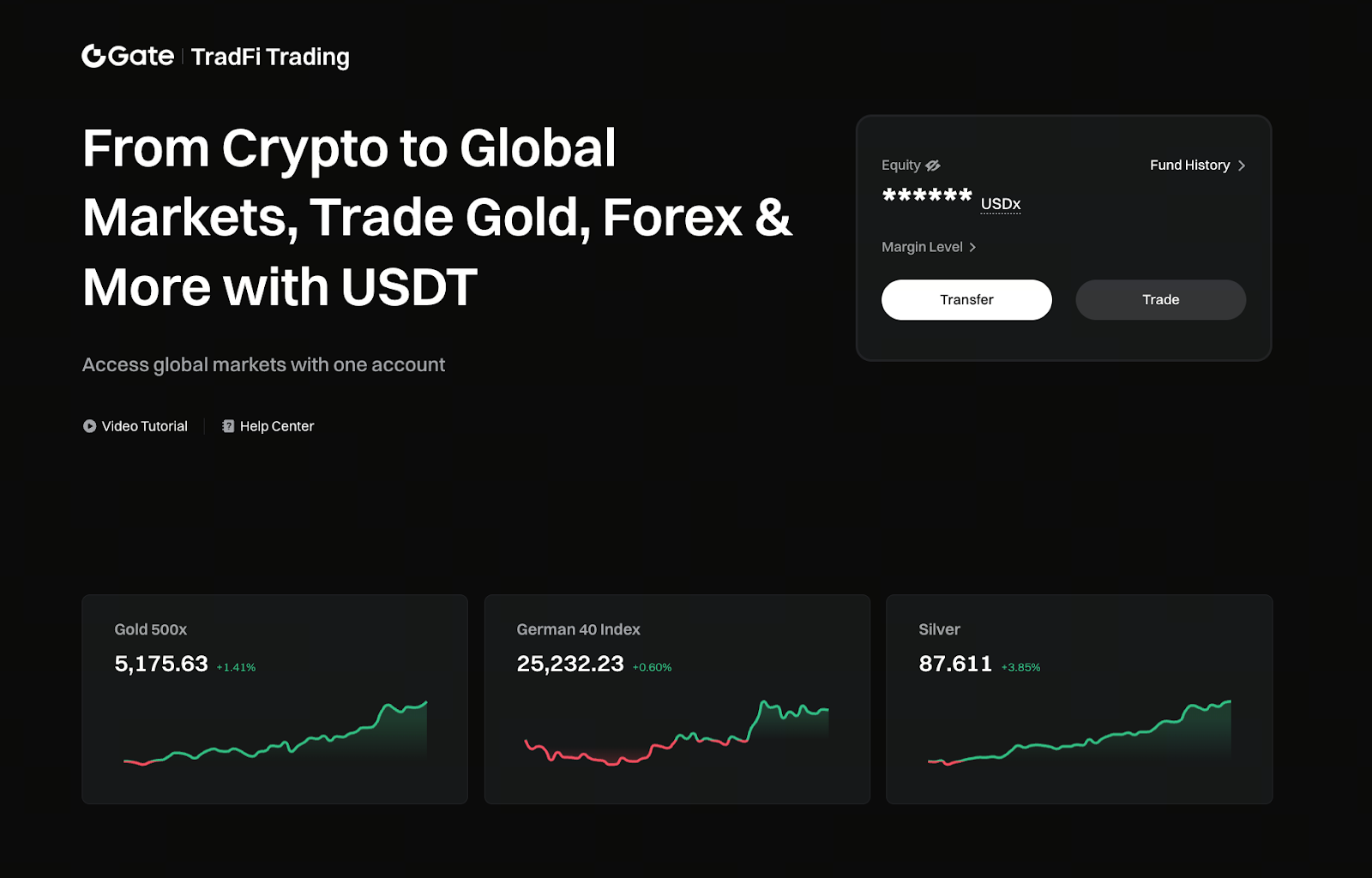

Image: https://www.gate.com/tradfi

As part of its multi-asset strategy, Gate introduced the TradFi module to offer users a unified entry point into traditional financial markets.

This module enables users to engage with global market price movements in a familiar trading environment, eliminating the need to open separate accounts with traditional brokers or switch platforms.

Gate TradFi is not just about increasing the number of tradable assets. It extends the trading ecosystem through account integration and system enhancements.

How Multi-Asset Trading Improves Capital Efficiency

One key advantage of multi-asset trading is the flexibility to reallocate capital as markets shift.

When volatility decreases in one market, users can quickly move funds to others. When macroeconomic factors impact gold or indices, they can respond immediately to those trends.

Managing assets under a unified account streamlines fund allocation and enhances the agility of trading decisions.

TradFi: Trading Mechanism and Operational Logic

Gate TradFi employs a Contract for Difference (CFD) model for price trading, allowing users to participate in price movements without holding the underlying asset.

This approach is well-suited for short- and medium-term trading strategies, and it simplifies leverage management and position adjustments.

The platform also provides clear interfaces for positions, margin, and risk alerts to help users manage risk effectively.

Seamless Dual-Platform Trading Experience

Gate TradFi supports both app and web-based trading.

Users can monitor market trends and positions on the go via mobile, or implement more complex strategies on the web. Dual-end synchronization ensures data consistency, delivering a smooth trading experience.

This level of convenience removes device and scenario barriers from cross-market trading.

Gate TradFi’s Long-Term Ecosystem Value

The introduction of TradFi not only expands the range of tradable assets but also broadens the platform’s ecosystem.

As global market connectivity increases, demand for multi-asset allocation will continue to grow. Gate TradFi is building a comprehensive trading environment that bridges both crypto and traditional markets through technological integration and product innovation.

In the future, cross-market trading capability could become a critical measure of platform competitiveness—and Gate TradFi is laying the foundation for this evolution.

Author: Max
Disclaimer
* The information is not intended to be and does not constitute financial advice or any other recommendation of any sort offered or endorsed by Gate.
* This article may not be reproduced, transmitted or copied without referencing Gate. Contravention is an infringement of Copyright Act and may be subject to legal action.

Related Articles

AI-Native Settlement Layers: How United Stables Is Building the Next Financial Rail
Beginner

AI-Native Settlement Layers: How United Stables Is Building the Next Financial Rail

Stablecoins were originally designed as dollar substitutes within exchanges, primarily used for asset pricing and trade settlement. As on-chain financial ecosystems have matured, their role has expanded beyond simple payments to include collateral assets, cross-chain liquidity mediums, and unified settlement units. In particular, as AI systems and automated agents begin to participate directly in economic activity, demand has risen sharply for programmable value units capable of instant settlement. This shift is pushing stablecoins toward the role of foundational financial infrastructure.
2026-03-25 03:16:17
The ve(3,3) Flywheel Explained: How AERO Tokenomics Powers Aerodrome’s DeFi Economy
Beginner

The ve(3,3) Flywheel Explained: How AERO Tokenomics Powers Aerodrome’s DeFi Economy

In the competition for DeFi liquidity, high-inflation mining alone is no longer enough to build lasting advantages. Aerodrome applies the ve(3,3) economic model to redesign token emissions, voting mechanisms, and revenue distribution, creating a liquidity flywheel centered on governance and cash flow. This article examines AERO tokenomics, the veAERO locking mechanism, and protocol revenue models to explain how Aerodrome builds a sustainable DeFi economic system.
2026-03-25 06:41:58
Aerodrome Tokenomics: How ve(3,3) Powers Base's Most Profitable DEX
Beginner

Aerodrome Tokenomics: How ve(3,3) Powers Base's Most Profitable DEX

AERO is the native token of Aerodrome Finance, a core decentralized exchange and liquidity protocol in the Base ecosystem. It is primarily used for liquidity incentives and ecosystem operations. veAERO is a governance NFT that users receive by locking AERO, representing both voting power and the right to share protocol revenue. Through a dual track structure of AERO as a utility token and veAERO as a governance credential, Aerodrome separates liquidity usage value from long term governance power, allowing participants to act as liquidity providers, governance decision makers, and revenue sharers within the same system.
2026-03-25 06:40:31
DePIN Identity Network and Real World Applications: How Humanity Protocol Brings on-chain Identity Into the Physical World
Beginner

DePIN Identity Network and Real World Applications: How Humanity Protocol Brings on-chain Identity Into the Physical World

Most Web3 identity systems remain confined to on-chain environments and struggle to achieve meaningful adoption in real world settings. Through a DePIN architecture and physical verification hardware, Humanity Protocol aims to bring decentralized identity into access control systems, hospitality, public services, and offline events, allowing on-chain identity to function not just as a digital credential, but as foundational infrastructure for real world access.
2026-03-25 07:40:53
How Does GoldFinger Work? Gold Asset Tokenization, Proof of Reserve, and on-chain Circulation Explained
Beginner

How Does GoldFinger Work? Gold Asset Tokenization, Proof of Reserve, and on-chain Circulation Explained

GoldFinger operates through a process that includes asset custody, Proof of Reserve, token minting, and on-chain circulation. By placing physical gold within a compliant custody framework and mapping it on-chain through ART tokens, GoldFinger turns gold into a digital, programmable asset. At the same time, its Proof of Reserve mechanism ensures that on-chain tokens correspond to the underlying assets, supporting trading, collateralization, and redemption in DeFi scenarios.
2026-04-15 03:01:54
Aster vs Hyperliquid: Which Perp DEX Will Prevail?
Beginner

Aster vs Hyperliquid: Which Perp DEX Will Prevail?

Aster and Hyperliquid are the two representative protocols of the "purpose-built L1 path" within the current decentralized perpetual exchange (Perp DEX) sector. As a pioneer in the field, Hyperliquid has built a deep liquidity moat through its highly mature order book architecture and strong community consensus. Conversely, Aster, as a rising challenger, seeks to leapfrog the competition in high-performance trading through more aggressive multi-chain aggregation logic, private transaction modules, and an underlying execution environment optimized for 2026 market demands.
2026-03-24 11:58:33





