Gate Simple Earn Launches GAIN High-Yield Plan Empowered by AI Innovation

Last Updated 2026-03-28 08:27:57
Reading Time: 1m
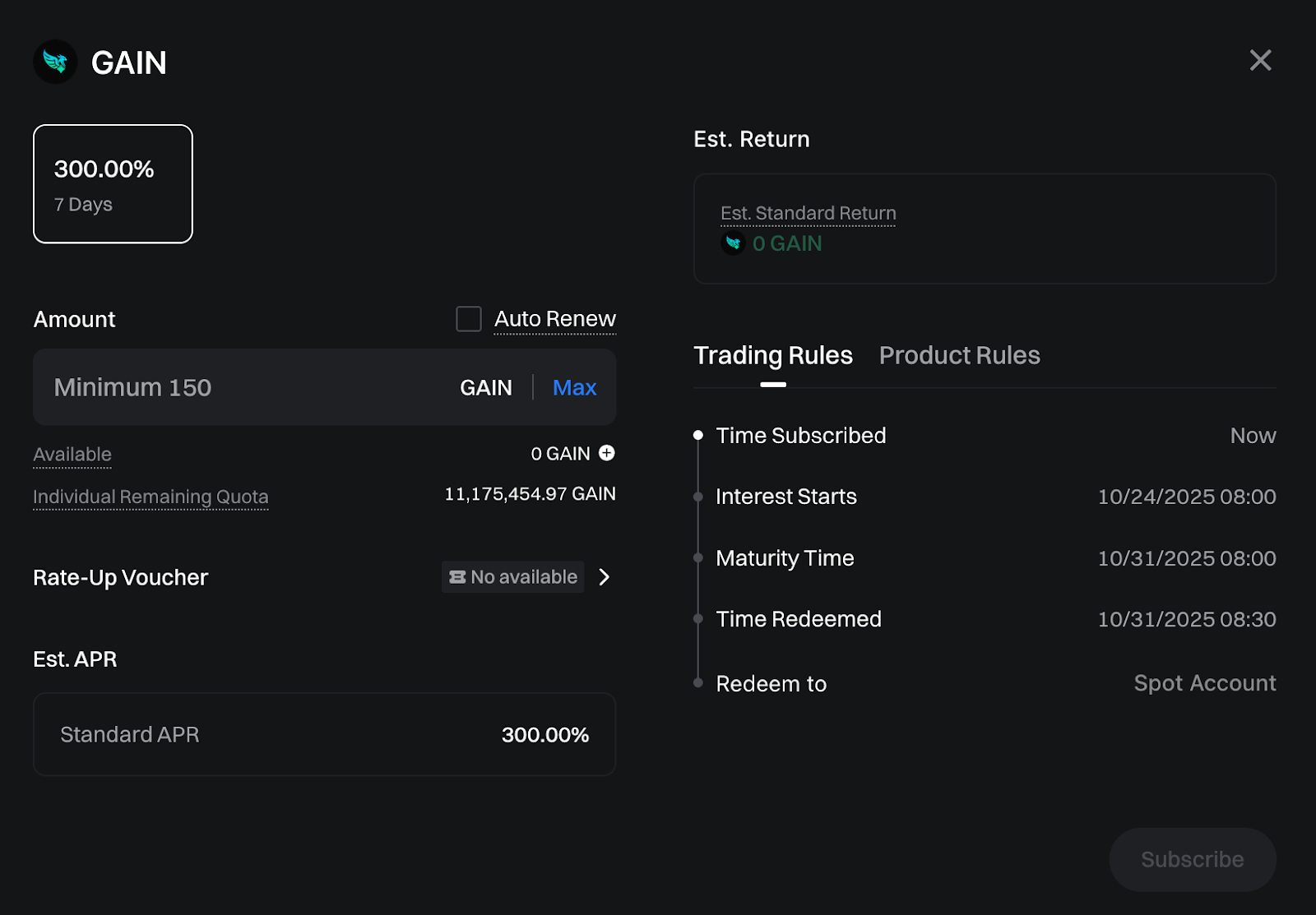
Gate Simple Earn has introduced a new GAIN 7-Day Fixed-Term Investment, featuring an annualized yield of up to 300% APR. This product is a standout short-term, high-yield choice in the market. The offering is capped at 20,000,000 GAIN and is available in limited quantities on a first-come, first-served basis.

GAIN 7-Day Fixed-Term Product Now Available

Gate Simple Earn has introduced the new GAIN 7-day fixed-term product, featuring up to 300% APR—a high-yield option for short-term investors. The total offering is capped at 20,000,000 GAIN, with limited availability on a first-come, first-served basis.

The investment period runs from October 20, 2025, 06:00 UTC to November 20, 2025, 06:00 UTC. Users can participate directly on the Gate platform’s event page. Gate will distribute earnings according to the rules after the investment period ends. Users can find detailed earnings information in the Financial Records section under Fixed-Term and Interest Earnings.
Invest in the Simple Earn 7-day fixed-term product now for up to 300% APR: https://www.gate.com/simple-earn

Griffin AI: Pioneering DeFi Intelligent Agents

The backbone of the GAIN ecosystem is Griffin AI, a rapidly growing no-code intelligent agent platform. With over 15,000 active agents deployed, Griffin AI automates DeFi operations using artificial intelligence, enabling trading and yield strategies to execute seamlessly across multiple blockchains. Its signature technology, the Trading Execution Agent (TEA), performs intelligent operations across various chains and wallets, minimizing manual risk and significantly enhancing efficiency and returns.

Expert Team and Strategic Vision

Griffin AI’s team comprises experienced finance and blockchain professionals. Founder Oliver Feldmeier previously established Europe’s first regulated digital asset exchange and led the team to a $100 million Nasdaq listing. Their mission is to bridge traditional finance with DeFi, making AI-powered decentralized finance more accessible to users. Approximately 95% of DeFi projects have yet to integrate AI, and Griffin AI aims to address this market gap.

Multi-Chain Integration and Ecosystem Development

Griffin AI’s technology ecosystem is integrated with several leading blockchains and protocols, including BNB Chain, NEAR Protocol, Cardano Foundation, Arbitrum, 1inch, Uniswap, and Bithumb’s Burrito Wallet. These collaborations have strengthened GAIN’s usability in DeFi and reinforced the foundation for broader ecosystem growth.

GAIN: The Core Token Powering Intelligent Agents

Serving as the engine for the Griffin AI ecosystem, the $GAIN token is essential for agent operations, fee payments, and earnings distribution. For investors seeking strong growth potential and multi-chain opportunities, GAIN is not only a reward mechanism within investment products, but also the core asset driving the entire AI+DeFi system.

Important Information

  1. Earnings Distribution: Interest will be paid out in GAIN tokens.
  2. Fairness Policy: Cheating during the event is strictly prohibited; violators will be disqualified.
  3. Risk Disclosure: Cryptocurrency markets are highly volatile and significantly impacted by market and regulatory changes. Please assess risks carefully before investing.
  4. Regional Restrictions: Users from the United Kingdom and other restricted regions are not eligible for this service. See the Gate User Agreement for further details.

Gate User Agreement: https://www.gate.com/legal/user-agreement

Summary

The latest GAIN 7-day fixed-term product from Gate Simple Earn delivers up to 300% APR, integrating Griffin AI’s intelligent agent technology and multi-chain ecosystem. This allows users to benefit from efficient, AI-driven financial management over a short period. Supported by Gate and Griffin AI, GAIN is more than an investment tool—it represents a significant development in DeFi’s intelligent evolution.

Author: Allen
Disclaimer
* The information is not intended to be and does not constitute financial advice or any other recommendation of any sort offered or endorsed by Gate.
* This article may not be reproduced, transmitted or copied without referencing Gate. Contravention is an infringement of Copyright Act and may be subject to legal action.

Related Articles

What is Fartcoin? All You Need to Know About FARTCOIN
Intermediate

What is Fartcoin? All You Need to Know About FARTCOIN

Fartcoin (FARTCOIN) is a representative meme coin within the Solana ecosystem based on an AI-driven narrative. Its core concept originated from an experiment aimed at exploring the "boundaries between AI Agents and humor." More than just a digital asset with social attributes, the project deeply couples absurd humor culture with on-chain financial logic by integrating autonomous AI interaction models.
2026-04-04 22:01:19
Gold Price Forecast for the Next Five Years: 2026–2030 Trend Outlook and Investment Implications, Could It Reach $6,000?
Beginner

Gold Price Forecast for the Next Five Years: 2026–2030 Trend Outlook and Investment Implications, Could It Reach $6,000?

Analyze current gold price trends alongside authoritative five-year forecasts, integrating an evaluation of market risks and opportunities. This gives investors insight into the potential trajectory of gold prices and the main drivers expected to shape the market over the next five years.
2026-03-25 18:13:30
Aster vs Hyperliquid: Which Perp DEX Will Prevail?
Beginner

Aster vs Hyperliquid: Which Perp DEX Will Prevail?

Aster and Hyperliquid are the two representative protocols of the "purpose-built L1 path" within the current decentralized perpetual exchange (Perp DEX) sector. As a pioneer in the field, Hyperliquid has built a deep liquidity moat through its highly mature order book architecture and strong community consensus. Conversely, Aster, as a rising challenger, seeks to leapfrog the competition in high-performance trading through more aggressive multi-chain aggregation logic, private transaction modules, and an underlying execution environment optimized for 2026 market demands.
2026-03-24 11:58:33
AI-Native Settlement Layers: How United Stables Is Building the Next Financial Rail
Beginner

AI-Native Settlement Layers: How United Stables Is Building the Next Financial Rail

Stablecoins were originally designed as dollar substitutes within exchanges, primarily used for asset pricing and trade settlement. As on-chain financial ecosystems have matured, their role has expanded beyond simple payments to include collateral assets, cross-chain liquidity mediums, and unified settlement units. In particular, as AI systems and automated agents begin to participate directly in economic activity, demand has risen sharply for programmable value units capable of instant settlement. This shift is pushing stablecoins toward the role of foundational financial infrastructure.
2026-03-25 03:16:17
ASTER Tokenomics: Buybacks, Burns, and Staking as the Value Foundation of ASTER in 2026
Beginner

ASTER Tokenomics: Buybacks, Burns, and Staking as the Value Foundation of ASTER in 2026

ASTER is the native equity and governance token of the Aster ecosystem, with its core value built upon a radical "Deflationary Engine." Beyond serving as a governance tool, ASTER integrates multiple utilities including staking rewards, trading fee discounts, and liquidity incentives. Through its deep integration with the upcoming dedicated Layer 1 mainnet, it enables direct value capture from protocol cash flow to token holders.
2026-03-25 07:38:07
Hybrid Collateral Stablecoins: Inside United Stables' Stability and Yield Architecture
Beginner

Hybrid Collateral Stablecoins: Inside United Stables' Stability and Yield Architecture

In the early stages of the crypto market, traditional stablecoins mainly relied on single-reserve or single-collateral models. Their primary focus was price stability and payment convenience, which allowed them to become foundational tools for on-chain trading and capital flows. As the market has entered a more mature financial phase, however, this structure has begun to reveal limitations, including high concentration risk and the difficulty of balancing liquidity with yield. These constraints have driven the evolution toward multi-layer collateral and portfolio-based designs, such as the dual-layer hybrid collateral architecture proposed by United Stables, which seeks to redefine the underlying logic of stable assets.
2026-03-25 03:17:39





