Gate Precious Metals Perpetual Contracts: Keeping Safe-Haven Assets Aligned with Real-Time Market Trends

Beginner
Quick Reads
Last Updated 2026-03-25 08:52:35
Reading Time: 1m
Gate has launched Gold and Silver USDT-margined perpetual contracts, integrating precious metals into a 24/7 trading ecosystem. This empowers traders to react promptly to market volatility, converting traditional safe-haven assets into dynamic tools for strategic trading.

The Market No Longer Waits—Hedging Strategies Must Accelerate

Traditionally, hedging strategies were adjusted only after significant events occurred. Traders followed the rhythms of legacy markets, making position changes during set trading windows. Now, with global markets highly interconnected, policy signals, geopolitical risks, and macroeconomic data no longer cluster at predictable times. Price reactions have compressed to minutes—or even seconds.

In this environment, if hedging assets remain limited to narrow trading hours, it creates a strategic mismatch. As market pace accelerates, hedging tools that can't participate in real time risk becoming part of the problem.

Precious Metals Enter the 24-Hour Trading Era
贵金属进入 24 小时交易架构

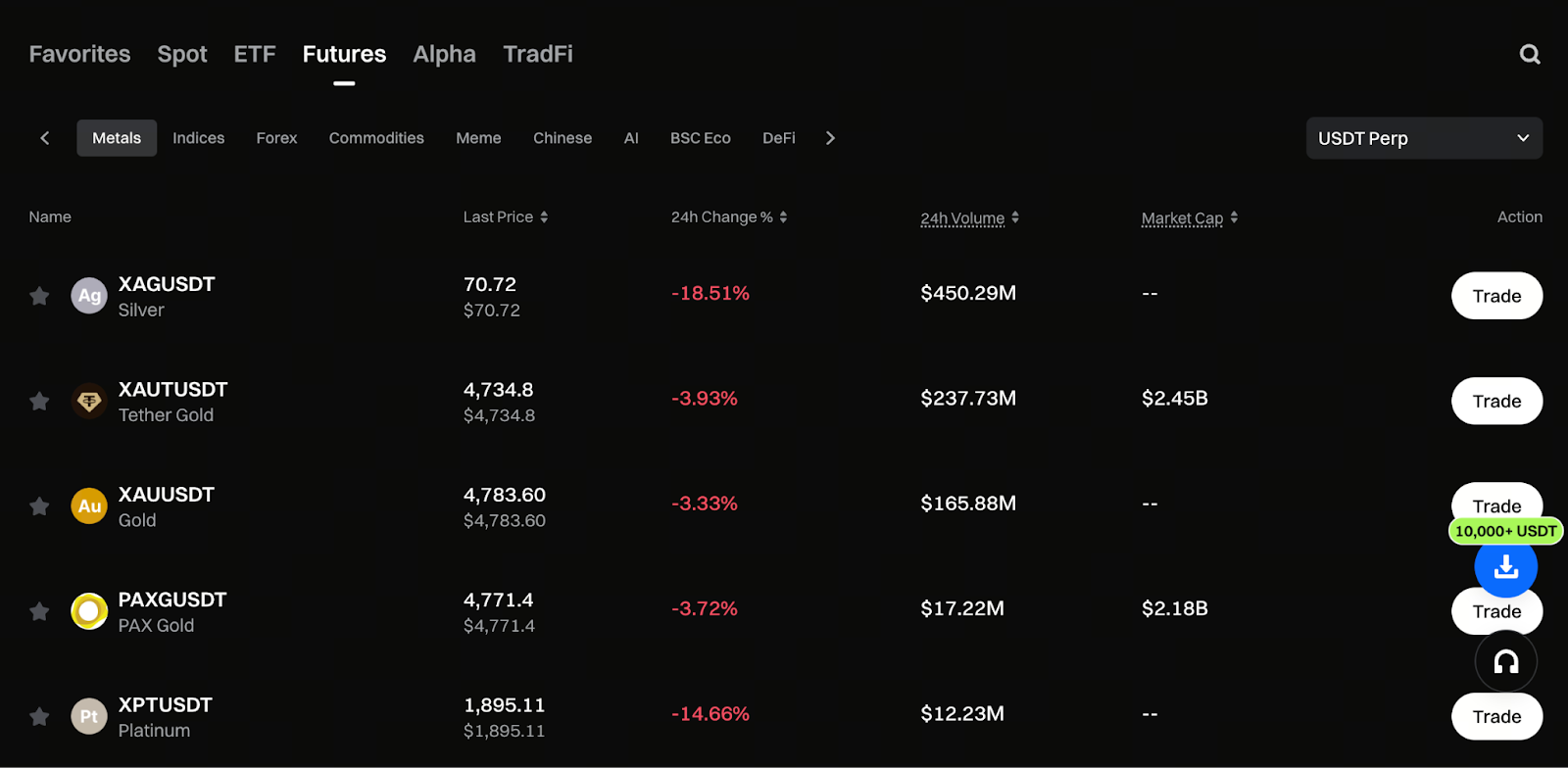
Gate’s gold (XAU) and silver (XAG) USDT-margined perpetual contracts directly address this new market structure. With perpetual contracts, precious metals are now fully integrated into a 24/7 trading environment—no longer restricted by the open and close of traditional financial markets.

When major events hit outside standard market hours, traders don’t have to wait for the next session. They can immediately adjust their risk exposure, shifting hedging from a passive response to an active, real-time decision.

Start trading now in the Gate Precious Metals section: https://www.gate.com/price/futures/category-metals/usdt

A Familiar Trading Framework—No Need for a New Learning Curve

Gate doesn’t treat precious metals contracts as a standalone system. Instead, they’re seamlessly integrated into the existing contract trading framework. XAU and XAG perpetual contracts use the same order process, leverage settings, and risk controls as other contracts. For experienced contract traders, there’s virtually no additional learning required. Precious metals are no longer a new market to relearn—they’re a new asset class that fits naturally into existing strategies, simply offering a different volatility profile.

Precious Metals Become Active Trading Instruments Again

Recently, capital has been flowing back into safe-haven assets, and precious metals have shown greater price elasticity. This makes them more than just static allocation tools—they’re now important instruments for swing trading, hedging, and portfolio balancing.

Multi-Source Index Pricing Minimizes Quotation Distortion

In leveraged trading environments, price stability is a core risk management concern. Gate’s precious metals perpetual contracts use multi-source indices for pricing, integrating data from multiple markets to avoid distortions from any single source. During fast-moving markets, this approach keeps prices fair so stop-losses, hedges, and strategies execute as intended. This is especially critical for short-term and risk-focused traders.

Where TradFi and Crypto Meet in Practice

From an allocation perspective, precious metals perpetual contracts sit at the intersection of traditional finance and crypto:

  • For traditional traders, gold and silver are familiar, easy-to-evaluate assets.

  • For crypto users, they introduce a different volatility structure, reducing portfolio concentration risk.

Whether you’re hedging macro events or executing cross-asset strategies in volatile markets, precious metals contracts provide a practical interface for actionable strategies.

A Key Piece of Multi-Asset Derivatives Strategy

Precious metals perpetual contracts aren’t just a one-off product update—they’re part of Gate’s ongoing expansion in the derivatives market. By leveraging existing liquidity, risk controls, and trading infrastructure, the platform remains flexible enough to add more traditional assets in the future. This signals Gate’s evolution from a crypto-only derivatives platform to an integrated venue for multi-market trading.

Conclusion

With gold and silver now available through 24-hour perpetual contracts, the role of hedging assets is changing. They’re no longer just passive allocations, but real-time strategic tools that respond instantly to market dynamics. Gate’s precious metals perpetual contracts give traders greater cross-asset flexibility—redefining the lines between TradFi and Crypto at the practical trading level.

Author: Allen
Disclaimer
* The information is not intended to be and does not constitute financial advice or any other recommendation of any sort offered or endorsed by Gate.
* This article may not be reproduced, transmitted or copied without referencing Gate. Contravention is an infringement of Copyright Act and may be subject to legal action.

Related Articles

AI-Native Settlement Layers: How United Stables Is Building the Next Financial Rail
Beginner

AI-Native Settlement Layers: How United Stables Is Building the Next Financial Rail

Stablecoins were originally designed as dollar substitutes within exchanges, primarily used for asset pricing and trade settlement. As on-chain financial ecosystems have matured, their role has expanded beyond simple payments to include collateral assets, cross-chain liquidity mediums, and unified settlement units. In particular, as AI systems and automated agents begin to participate directly in economic activity, demand has risen sharply for programmable value units capable of instant settlement. This shift is pushing stablecoins toward the role of foundational financial infrastructure.
2026-03-25 03:16:17
The ve(3,3) Flywheel Explained: How AERO Tokenomics Powers Aerodrome’s DeFi Economy
Beginner

The ve(3,3) Flywheel Explained: How AERO Tokenomics Powers Aerodrome’s DeFi Economy

In the competition for DeFi liquidity, high-inflation mining alone is no longer enough to build lasting advantages. Aerodrome applies the ve(3,3) economic model to redesign token emissions, voting mechanisms, and revenue distribution, creating a liquidity flywheel centered on governance and cash flow. This article examines AERO tokenomics, the veAERO locking mechanism, and protocol revenue models to explain how Aerodrome builds a sustainable DeFi economic system.
2026-03-25 06:41:58
Aerodrome Tokenomics: How ve(3,3) Powers Base's Most Profitable DEX
Beginner

Aerodrome Tokenomics: How ve(3,3) Powers Base's Most Profitable DEX

AERO is the native token of Aerodrome Finance, a core decentralized exchange and liquidity protocol in the Base ecosystem. It is primarily used for liquidity incentives and ecosystem operations. veAERO is a governance NFT that users receive by locking AERO, representing both voting power and the right to share protocol revenue. Through a dual track structure of AERO as a utility token and veAERO as a governance credential, Aerodrome separates liquidity usage value from long term governance power, allowing participants to act as liquidity providers, governance decision makers, and revenue sharers within the same system.
2026-03-25 06:40:31
DePIN Identity Network and Real World Applications: How Humanity Protocol Brings on-chain Identity Into the Physical World
Beginner

DePIN Identity Network and Real World Applications: How Humanity Protocol Brings on-chain Identity Into the Physical World

Most Web3 identity systems remain confined to on-chain environments and struggle to achieve meaningful adoption in real world settings. Through a DePIN architecture and physical verification hardware, Humanity Protocol aims to bring decentralized identity into access control systems, hospitality, public services, and offline events, allowing on-chain identity to function not just as a digital credential, but as foundational infrastructure for real world access.
2026-03-25 07:40:53
How is the price of PAXG determined? Pegging mechanism, trading depth, and influencing factors
Beginner

How is the price of PAXG determined? Pegging mechanism, trading depth, and influencing factors

PAXG (Pax Gold) is a tokenized asset backed by physical gold reserves, launched by fintech firm Paxos and issued as an ERC-20 token on the Ethereum blockchain. The core concept is to digitally represent real-world gold assets, allowing investors to hold and trade gold via the blockchain network. Because each PAXG token corresponds to a specific quantity of physical gold, its price is theoretically expected to closely track the global gold market.
2026-03-24 19:11:40
How Does PAXG Work? In-Depth Overview of the Physical Gold Tokenization Mechanism
Beginner

How Does PAXG Work? In-Depth Overview of the Physical Gold Tokenization Mechanism

PAXG (Pax Gold) is a tokenized asset backed by physical gold, issued by the fintech company Paxos and traded on the Ethereum blockchain as an ERC-20 token. The core concept is to tokenize physical gold on-chain, with each PAXG token representing ownership of a certain amount of gold. This structure enables investors to hold and trade gold in the form of a digital asset.
2026-03-24 19:12:51





