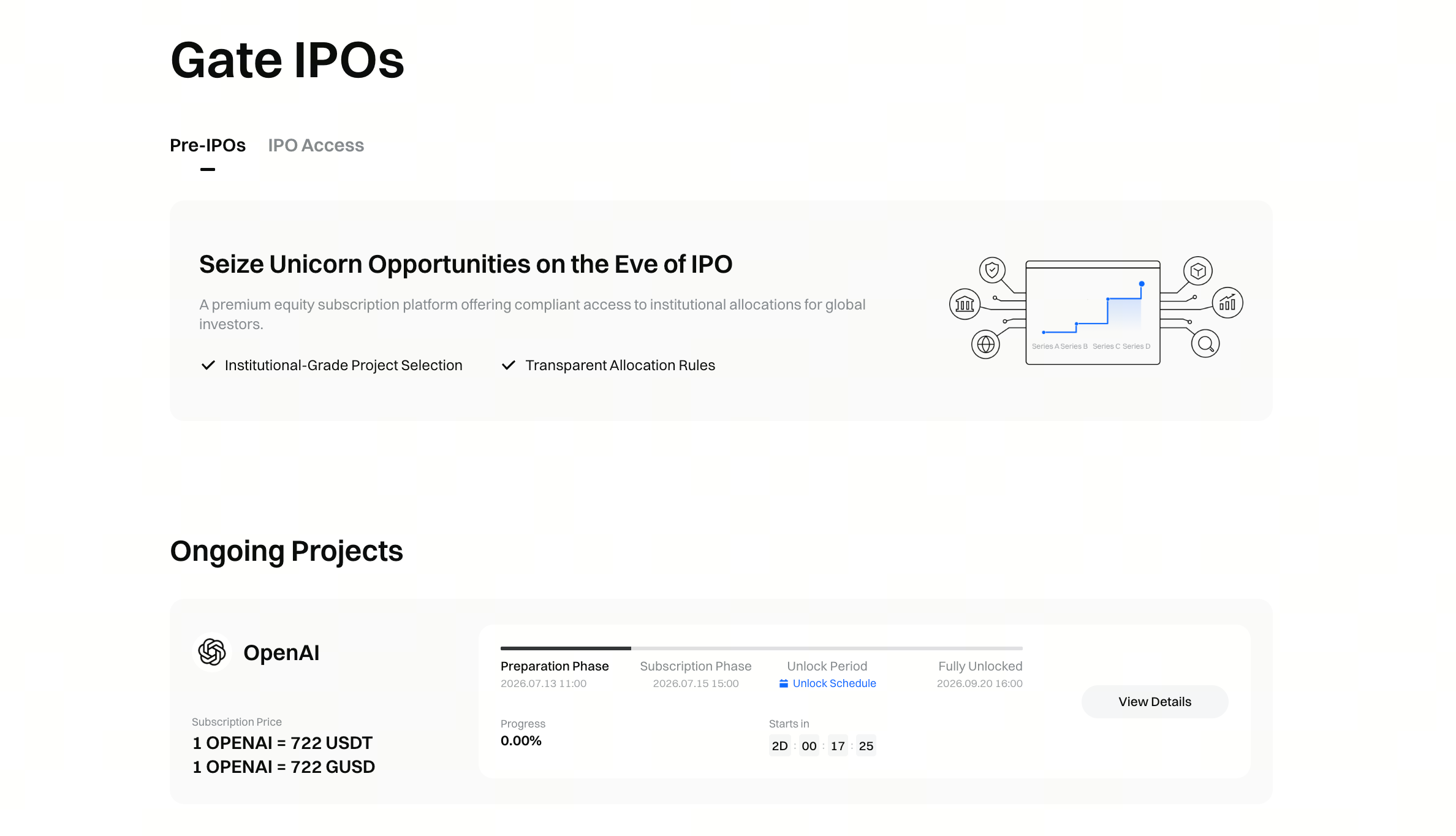
OPENAI is a mirror note, not company equity. The official subscription window runs from July 15, 2026, 07:00 to July 17, 2026, 07:00 (UTC), with USDT and GUSD as the accepted subscription tokens. According to the announcement, this round waives all implied trading and custody fees, but the product remains high-risk and is not principal-protected. The process navigation is outlined in the announcement as Home — Earn — Launch — Pre-IPOs, serving only as a guide for access—not as a guarantee of results.
What official parameters should be checked before subscribing?
The announcement details: project name OpenAI, asset token symbol OPENAI, implied OpenAI market cap of approximately $895 billion, total subscription amount of 27,700 units, fixed subscription price of 1 OPENAI = 722 (USD price disclosed alongside USDT/GUSD subscription tokens), minimum per transaction of 100 USDT or 100 GUSD, and a per-person cap of 277 units. Institutional accounts and sub-accounts cannot participate; borrowed funds are not permitted; users in restricted regions may be unable to access the service. The stated total subscription value of around $20 million is provided for scale reference only and is not a prediction of individual allocation.
The “submitted subscription amount” simply locks the committed funds and does not represent the final voucher quantity. PANews’ Chinese explanation of dual-currency subscription and minimum thresholds may be used for cross-checking, but the Gate announcement and project page take precedence. Review the parameter table in full: price, pool split, cap, and window are all essential.
How are the USDT and GUSD subscription pools structured?
This round is split into two independent pools: a USDT pool with 19,390 units (70%) and a GUSD pool with 8,310 units (30%). The per-user cap within each pool is 193.9 and 83.1 OPENAI, respectively. The two pools are strictly separate—allocations are calculated independently, and quotas cannot be transferred between pools. Choosing a token means you compete within that specific pool and are subject to its cap, not a shared quota.
| Subscription Pool |
Quantity |
Percentage |
Per-User Pool Cap |
| USDT |
19,390 OPENAI |
70% |
193.9 |
| GUSD |
8,310 OPENAI |
30% |
83.1 |
| Total |
27,700 OPENAI |
100% |
Total ≤277 |
The fixed price and pool structure together define the subscription input for this round. For details on how the 722 price and share count map to the ~$895 billion reference valuation, see Implied Valuation and Dilution.
How is the hourly average locked amount calculated?
The official allocation is based on each user’s hourly average locked amount during the subscription window, as a share of the project’s total average locked amount. Formula: hourly average locked amount = sum of hourly locked amount snapshots ÷ total subscription hours (48 hours). The system tracks how many hourly snapshots your funds are locked in, not just the ending balance.
Example from the announcement: If you lock 100,000 USDT in the first hour and maintain it throughout, your average is 100,000. If you lock in the 24th hour and maintain to the end, the average is 50,000. If you only lock in the final hour, the average is about 2,083. Thus, “the earlier you subscribe, the higher your allocation weight” is due to time-weighted calculation, not a guarantee of allocation. Remember, the denominator is the total average locked amount, and both the total and per-user caps apply. The announcement clarifies that these examples illustrate allocation logic only and do not represent the final amount received.
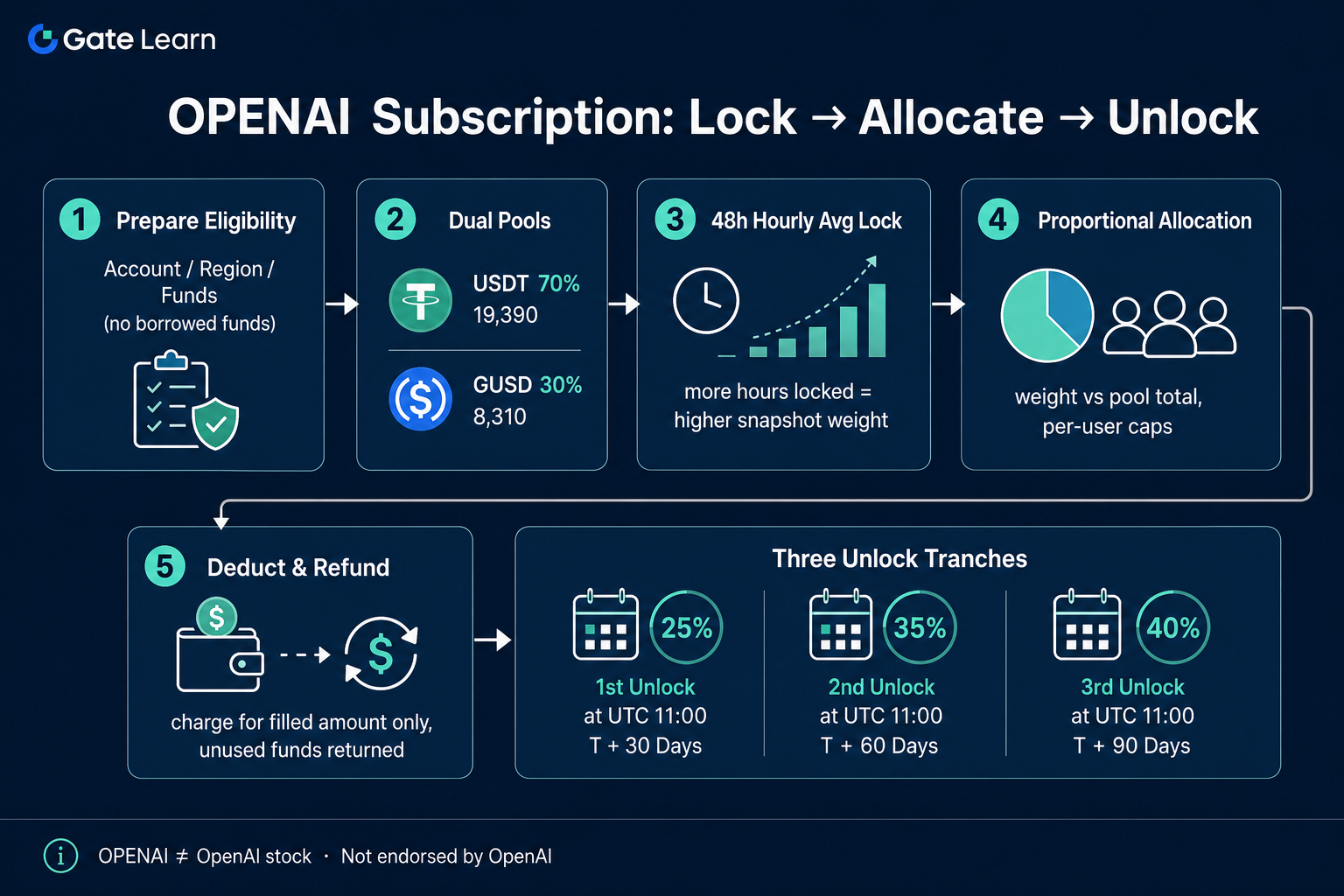 Educational flow: dual-token pools, 48-hour average lock, proportional allocation, and three-phase unlock.
How are allocation, deduction, and refunds processed?
After the subscription period ends, the system deducts funds based on the actual number of asset vouchers allocated, and refunds any remaining committed funds. The invested amount does not equal the final voucher value or quantity; if the actual allocation is less than 0.00000001, no voucher is issued and a full refund is provided. The first unlock and refund of unused funds will be processed by July 17, 2026, 11:00 (UTC). Equating “successful lock” with “purchasing the corresponding amount of OPENAI” overlooks the critical step of deduction based on actual allocation.
| Scenario |
Official Processing Logic |
| Actual allocation |
Deduct and distribute based on actual amount |
| Allocation less than committed |
Excess locked funds refunded to spot account |
| Extremely small allocation (<0.00000001) |
No issuance, full refund |
How does the three-phase unlock affect tradable supply?
Allocated OPENAI unlocks in three phases: July 17, 2026, 11:00 (UTC) for 25%; August 17, 2026, 11:00 (UTC) for 35%; September 17, 2026, 11:00 (UTC) for 40%. Unlocking only determines when the allocated amount becomes tradable. Pre-market trading opens July 20, 2026, 08:00 (UTC); see Pre-Market Trading and Settlement for rules.
The project page FAQ notes that asset vouchers can be freely traded pre-market. When reading this alongside the announcement’s phased unlock, understand that “allocation comes first, then unlocks according to the schedule to become tradable”—do not conflate subscription amount, allocation, and unlocked amount as the same figure.
What rule boundaries and risks require attention?
This product does not represent actual OpenAI stock; OpenAI has not participated, authorized, or endorsed, and does not receive any raised funds. Describing the subscription as “buying OpenAI equity” is contrary to the disclaimer. Time-weighted allocation may result in oversubscription: even if early locking increases your weight, the overall average locked amount, project total, and per-user cap jointly determine the outcome—locked amount does not map 1:1 to final allocation.
Distinguish between “subscription parameters” and “valuation narrative.” The 722 price and ~$895 billion implied market cap are inputs for this round only and do not guarantee allocation or pre-market trading levels. Changes in share capital for a non-listed company, uncertain listing timing, pre-market liquidity, regional and account eligibility, and post-IPO settlement conditions can all affect what can ultimately be claimed. For more on valuation, share capital changes, listing uncertainty, liquidity, and eligibility restrictions, see Product Risk Checklist.
From the OpenAI company perspective, financing news and management information provide only background. From the OPENAI product perspective, the official parameters take precedence: subscription window, pool split, hourly average formula, deduction/refund process, and three-phase unlock. Both sets of information may coexist but are not interchangeable.
Summary
By subscribing to OPENAI via Gate Pre-IPOs, the official process is: USDT/GUSD split pools, 48-hour hourly average lock ratio allocation, deduction and refund based on actual allocation, and 25%/35%/40% three-phase unlock. This process facilitates the issuance and circulation of mirror notes and does not provide a path to acquire OpenAI equity. Interpreting “earlier lock, higher weight” as a time-weighted calculation factor—not a guaranteed outcome—ensures consistency with the announcement examples and cap rules.
FAQ
What is the minimum subscription amount for OPENAI?
The official minimum per transaction is 100 USDT or 100 GUSD. This minimum does not guarantee any specific allocation.
Why does earlier locking affect allocation weight?
Allocation is based on the 48-hour hourly average locked amount. Locking earlier means your funds appear in more hourly snapshots, raising your average for proportional calculation. This does not guarantee a particular result.
What is the difference between the USDT pool and the GUSD pool?
The pools are independent: the USDT pool has 19,390 units, the GUSD pool has 8,310 units, with per-user caps of 193.9 and 83.1, respectively.
When will unallocated funds be refunded?
The announcement states that the first voucher unlock and unused funds will be processed for refund or distribution by July 17, 2026, 11:00 (UTC).
Is trading guaranteed after the three-phase unlock?
Unlocking only releases the tradable quantity. Pre-market trading depends on market liquidity, trading rules, and account eligibility; there is no official guarantee of trading outcomes.