Most investors, when hitting their first daily limit, instinctively think, "Sell now and lock in profits." But in a strong trending market, true high-growth stocks rarely peak in a single day—they rally consecutively.
Recently, AI and semiconductor stocks have re-emerged as the market's core focus. Several data center, GPU, memory chip, and cloud computing companies have been continuously setting new recent highs. Popular tech companies like Nvidia, AMD, Micron, and Snowflake have all posted notable gains recently as capital continues to flow toward AI infrastructure.
Examples:
The underlying theme: capital relentlessly chasing the core track.
Thus, a single daily limit doesn't mark the end—it often signals the beginning of the main uptrend.

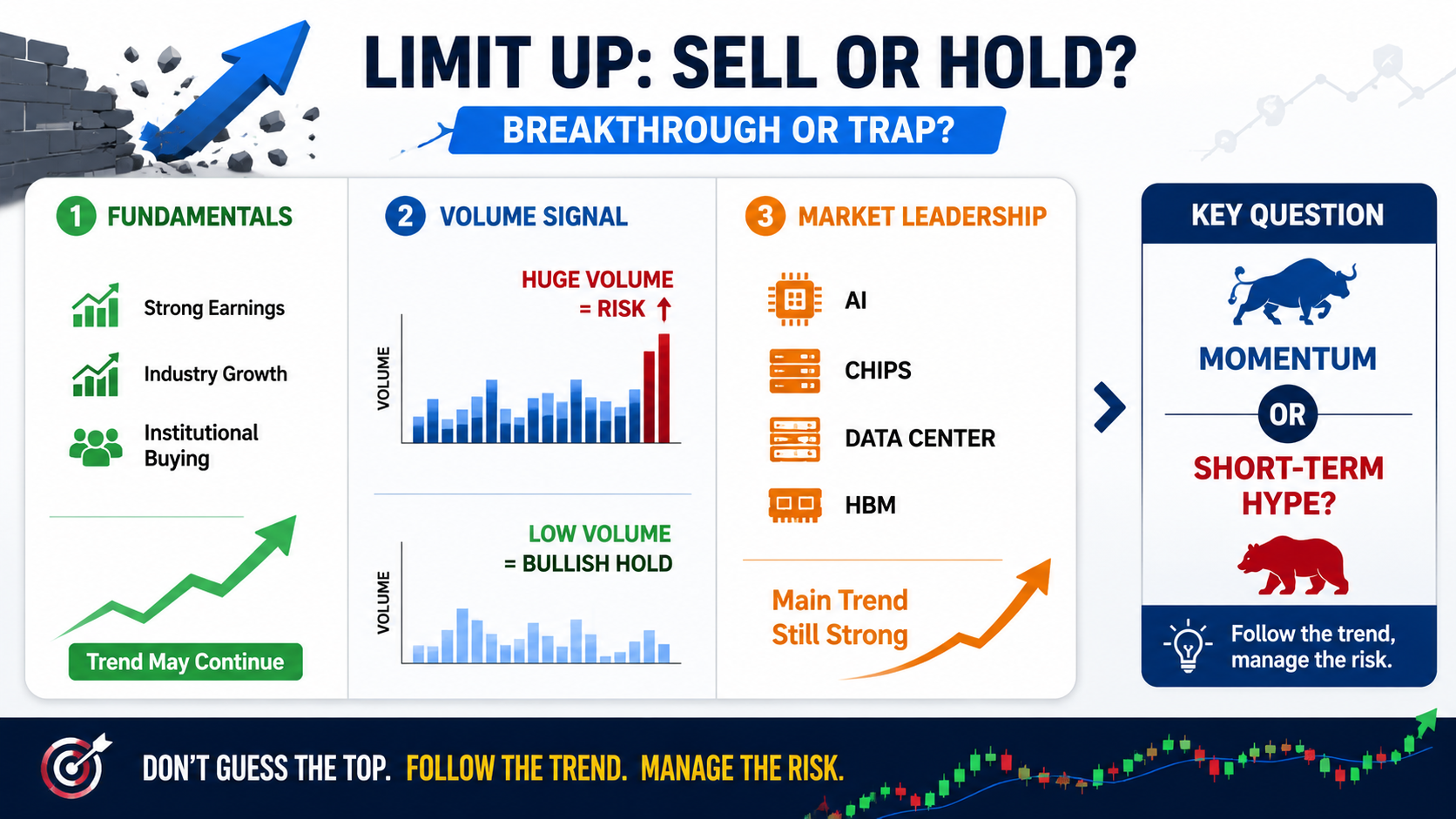
Yes, you can sell after a limit-up. But the real question isn't "can you?"—it's "should you?"
Several key factors determine the answer.
A limit-up driven purely by short-term news or hype often leads to a high open followed by a fade.
But if it's backed by earnings growth, industry tailwinds, and sustained institutional buying, the rally tends to be sustainable.
The recent AI supply chain strength is a textbook case of "earnings + capital" synergy.
Market tops rarely appear out of nowhere—they come with massive volume.
If a stock hits its daily limit with a sudden surge in volume, it suggests distribution is underway and divergence among participants is growing.
On the other hand, a limit-up on shrinking volume typically means light selling pressure and strong holding sentiment.
In a strong market, the theme is everything.
As long as AI, semiconductors, data centers, and related sectors remain active, leading stocks have room to keep running.
Semiconductor ETFs, AI servers, HBM memory, and other areas continue to attract flows, signaling sustained risk appetite.
A clear pattern in this cycle: "True leaders have much more room to move after a limit-up."
AI memory demand is exploding, HBM supply is tight, and expectations for high-bandwidth memory are rising. Micron's gains have been staggering.
Many investors sold after the first major rally, only to watch the stock accelerate further—a classic trend scenario.
With AI server demand surging, AMD's recent earnings were robust, and the market has re-rated its AI chip prospects.
Selling simply because "it's already up a lot" often means missing the larger trend.
The AI data platform concept has drawn heavy capital. Snowflake shot up nearly 40% in one day after a strong earnings beat.
But such explosive moves also amplify volatility—the trend may hold, but risk is rising in tandem.
Strong stocks can keep climbing, but no one holds forever.
Watch for these red flags:
A sudden volume explosion on a limit-up day often signals that capital is showing clear divergence.
Once core sectors like AI or chips start to cool, many high-flying names can reverse rapidly.
Markets often "buy the rumor, sell the news." If a stock runs up ahead of an announcement, it may peak when the news drops.
When everyone is talking about the same stock, it's usually a sign that short-term sentiment is overheated.
Many fear "selling too early" but underestimate "drawdown from highs." In reality, once a high-flying stock turns, the pullback can be brutal—especially for high-valuation tech names. They soar fast but can crash just as hard.
Recently, software AI names have diverged sharply. While hardware plays stayed strong, some SaaS companies plummeted on weak guidance. This shows that even within AI, the market is differentiating between companies with real earnings power and those without.
Experienced traders rarely go all-in or all-out. Instead, they:
This preserves upside potential while capping downside risk.
Instead of "calling the top," build a disciplined trading plan.
The AI supply chain remains a dominant global focus. Chips, servers, data centers, and AI infrastructure continue to attract capital flows.
But market divergence is becoming sharper. Companies with real earnings and solid industrial logic keep rising, while pure hype plays increasingly show volatility.
So, "Should I sell after a limit-up?" has no one-size-fits-all answer.
The real question isn't the limit-up itself—it's whether the driving logic behind the stock's rise remains intact.